
Quest Protein Bars Review
 By Lisa Benz, Editor-in-chief · Updated Jul 15, 2026 · 9 min read
Disclosure: this article may contain partner links. If you buy through them, we earn a commission at no extra cost to you. The ranking is set by our editors.
Contents
- Quest Protein Bars Review: Quick Verdict
- Quest Protein Bar Nutrition Facts and Key Specs
- What Quest Protein Bars Taste and Feel Like
- Quest's Two Sweetener Systems and What They Mean for Digestion
- Quest Bar Flavors, Sub-Lines, and Standout Picks
- Quest Protein Bar Prices by Pack Size
- Quest vs. David Protein vs. Barebells: How the Numbers Compare
- Who Quest Protein Bars Are Best For
- Quest Protein Bars Review FAQs
- Final Verdict on Quest Protein Bars
Quest protein bars deliver 21 grams of protein and 190 calories per bar. Sugar sits at 1 gram, and net carbs run as low as 4 grams in flavors like Chocolate Chip Cookie Dough and Birthday Cake. That profile puts Quest behind David Protein Bar on raw protein density (28g) but roughly even with Barebells on protein count (20g) and taste. Quest bars are dense and chewy. The erythritol and sucralose used to hit that low sugar number are a known digestive trigger for some people. This review covers real 2026 pricing across every pack size, what Quest's two sweetener formulas actually are, and where Quest lands next to David and Barebells on the numbers that matter.
Quest Protein Bars Review: Quick Verdict
Quest earns its spot as one of the better low-carb protein bars on the market. Not the best bar overall. At 21g protein, 190 calories and 4g net carbs per bar, it undercuts most competitors on carbs while still hitting a serious protein number. The price lands around $2.20 a bar in a multipack. It ranks below David Protein on pure protein density and lands close to Barebells on overall appeal, so treat it as the pick for low-carb eaters first and protein-maximizers second. Two things are most likely to turn a buyer off: the chewy, dense bite and the erythritol-and-sucralose sweetener system. Both are worth knowing before the first box arrives.
Quest Protein Bar Nutrition Facts and Key Specs
Here are the key specs for the flagship Chocolate Chip Cookie Dough bar, sourced directly from questnutrition.com as of mid-2026.
| Attribute | Value |
|---|---|
| Type | Whey and milk protein isolate bar |
| Protein per bar | 21g |
| Calories | 190 |
| Sugar | 1g |
| Fiber | 14g |
| Net carbs | 4g |
| Price per bar | approximately $2.20 (12-count box) |
| Flavors | around 20 core flavors plus sub-line variants |
| Format | 60g bar, gluten-free, keto-friendly |
| Rating note | best-in-class for net carbs among bars this site has reviewed, mid-pack on taste |
Those numbers apply most directly to Quest's OG line in flavors like Chocolate Chip Cookie Dough and Birthday Cake, and they come straight from Quest's own product pages as of mid-2026. Net carbs move a little depending on which flavor you grab, since Quest calculates net carbs by subtracting both fiber and sugar alcohols from total carbohydrates rather than just fiber. Birthday Cake lands at 4g net carbs using that method, while a flavor like Chocolate Chip Cookie Dough can read closer to 10g net carbs if you only subtract fiber from the 22g of total carbs on the label. Read the specific flavor's label if net carbs are your hard limit, not just the headline number on the box.
Fourteen grams of fiber is a genuinely high number for a snack this size, and it's a large part of why Quest bars feel filling despite the low calorie count. The protein blend is milk protein isolate and whey protein isolate, which is why the texture leans dense rather than airy.
What Quest Protein Bars Taste and Feel Like
Quest bars are dense, chewy and closer to a fudgy protein brick than a candy bar. That texture is divisive. Reviewers across multiple sites describe the bite as "tough" or "a chore to chomp," and the 2022 formula update softened the recipe without fully solving that problem. Chocolate Chip Cookie Dough tastes like real cookie dough with actual chocolate chunks mixed in, which is why it remains the brand's most requested flavor years later. Flavor quality swings hard depending on which one you pick. Chocolate Chip Cookie Dough and Birthday Cake are consistently rated near the top by independent testers, while flavors like Chocolate Sprinkled Doughnut and plain Chocolate Peanut Butter show up near the bottom of most rankings.
The newer sub-lines fix some of this. Crispy Hero and Overload bars use crunchy layers and softer fillings that read closer to an actual candy bar than the original chewy format, at the cost of a slightly different macro profile per bar. If texture is your main hesitation with Quest, trying one of these newer lines before writing the brand off is worth the extra dollar or two per bar.
Quest's Two Sweetener Systems and What They Mean for Digestion
Quest doesn't use one single sweetener formula across its whole lineup. Some flavors are sweetened with lo han guo (monk fruit extract) and sucralose, while others use stevia and erythritol, a sugar alcohol. Both systems land at the same 1g of sugar on the label, but they aren't identical ingredients, and checking the panel on the specific flavor you buy matters if you're sensitive to one sweetener but not the other.
Which sweetener system is in your bar
The label is the only reliable way to know which system a specific flavor uses, since Quest has shifted formulas across its catalog over time and doesn't publish a single master list. Original bars like Chocolate Chip Cookie Dough commonly list erythritol, stevia sweetener, and sucralose together on the same panel, so in practice most current OG-line bars combine elements of both systems rather than using strictly one or the other.
Who should be careful with Quest bars
Erythritol and sucralose are both linked to digestive upset in a subset of people, particularly with regular daily use. Soluble corn fiber, which shows up in several Quest flavors, can add to that effect at the fiber levels Quest bars carry. None of this makes the bars unsafe, and there's no confirmed reformulation or recall tied to the bar lineup itself. It does mean that stacking two or three Quest bars a day is more likely to cause bloating than eating one, and anyone with a known sensitivity to sugar alcohols should start with a single bar before committing to a full box.
Worth noting for clarity: a 2026 class-action lawsuit filed against Quest Nutrition concerns lead levels in its ready-to-drink protein shakes and milkshakes, a separate product line from the bars covered in this review. That case doesn't name the protein bars, and there's no similar claim against the bar lineup.
Quest Bar Flavors, Sub-Lines, and Standout Picks
Quest sells around 20 core flavors, and the catalog spans several distinct product lines rather than one uniform bar shape. Chocolate Chip Cookie Dough is the long-running favorite and shows up near the top of nearly every independent ranking. Cookies & Cream, S'Mores, Mint Chocolate Chunk, Birthday Cake, Blueberry Muffin, and White Chocolate Raspberry round out the most consistently well-reviewed core flavors, while Chocolate Peanut Butter and Chocolate Sprinkled Doughnut are the two most commonly criticized.
Quest's product sub-lines explained
Beyond the original bar, Quest runs four sub-lines worth knowing before you shop. Overload bars are thicker and candy-forward, built around dessert flavors like Cookie Commotion and Chocolate Explosion. Stacks are Quest's largest bars by volume, layered with fillings, though independent reviewers have found the layering adds bulk without adding much flavor. Crispy Hero bars use a crunchy wafer-style base instead of the traditional chewy bar, and they consistently score better on texture than the original line. Mini bars are a smaller-format version of the classic recipe, sold in 14-count boxes, aimed at portion control rather than a full meal-replacement snack.
Quest Protein Bar Prices by Pack Size
A single Quest bar costs roughly $2.20 to $2.75 when you buy direct from Quest in bulk. As of mid-2026, Quest's own site lists current pricing across every pack size.
| Pack size | Price | Effective price per bar |
|---|---|---|
| 4-count box | $10.99 | about $2.75 |
| 12-count box | $31.97 | about $2.66 |
| 36-count bundle (three 12-packs) | $90.91 | about $2.53 |
| 14-count mini bars | $19.99 | about $1.43 (smaller bar) |
Reported retail prices at stores like Target and Walgreens run higher, in the $2.79 to $4.49 range per single bar, based on retailer listings rather than Quest's own pricing. Buying direct from Quest or in a large Amazon multipack keeps the per-bar price meaningfully lower than picking up single bars at a retail store. The 12-count and 36-count boxes give the best per-bar price directly from Quest, and Amazon multipacks are typically the cheapest overall source once shipping and any subscription discount are factored in.
Quest vs. David Protein vs. Barebells: How the Numbers Compare
Quest ranks behind David Protein on raw protein density and lands close to Barebells on overall profile. It isn't the top pick if protein-per-bite is the only thing that matters to you. For the full field of options beyond these three, our best protein bars guide ranks the wider category. Quest's edge is a precise net-carb number: 4g in its best-performing flavors, thanks to a sugar alcohol and fiber content that does most of the work of cutting the effective carb count.
| Attribute | Quest | David Protein Bar | Barebells |
|---|---|---|---|
| Protein per bar | 21g | 28g | 20g |
| Calories | 190 | 150 | 200 |
| Sugar | 1g | 0g | 1g |
| Net carbs | 4g | not published | not published |
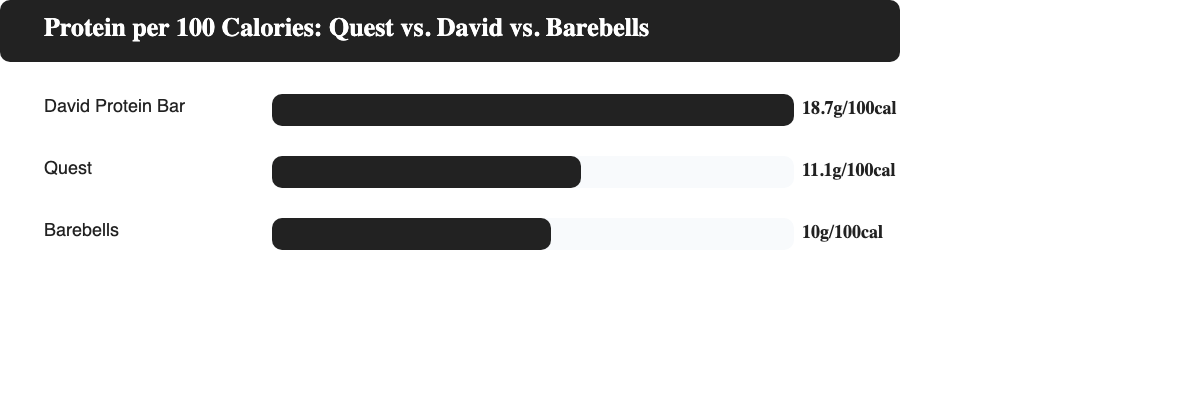
David wins on protein density and calorie efficiency by a clear margin, delivering more protein at fewer calories than either Quest or Barebells. Quest is the only one of the three with a clearly stated net-carb figure, at 4g, since our David Protein Bar Review and Barebells Protein Bar Review don't publish an explicit net-carb number for either bar. Barebells sits closest to Quest on protein, with the deciding factor for most buyers coming down to texture preference rather than macros, since Barebells uses a softer, more candy-like bite that Quest's chewier format doesn't match.
Who Quest Protein Bars Are Best For
Quest fits best for low-carb and keto eaters who want a genuinely high-fiber, low-net-carb snack and don't mind a dense, chewy bite. It also works well as a budget-friendly multipack option for anyone hitting a daily protein target on a schedule, since the 12-count and 36-count boxes bring the per-bar cost down without sacrificing the macro profile.
It's a weaker fit for anyone chasing maximum protein per bar, since David Protein beats it by 7 grams per serving, and for anyone with a known sensitivity to sugar alcohols or artificial sweeteners, since erythritol and sucralose are both present across most of the lineup. Readers who want a softer, more dessert-like bite should also look at our Barebells Protein Bar Review or Quest's own Crispy Hero and Overload sub-lines before committing to a full box of the original bar.
Quest Protein Bars Review FAQs
Are Quest protein bars keto-friendly?
Yes, most Quest bars fit a keto diet, since the net carbs run as low as 4g per bar once fiber and sugar alcohols are subtracted from total carbohydrates. Net carbs do vary by flavor, so checking the specific label matters if you're tracking a strict daily carb limit.
What sweetener does Quest use?
Quest uses two different sweetener systems across its catalog: some flavors rely on lo han guo (monk fruit) and sucralose, while others use stevia and erythritol, a sugar alcohol. Checking the ingredient panel on the exact flavor you buy is the only reliable way to know which system is in your bar.
Do Quest bars cause bloating?
Some people experience bloating from Quest bars, mainly due to the erythritol, sucralose, and soluble corn fiber in the recipe. Sticking to one bar a day rather than stacking several at once is the simplest way to reduce that risk if your stomach is sensitive to sugar alcohols.
Where is the cheapest place to buy Quest bars?
The cheapest per-bar price usually comes from Quest's own 12-count or 36-count multipacks or from Amazon multipacks, not from single bars bought at a gas station or convenience store. As of mid-2026, a 12-count box runs $31.97 directly from Quest, which works out to about $2.66 per bar before any subscription discount.
Is Quest better than David Protein or Barebells?
No, Quest isn't better than David Protein on protein density, since David delivers 28g of protein per bar against Quest's 21g. Quest does offer a clearly stated, low net-carb figure (4g in its best-performing flavors) that makes it the stronger pick specifically for low-carb eaters rather than for anyone chasing the highest protein count.
Final Verdict on Quest Protein Bars
Quest protein bars are a strong, not top-ranked, pick in a crowded field. The 21g protein, 190 calorie, 4g net carb profile makes it one of the better low-carb options on the market. Real 2026 pricing across pack sizes keeps it affordable in bulk. It ranks behind David Protein on protein density and sits close to Barebells on overall appeal. Buyers chasing the single highest protein number or the softest bite should look elsewhere first. For anyone prioritizing low net carbs, high fiber and a wide flavor lineup, Quest remains one of the more dependable choices on the shelf.