 Nutrition editor
Home Chef is one of the biggest names in meal kit delivery, and it comes with a detail most competitors don’t have: it’s owned by Kroger, the grocery chain. That ownership changes how the service works in ways most reviews skip over, from in-store pickup to sourcing.
This review breaks down what Home Chef costs, what you get for that price, how the food holds up on ingredient quality and sodium content, and who the service fits best.
What Is Home Chef?
Home Chef is a meal kit delivery service. It ships pre-portioned ingredients and step-by-step recipe cards to your door each week. Founded in 2013 in Chicago, the company built its name on letting customers pick meals from a rotating menu instead of locking them into a fixed plan. Kroger acquired Home Chef in 2018, and the company still operates as a subsidiary today. That deal is worth knowing about before you sign up, and it’s covered in full further down this review.
| Attribute | Home Chef |
|---|---|
| Price per serving | $7.99 to $13.99 (standard menu); as low as $6.99 on the Family Menu |
| Shipping | $10.99 flat fee per box |
| Minimum order | $50.95 (Home Chef Plan) or $82.91 (Family Plan), shipping included |
| Plans | Home Chef Plan, Family Plan (4-serving meals) |
| Meal formats | Classic meal kits, Express, Chopped & Ready, Fast & Fresh |
| Owner | Kroger (since 2018) |
| Skip or cancel | No contract, skip any week online |
How Much Does Home Chef Cost?
Home Chef meals run $7.99 to $13.99 per serving on the standard menu, plus a flat $10.99 shipping fee on every box. The exact price depends on which recipes you pick each week. Premium proteins like filet mignon and shrimp push the per-serving cost toward the top of that range, while simpler chicken and vegetarian dishes sit closer to the bottom.
Its own FAQ states that standard meals average $9.99 per serving, with a minimum weekly order value of $50.95 for the Home Chef Plan, shipping included. Switch to the Family Menu and meals drop to as low as $6.99 per serving, but the plan carries a higher $82.91 minimum since every Family Menu meal is sold in 4-serving portions.
| Plan | Price per serving | Minimum order (with shipping) |
|---|---|---|
| Home Chef Plan (standard) | $7.99 to $13.99 | $50.95 |
| Family Plan | As low as $6.99 | $82.91 |
New customers get a discounted rate on their first few boxes. As of this writing, Home Chef’s signup offer takes 30% off the first three boxes, up to $30 off each, followed by 45% off the next two boxes, up to $45 off each. Offer terms shift often, so check our current Home Chef promo code breakdown for the latest numbers before you commit to a plan size.
What Meal Plans and Formats Does Home Chef Offer?
Home Chef sells four meal formats each week, and you can mix and match all four in a single box.
| Format | What it is | Typical prep time |
|---|---|---|
| Classic meal kits | Pre-portioned ingredients with full recipe instructions, cook from scratch | 15 to 60 minutes |
| Express | Simplified recipes with fewer steps and less cleanup | 30 minutes or less |
| Chopped & Ready | Pre-chopped ingredients assembled in a provided tin, then baked | Oven time only, minimal prep |
| Fast & Fresh | Fully prepared, microwave-ready meals | A few minutes |
On top of these four formats, Home Chef runs a separate Family Plan built around kid-friendly recipes sold in 4-serving portions, including its own Chopped & Ready and Taco Kit options. On the standard Home Chef Plan, you can adjust portions per meal to 2, 4 or 6 servings, and choose anywhere from two meals a week up to as many as you want, feeding two to eight people.
One thing worth flagging directly: Home Chef’s own site isn’t fully consistent about how big its weekly menu actually is. The homepage and “How It Works” page both advertise “over 35 meals and 18 Extras,” but the site’s own FAQ says customers choose from “20+ recipes each week.” The real number likely depends on your delivery zip code and the week you’re ordering, so treat “dozens of options” as the safer claim rather than a fixed count.
Is Home Chef Owned by Kroger?
Yes, Home Chef has been a Kroger subsidiary since 2018. Kroger announced the acquisition in May 2018 and completed the deal that June, paying $200 million upfront with up to $500 million in additional earnout payments over five years tied to growth milestones. Home Chef kept its Chicago headquarters and its own distribution centers. It just operates under Kroger’s ownership now, not as an independent company.
That ownership shows up in two practical ways. Home Chef meal kits sit on shelves inside Kroger grocery stores, not just in shipped boxes. You can also order online and pick up your box at a participating Kroger location instead of waiting for home delivery, a fulfillment option most standalone meal kit brands, HelloFresh and Blue Apron included, don’t offer.
How Is the Food Quality and Ingredient Sourcing?
Home Chef doesn’t guarantee its produce or proteins are organic by default. You can customize select recipes to use organic chicken instead, though that swap can come with a small upcharge depending on the meal. Vegetables arrive unwashed and uncut. You’re expected to supply your own cooking oil, salt and pepper, none of which comes in the box.
Reviewers who’ve ordered multiple boxes describe the ingredients as fresh. Quality compares well to what they’d pick out themselves at a grocery store, and that held true even for delicate items like baby spinach. Produce issues happen occasionally, most often a wilted herb or a bruised vegetable. Home Chef’s customer service has a track record of issuing credit fast when a customer flags a problem.
How Much Sodium Is in Home Chef Meals?
Sodium content varies a lot by dish, and some Home Chef meals run high. A detailed breakdown from a long-term subscriber found sodium levels per serving ranging from 770 milligrams on the low end (Maple Garlic Salmon with Butternut Squash Almondine) up to 2,450 milligrams on a Hot Wing Chicken Flatbread, which alone exceeds the American Heart Association’s recommended daily sodium limit of 2,300 milligrams.
Three other dishes landed in a high-but-more-typical middle range. Creamed Spinach and Shrimp Orzo came in at 1,690 milligrams, Salmon and Classic Citrus Beurre Blanc at 1,580 milligrams, Greek-Style Beef Penne at 1,160 milligrams. Fish and seafood recipes ran lower on sodium than the sauce-heavy chicken and pasta dishes in that same reporting.

Home Chef publishes nutrition information for every recipe on its website and app before you select your weekly meals, so you can check sodium content ahead of ordering rather than after the box arrives. If you’re watching your sodium intake, that’s worth doing every week, since the gap between the lowest and highest options is wide enough to matter.
What Are the Pros and Cons of Home Chef?
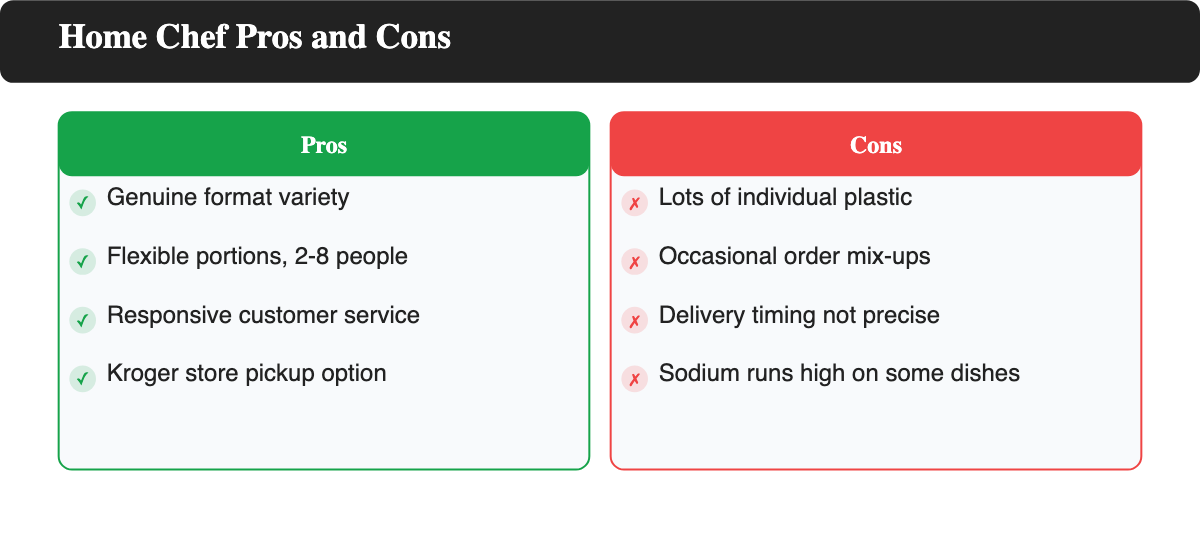
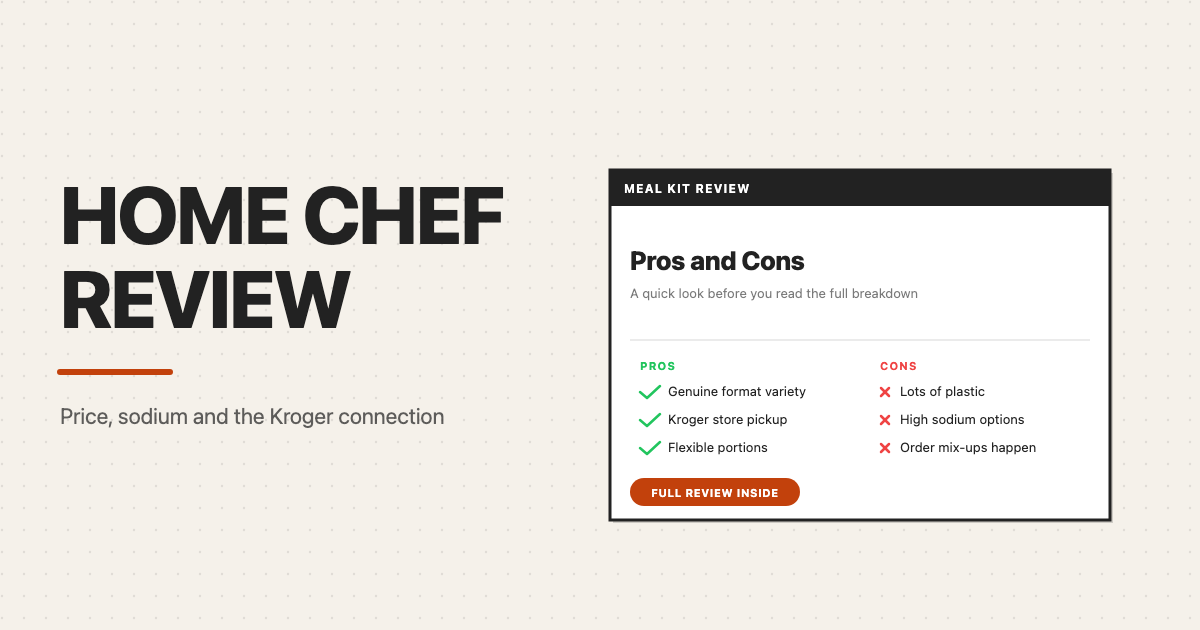
- Pro: Genuine format variety. Classic kits, Express, Chopped & Ready and Fast & Fresh cover everything from a full cooking project to a five-minute reheat, all in the same weekly order.
- Pro: Flexible portions and household sizes. You can adjust servings per meal and feed anywhere from two to eight people without switching plans.
- Pro: Responsive customer service. Multiple independent reviews report fast credit or refunds when a meal arrives with an issue.
- Con: A lot of individually wrapped plastic. Every ingredient is bagged separately for portion accuracy, which multiple reviewers flag as excessive packaging.
- Con: Occasional order mix-ups. Getting the wrong protein or ingredient bag for a recipe happens occasionally, though it’s typically resolved with a refund or a swap.
- Con: Delivery timing isn’t always precise. Boxes generally arrive on the scheduled day, but the exact time within that day can land later than expected, which matters if you’re planning to cook the same night it arrives.
Is Home Chef Worth It?
Home Chef is a strong pick if you want to cook varied meals without the planning or grocery shopping. Busy weeks are where the format variety earns its keep, with the oven-ready and microwave options doing the heavy lifting. The Kroger ownership adds a real practical benefit too: in-store pickup as an alternative to delivery, plus wider grocery-store availability than most standalone meal kit brands offer.
It won’t save you much money compared with grocery shopping yourself. It is cheaper and faster than ordering takeout for the same number of meals, though. If you’re sodium-conscious, check the nutrition panel before you pick your weekly meals. The gap between the lowest and highest sodium dishes is wide enough to matter for your diet.
Want to see how Home Chef stacks up against the competition? Read our full HelloFresh vs Home Chef comparison, or browse our roundup of the best meal delivery services to see where it ranks against the rest of the field.
Home Chef FAQ
Can I skip a week of Home Chef?
Yes, skipping a week is easy and doesn’t require canceling your account. You can skip an upcoming order from your account dashboard before the weekly order deadline, and Home Chef sends a confirmation email once the skip is applied.
Does Home Chef require a subscription contract?
No, Home Chef doesn’t lock you into a fixed contract. You can skip any week or cancel your account online at any time, though you’ll want to do it before that week’s order deadline to avoid getting charged.
Does Home Chef offer vegetarian or low-carb meals?
Yes, Home Chef tags its weekly menu with filters including vegetarian and carb-conscious options, so you can narrow the menu down before choosing your meals. Availability of specific diet tags varies week to week depending on the current recipe rotation.
What’s the difference between the Home Chef Plan and the Family Plan?
The Home Chef Plan is the standard menu, where you build your own box and adjust each meal to 2, 4 or 6 servings. The Family Plan is a separate menu of kid-friendly recipes sold only in 4-serving portions, usually at a lower per-serving price than the standard plan.
Can I pick up my Home Chef order at a Kroger store instead of home delivery?
Yes, since Home Chef is a Kroger subsidiary, you can order online and choose pickup at a participating Kroger location instead of waiting for home delivery, an option most standalone meal kit services don’t offer.