
Huel Black Edition Review: Nutrition, Price, Taste and Verdict
 By Lisa Benz, Editor-in-chief · Updated Oct 6, 2026 · 8 min read
Disclosure: this article may contain partner links. If you buy through them, we earn a commission at no extra cost to you. The ranking is set by our editors.
Contents
- What Is Huel Black Edition?
- Nutrition Facts: Calories, Protein and Macros in Every Serving
- Pros and Cons of Huel Black Edition
- Flavor Lineup: Which Huel Black Edition Flavors Taste Best
- How Much Does Huel Black Edition Cost Per Serving?
- Huel Black Edition Powder vs the Ready-to-Drink Shake
- Huel Black Edition vs Huel Original Powder
- Huel Black Edition vs Ka'Chava: Which Meal Replacement Wins?
- Who Should (and Shouldn't) Buy Huel Black Edition?
- Is Huel Black Edition Third-Party Tested? Our Verdict
- Frequently Asked Questions
Huel Black Edition packs 40 grams of protein and just 400 calories into a single scoop of plant-based meal replacement powder. That ratio is why it has become Huel's best-selling product since launch. This review breaks down the real nutrition numbers, current US pricing, how the flavors actually taste, and whether it beats Huel's own Original Powder or a rival like Ka'Chava.
What Is Huel Black Edition?
Huel Black Edition delivers 400 calories and 40 grams of protein per serving, built around a higher protein, lower carb macro split than Huel's Original Powder. It is not the same product as the Huel Black Edition Ready-to-Drink bottle, a separate ready-made shake covered later in this review. The powder needs mixing with water or a blender. The bottle needs nothing at all.
Each serving comes from pea protein, brown rice protein and flaxseed, with 9 to 11 grams of fiber and net carbs starting around 15 grams. A bag holds 17 servings and comes in 10 flavors. All are gluten-free, 100 percent vegan and non-GMO, with no artificial sweeteners, colors or flavors.
- Calories: 400 per serving
- Protein: 40g per serving
- Fiber: 9-11g per serving
- Net carbs: from about 15g per serving
- Price: $3.53 per serving one-time, $2.65 subscribed
- Flavors: 10 options
- Diet tags: vegan, gluten-free, non-GMO
Nutrition Facts: Calories, Protein and Macros in Every Serving
A single 90-gram serving of Huel Black Edition provides 400 calories, 40 grams of protein, 9 to 11 grams of fiber and net carbs from around 15 grams, based on the current product page. That works out to roughly 40 percent of calories from protein and 40 percent from fat, with the rest from net carbs. Fat and sugar are not listed on Huel's own spec sheet. Independent lab-style reviews from BarBend and Garage Gym Reviews both report an estimated range of 17 to 18 grams of fat and 1 to 6 grams of sugar depending on flavor.
| Nutrient | Per Serving |
|---|---|
| Calories | 400 kcal |
| Protein | 40g |
| Net carbs | from ~15g |
| Fiber | 9-11g |
| Fat | ~17-18g (independently reported) |
| Sugar | ~1-6g (independently reported, varies by flavor) |
The protein comes from a blend of pea protein, brown rice protein and flaxseed rather than whey. That combination is what makes the amino acid profile complete without relying on dairy. Huel also adds its usual blend of 27 vitamins and minerals to each serving, so the powder is designed to function as a full meal rather than just a protein top-up.
How Much Protein Is in Huel Black Edition?
Huel Black Edition contains 40 grams of protein per 400-calorie serving, sourced from pea protein, brown rice protein and flaxseed. That sits near the upper end of what most nutrition bodies recommend for a single meal. It is also noticeably higher than Huel's own Original Powder, which carries 30 grams of protein per serving.
Pros and Cons of Huel Black Edition
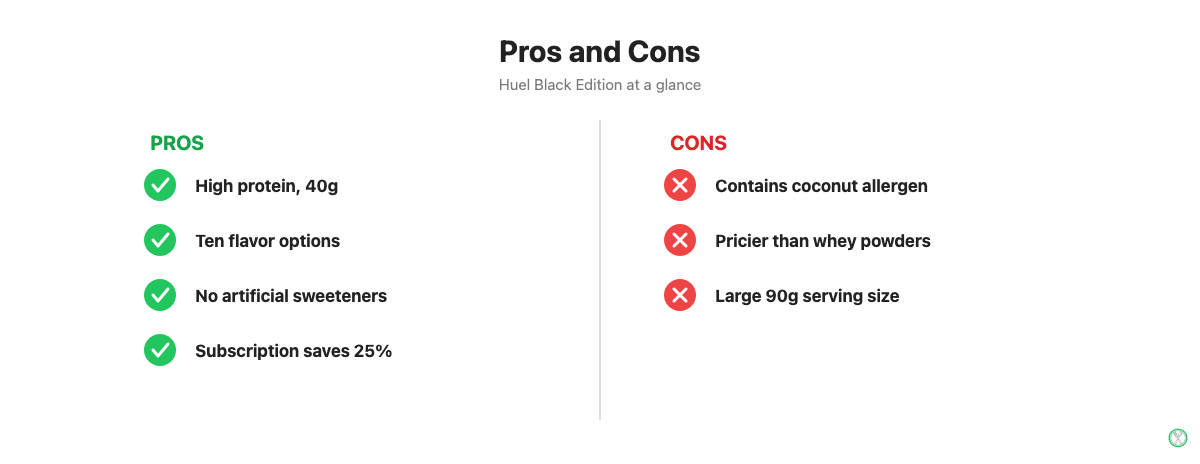
Before getting into flavors and pricing, here is the shorthand version of what stands out and what does not.
- Pro: 40g of protein per serving, among the highest of any plant-based meal replacement on the market
- Pro: 10 flavor options, more variety than most competitors
- Pro: No artificial sweeteners, gluten-free and fully vegan
- Pro: Subscription pricing cuts the cost per serving by roughly 25 percent
- Con: Contains coconut, a tree nut allergen some buyers need to avoid
- Con: Priced above most whey-based protein powders per serving
- Con: The 90-gram serving size can be hard to fit into a standard 20-ounce shaker bottle
Flavor Lineup: Which Huel Black Edition Flavors Taste Best
Salted Caramel and Coffee Caramel rate highest with reviewers. Chocolate and Cookies & Cream score lowest across independent taste tests. The current 10-flavor lineup covers Chocolate Peanut Butter, Chocolate, Banana, Strawberry, Vanilla, Cookies & Cream, Cinnamon Roll, Coffee Caramel and Salted Caramel, plus an Unflavored & Unsweetened option for anyone who wants to add their own mix-ins.
- Salted Caramel: the most-recommended flavor across reviewer taste panels
- Coffee Caramel: fragrant and well-balanced, a close second
- Vanilla: masks the plant-protein aftertaste better than expected
- Strawberry Shortcake: underwhelming at first, improves with repeat servings
- Cinnamon Roll and Banana: solid but unremarkable middle-of-the-pack options
- Cookies & Cream: divisive, some testers describe an odd aftertaste
- Chocolate: the weakest flavor by reviewer consensus, with pea protein overpowering the cocoa
Texture is consistent across flavors: thick, with visible fiber particles, closer to a smoothie than a thin protein shake. A countertop blender smooths it out more than a handheld shaker bottle does, since the 90-gram powder-to-liquid ratio leaves little room to shake in a standard bottle.
How Much Does Huel Black Edition Cost Per Serving?
Huel Black Edition costs $3.53 per serving on a one-time order and $2.65 per serving on subscription. Those figures come from Huel's current $60 one-time and $45 subscription price for a 17-serving bag. That subscription discount works out to about 25 percent off, which adds up over time.
On a one-time bag, a month of daily servings (30 servings) costs roughly $106. On subscription, the same 30 servings cost about $79, a savings of around $27 a month or over $300 a year for someone replacing one meal a day. Subscription intervals are flexible, so it is possible to space out deliveries and still keep the discounted per-serving price.
Huel Black Edition Powder vs the Ready-to-Drink Shake
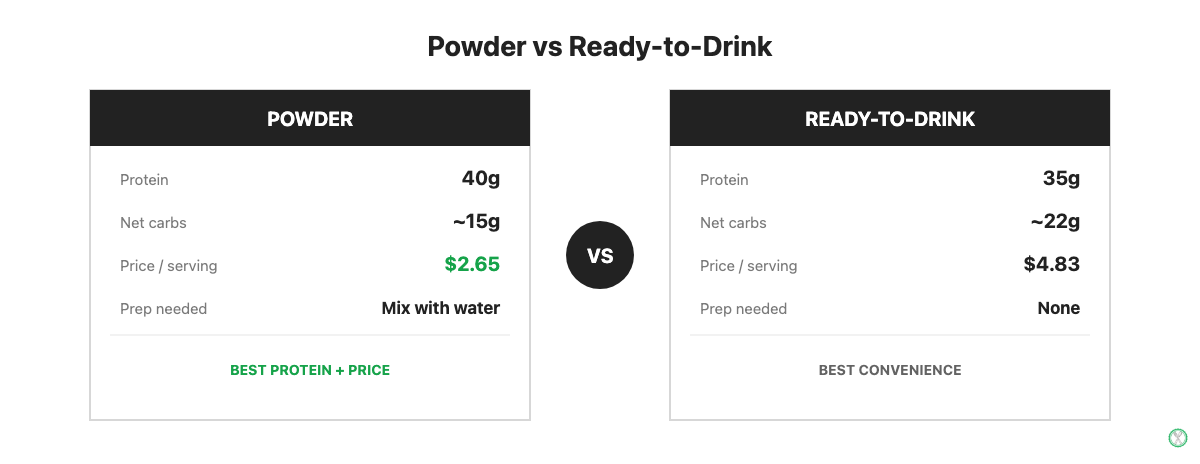
The Huel Black Edition powder and the Huel Black Edition Ready-to-Drink bottle share a name but are not the same product. The powder carries more protein and fewer carbs, while the bottle trades a few grams of protein for zero prep time.
| Attribute | Black Edition Powder | Black Edition Ready-to-Drink |
|---|---|---|
| Protein per serving | 40g | 35g |
| Net carbs | from ~15g | from ~22g |
| Fiber | 9-11g | from ~6g |
| Price per serving (subscribed) | $2.65 | $4.83 |
| Prep required | Mix with water or blend | None, ready to drink |
Anyone who wants the highest protein and lowest cost per serving should stick with the powder. Anyone who wants a meal replacement they can grab straight from the fridge should look at the bottle instead. That convenience trades a few grams of protein for a higher price per serving.
Huel Black Edition vs Huel Original Powder
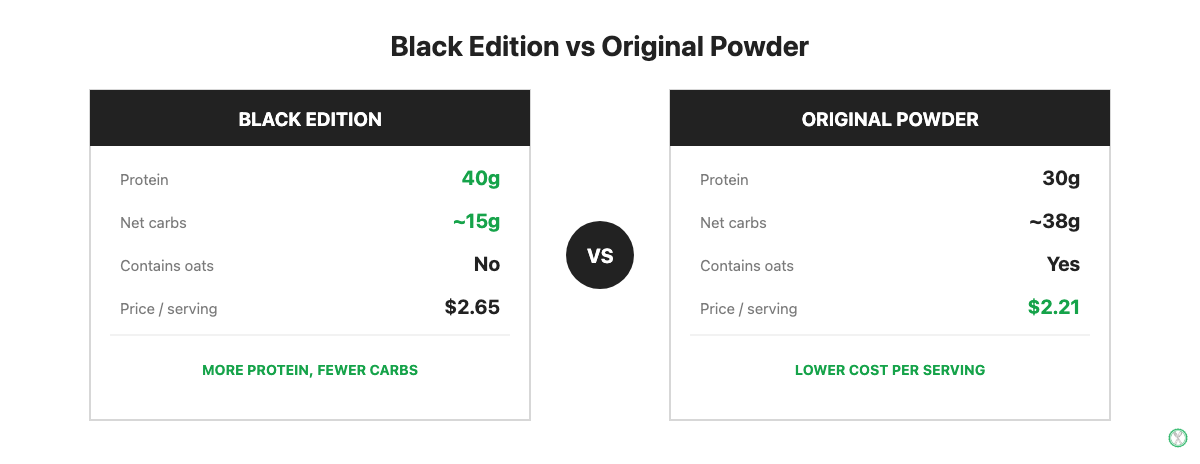
Huel Black Edition carries 33 percent more protein and roughly 60 percent fewer net carbs than Huel's Original Powder, making it the better pick for anyone prioritizing protein over carbohydrate volume.
| Attribute | Black Edition | Original Powder |
|---|---|---|
| Calories | 400 | 400 |
| Protein | 40g | 30g |
| Net carbs | from ~15g | from ~38g |
| Fiber | 9-11g | from ~8g |
| Contains oats | No | Yes |
| Price per serving (subscribed) | $2.65 | $2.21 |
Original Powder is cheaper per serving and still gluten-free despite using oats, which makes it the better fit for anyone who wants a balanced, moderate-carb meal replacement without paying extra for the higher protein target. Black Edition earns its higher price with a macro profile built specifically for people who want more protein and fewer carbs in the same 400 calories.
Huel Black Edition vs Ka'Chava: Which Meal Replacement Wins?
Huel Black Edition wins on protein and calories per dollar, while Ka'Chava wins on ingredient variety, packing 85-plus superfoods into a lower-calorie serving.
| Attribute | Huel Black Edition | Ka'Chava |
|---|---|---|
| Price per serving | $2.65 (subscribed) | $3.99 (one-time) |
| Calories | 400 | 240 |
| Protein | 40g | 25g |
| Carbs | from ~15g net | 22g total |
| Fat | ~17-18g | 6g |
| Fiber | 9-11g | 6g |
| Flavors | 10 | 8 |
Ka'Chava is closer to a nutrient-dense snack than a full meal replacement, with roughly 160 fewer calories per serving than Huel Black Edition. Anyone who wants a true meal-in-a-glass with a full 400 calories and 40 grams of protein gets more of both from Huel Black Edition per dollar. Anyone who wants a lighter shake with a wider superfood ingredient list and does not need the extra calories may prefer Ka'Chava instead.
Who Should (and Shouldn't) Buy Huel Black Edition?
Huel Black Edition fits best for people who need a convenient, high-protein meal on days when cooking is not realistic. It is not built to replace every meal, every day. For a broader look at the category, see our roundup of the best meal replacement shakes and the best protein powders.
- Good fit: vegan and vegetarian athletes who want a plant-based protein boost without whey
- Good fit: hard gainers who need extra calories and protein without eating more solid food
- Good fit: frequent travelers who need a meal that survives a bag without refrigeration
- Not a fit: anyone with a tree nut allergy, since the formula contains coconut
- Not a fit: budget-focused buyers who are comparing purely on price against whey-based protein powders
- Not a fit: anyone looking to replace whole food meals entirely and permanently
Is Huel Black Edition Third-Party Tested? Our Verdict
Is Huel Black Edition Third-Party Tested?
Not in the way most supplement shoppers mean the term. Huel states that its products are tested by independent ISO 17025-accredited laboratories for microorganisms, nutrition, heavy metals, pesticides and allergens. The brand does not, however, carry a dedicated third-party sport-certification seal such as NSF Certified for Sport or Informed Sport. That gap is likely why several independent reviewers score Huel as lacking third-party testing, even though accredited lab testing is happening behind the scenes.
Overall, Huel Black Edition earns its place as one of the highest-protein plant-based meal replacements available, and the 25 percent subscription discount makes the price gap against whey-based competitors easier to justify. The main trade-offs are the missing sport-certification seal and a texture that takes some getting used to compared to a thinner whey shake. For anyone who wants a genuine meal replacement rather than a light protein snack, it remains one of the stronger options on the market.
Frequently Asked Questions
Can I lose weight with Huel Black Edition?
Yes, Huel Black Edition can support weight loss when it replaces a higher-calorie meal and fits inside an overall calorie deficit, but the shake itself does not cause weight loss on its own. Its high protein and fiber content help with fullness, which makes it easier to stick to a lower-calorie plan.
Is it safe to drink Huel Black Edition every day?
Occasional daily use as one meal replacement is generally fine for most healthy adults, but replacing every meal with a powder long-term is not recommended. Whole food still provides texture, satiety and nutrient variety that a shake cannot fully replicate.
Does Huel Black Edition contain any allergens?
Huel Black Edition contains coconut, which is classified as a tree nut allergen, so it is not suitable for anyone with a tree nut allergy. It is otherwise free from the major allergens covered by soy, dairy and gluten.
What is the difference between Huel Black Edition and Huel Original Powder?
Huel Black Edition carries 40 grams of protein and net carbs from around 15 grams per serving. Huel Original Powder carries 30 grams of protein, net carbs from around 38 grams and oats that Black Edition does not use. Black Edition suits buyers who want more protein and fewer carbs, while Original Powder suits buyers who want a lower-cost, moderate-carb option.
Where can I buy Huel Black Edition?
Huel Black Edition is available directly from huel.com with free US shipping over a minimum order size, and it is also sold through Amazon, though third-party retail listings sometimes run at a higher price than ordering direct.