
Huel vs Soylent: Which Meal Replacement Wins in 2026?
 By Lisa Benz, Editor-in-chief · Updated Oct 6, 2026 · 8 min read
Disclosure: this article may contain partner links. If you buy through them, we earn a commission at no extra cost to you. The ranking is set by our editors.
Contents
Huel and Soylent are the two brands most people land on when they search for a complete-nutrition meal replacement, and they take different approaches to the same idea. Huel builds its formula around pea and rice protein, oats and flaxseed, and charges a premium for it. Soylent leans on soy protein isolate and a simpler ingredient list to keep the price down. Huel also changed hands in a big way this year: Danone announced a roughly $1.2 billion deal to acquire Huel in March 2026. That shift doesn't touch what's in your shaker today, but it says a lot about where the brand is headed. Here's how the two compare on price, protein, taste and who each one fits best.
Huel vs Soylent at a Glance
The two brands don't share a birthplace, an owner, or a protein source. Huel launched in the UK in 2015 and expanded into ready-to-drink bottles, hot meals, protein powder and bars, all built on a pea-and-rice protein base with oats and flaxseed for fat and fiber. Soylent traces back further, to Rob Rhinehart's 2013 crowdfunded formula, and now belongs to Starco Brands, which bought the company in 2023 and pushed it toward a subscription-first model. Huel's trajectory shifted too: Danone announced an agreement to acquire Huel in March 2026 for roughly $1.2 billion, folding the brand into its Functional Nutrition portfolio. The deal was still working through regulatory approval as of this writing. It hasn't changed Huel's product lineup or pricing.
| What you're comparing | Huel | Soylent |
|---|---|---|
| Price per serving | $2.21-$6.04, depending on format | $1.82-$4.50, depending on format |
| Protein per 400-calorie serving | 30-40g | 20g |
| Protein source | Pea and rice protein (vegan) | Soy protein isolate |
| Founded | 2015, United Kingdom | 2013, United States |
| Current owner | Independent; Danone acquisition announced March 2026, pending close | Starco Brands, since 2023 |
| Format range | Powder, ready-to-drink, hot meals, protein powder, bars, greens | Ready-to-drink and powder across 4 product lines |
How Much Do Huel and Soylent Cost Per Serving?
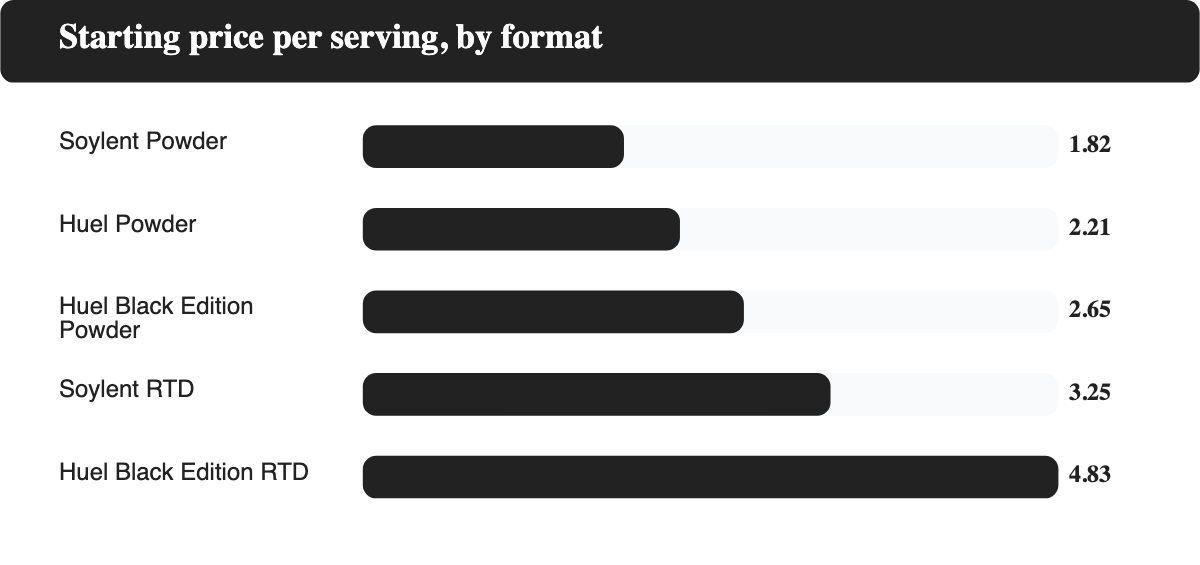
Soylent is the cheaper way to hit a full 400-calorie meal replacement. Its Complete Meal line runs roughly $1.82 to $3.25 per serving on subscription, with ready-to-drink bottles at the higher end of that range and powder at the lower end. Huel's standard Powder starts a little higher, around $2.21 to $2.76 per meal on subscription. Prices climb fast once you move up the lineup: Black Edition powder runs about $2.65 to $3.31 per meal, and the Black Edition Ready-to-Drink bottles run $4.83 to $6.04 depending on whether you subscribe or buy one-time.
Both brands push subscribers toward recurring orders with real discounts. Huel knocks 20% off every recurring order, with an added discount on orders over $120. Soylent's subscription savings work in a similar way. Pricing shifts with promotions and pack size on both sites, so treat these as ranges rather than fixed numbers and check the live price before you order.
Nutrition Compared: Protein, Fat, Fiber and Sugar
Protein is where the two brands differ the most. Huel's standard Powder delivers 30 grams per 400-calorie serving, and Black Edition pushes that to 40 grams, nearly double what Soylent's Complete Meal offers at 20 grams. Huel builds that protein from pea and rice sources, which is why the brand markets almost its entire range as vegan. Soylent uses soy protein isolate instead, a complete amino acid profile on its own, but not an option if you're managing a soy allergy.
Fat and fiber tell a different story. Huel's oat-and-flaxseed base runs lower in fat, around 12 to 13 grams per serving, and higher in fiber, 7 to 8 grams. Soylent's Complete Meal runs the opposite way: roughly 19 to 21 grams of fat and 3 to 5 grams of fiber, sourced mostly from high-oleic sunflower oil and soluble corn fiber. Both brands keep added sugar low, 1 gram or less per serving, though they get there differently. Huel relies on naturally low-sugar ingredients; Soylent sweetens with allulose and sucralose.
| Per 400-calorie serving | Huel (Powder / Black Edition) | Soylent (Complete Meal) |
|---|---|---|
| Protein | 30g / 40g | 20g |
| Fat | ~12-13g | ~19-21g |
| Fiber | 7-8g | 3-5g |
| Added sugar | ~1g | ~1g or less |
| Protein source | Pea and rice | Soy protein isolate |
Neither brand is a substitute for a varied, whole-food diet, and doctors and dietitians who've reviewed both make the same point: use them a few times a week for genuine convenience, not as your only source of nutrition every day. Anyone with IBS or a sensitive gut should ease in gradually with either brand, since a sudden jump in fiber (Huel's angle) or a shift to a soy-based formula (Soylent's angle) can cause temporary bloating.
Product Lineup and Format
Huel spreads across more formats than Soylent does. That matters if you want variety beyond a shake. Soylent keeps its lineup tighter and leans on that simplicity to hold its price down.
Huel's lineup
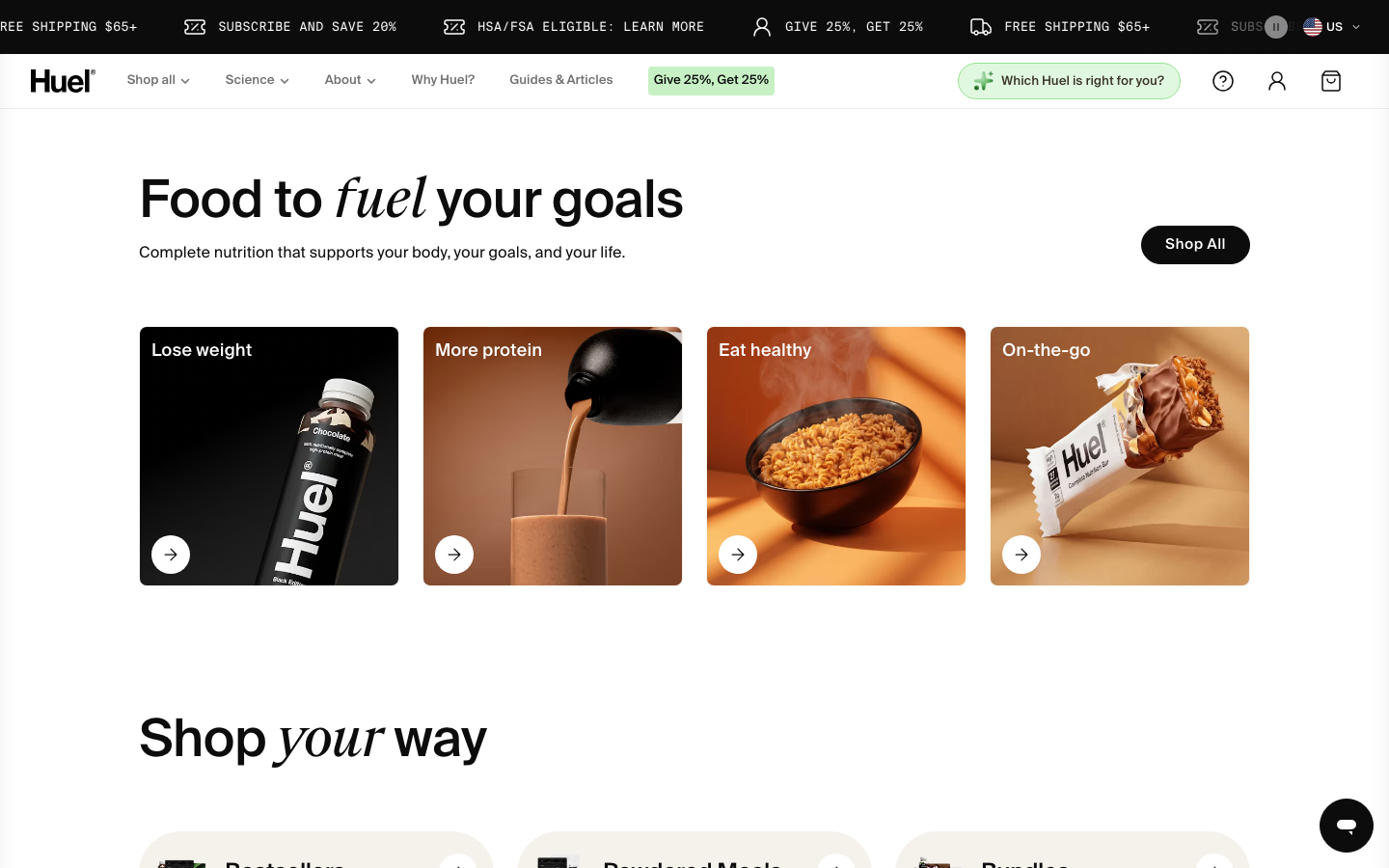
Huel sells five distinct product lines: Powder, Black Edition powder, Black Edition Ready-to-Drink, Hot & Savory instant meals, and Daily Greens, plus a separate protein powder and bar range. The Black Edition powder is the most popular entry point for anyone prioritizing protein, while Hot & Savory is the closer of the two brands to an actual cooked meal rather than a drink.
| Huel spec | Detail |
|---|---|
| Protein per serving | 30-40g |
| Calories per serving | 400 (25 for Daily Greens) |
| Price per meal | $2.21-$6.04 |
| Formats | Powder, RTD, hot meals, protein powder, bars, greens |
| Diet tags | Vegan, gluten-free across most of the range |
Soylent's lineup
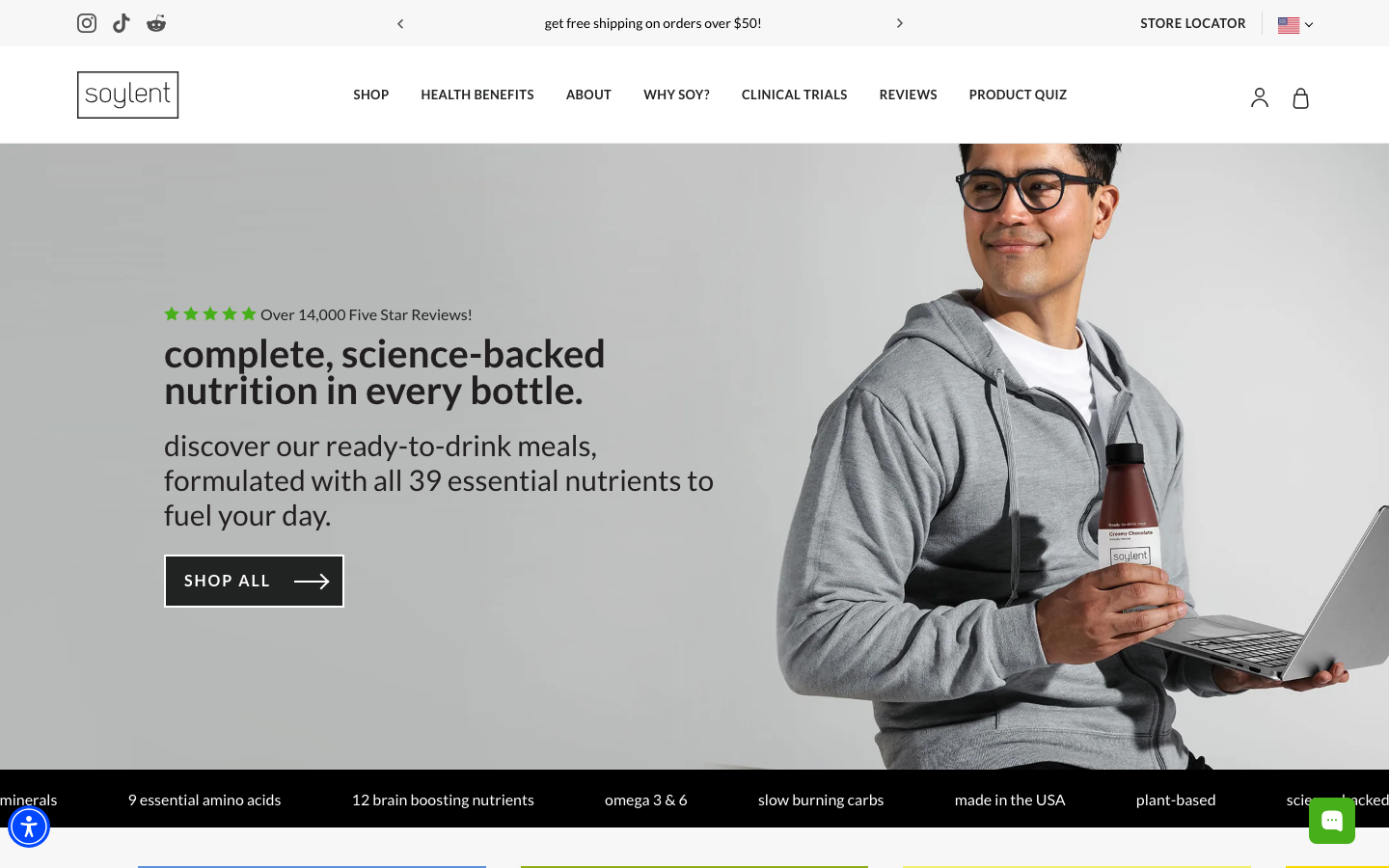
Soylent's current catalog holds four lines: Complete Meal (the original, full 400-calorie shake), Complete Protein (a lighter, protein-focused shake with 0g sugar), Complete Coffee (Complete Meal nutrition plus caffeine) and Complete Energy (a lighter nootropic-and-caffeine drink, not a full meal replacement). Complete Meal is the anchor product and the one most directly comparable to Huel's core Powder and Black Edition lines.
| Soylent spec | Detail |
|---|---|
| Protein per serving | 20g (Complete Meal), ~30g (Complete Protein) |
| Calories per serving | 400 (Complete Meal), lower for Protein and Energy lines |
| Price per meal | $1.82-$4.50 |
| Formats | Ready-to-drink bottles and powder, 4 product lines |
| Diet tags | Vegan, gluten-free, dairy-free |
Taste and Texture: Which Goes Down Easier?
Testers land on different sides here. It's a matter of preference, not one brand beating the other outright. Huel's powder carries a persistent gritty texture that reviewers flag even after thorough mixing in a proper shaker bottle, plus a plant-protein aftertaste that comes with using pea protein instead of dairy whey or soy. Soylent's texture reads smoother by comparison, helped by allulose as a sweetener, though some reviewers describe the flavor as leaning artificial on a few flavors. Soylent's lighter profile also leaves you full for a shorter stretch than Huel's higher-fiber formula does.
If grittiness is your dealbreaker, Huel's Ready-to-Drink bottles skip the mixing step entirely and land closer to a standard protein drink texture, though the plant-protein aftertaste still follows through. On the Soylent side, Complete Coffee and Complete Energy tend to mask the base flavor better than Complete Meal does, since the coffee or nootropic notes are more dominant.
Which One Should You Choose?
Neither brand is a strict upgrade over the other, and the right pick comes down to what you're optimizing for.
- Pick Huel if: protein density is your priority, you want more format variety (hot meals, bars, a greens mix), or you specifically want a pea-and-rice protein source instead of soy.
- Pick Soylent if: price per serving matters most, you prefer a smoother, less gritty texture, or you want a lighter protein-focused option like Complete Protein without a full 400-calorie load.
| Huel pros | Huel cons |
|---|---|
| Nearly double the protein of Soylent in Black Edition | Costs more across almost every format |
| Widest format range: powder, RTD, hot meals, bars, greens | Gritty texture is a consistent tester complaint |
| Fully vegan and gluten-free across most of the range | Pending Danone acquisition adds some ownership uncertainty |
| Soylent pros | Soylent cons |
|---|---|
| Cheapest way to hit a full 400-calorie meal replacement | Half the protein of Huel Black Edition |
| Smoother texture, less grittiness than Huel's powder | Not suitable if you have a soy allergy |
| Complete Protein option for lighter, protein-only servings | Narrower format range than Huel |
Both brands' first-order promotions make it inexpensive to try one for yourself before committing to a subscription. For a deeper look at either brand alone, our full Huel review and Soylent review cover taste testing, side effects and ordering details in more depth, and our best meal replacement shakes guide ranks both against Ka'Chava and other complete-nutrition brands side by side.
Frequently Asked Questions
Is Huel or Soylent better for weight loss?
Neither is marketed specifically as a weight-loss product, but both make portion and calorie control easier for people who overeat when meals aren't pre-measured. Huel's higher protein and fiber content may keep you feeling full longer, which can help with appetite control, but actual weight loss still comes down to overall calorie balance rather than which shake you choose.
Which is cheaper, Huel or Soylent?
Soylent is cheaper overall, running roughly $1.82 to $4.50 per serving against Huel's $2.21 to $6.04, with the gap widest when comparing Soylent's powder to Huel's Ready-to-Drink bottles. Huel's higher price buys close to double the protein per serving, so the better value depends on whether you're optimizing for cost or protein density.
Does the Danone acquisition affect Huel's pricing or products?
Not yet. The deal was announced in March 2026 and was still moving through regulatory approval as of this writing, and Huel's product lineup and pricing haven't changed as a result. Ownership changes like this can eventually influence a brand's formulas or pricing strategy, so it's worth rechecking Huel's current lineup periodically once the deal closes.
Is Soylent or Huel vegan?
Both brands are vegan across most of their core lineups. Huel builds its protein from pea and rice, while Soylent uses soy protein isolate, which is plant-based but a common allergen, so check the label if you're managing a soy allergy alongside a vegan diet.
Can I switch between Huel and Soylent easily?
Yes, both brands let you cancel or pause a subscription from your account settings without a fee, so there's nothing stopping you from trying one for a few weeks and switching to the other. Many first-time buyers do exactly that to compare taste and texture before settling on one.