
Cleanest Protein Powder: 8 Picks Backed by Third-Party Testing (2026)
 By Lisa Benz, Editor-in-chief · Updated Oct 6, 2026 · 12 min read
Disclosure: this article may contain partner links. If you buy through them, we earn a commission at no extra cost to you. The ranking is set by our editors.
Contents
- What Makes a Protein Powder "Clean"?
- Ingredients to Avoid on a Protein Powder Label
- Do Protein Powders Contain Heavy Metals? Should You Worry?
- NSF Certified for Sport vs Informed Sport vs Informed Choice: What's the Difference?
- Compare the Cleanest Protein Powders at a Glance
- Cleanest Overall: Transparent Labs 100% Grass-Fed Whey Protein Isolate
- Cleanest Single-Ingredient Whey: Naked Nutrition Naked Whey
- Cleanest NSF Certified for Sport Pick: Garden of Life SPORT Grass-Fed Whey
- Cleanest Value Pick With Informed Sport Certification: Kaged Whey Protein Isolate
- Cleanest Dual-Certified Pick for Tested Athletes: Momentous Essential Grass-Fed Whey
- Cleanest Budget Pick: Nutricost Whey Isolate
- Cleanest Organic Plant-Based Pick: Truvani Organic Plant-Based Protein
- Cleanest Full-Transparency Grass-Fed Pick: Legion Whey+
- How to Pick the Cleanest Protein Powder for Your Goals
- Cleanest Protein Powder FAQ
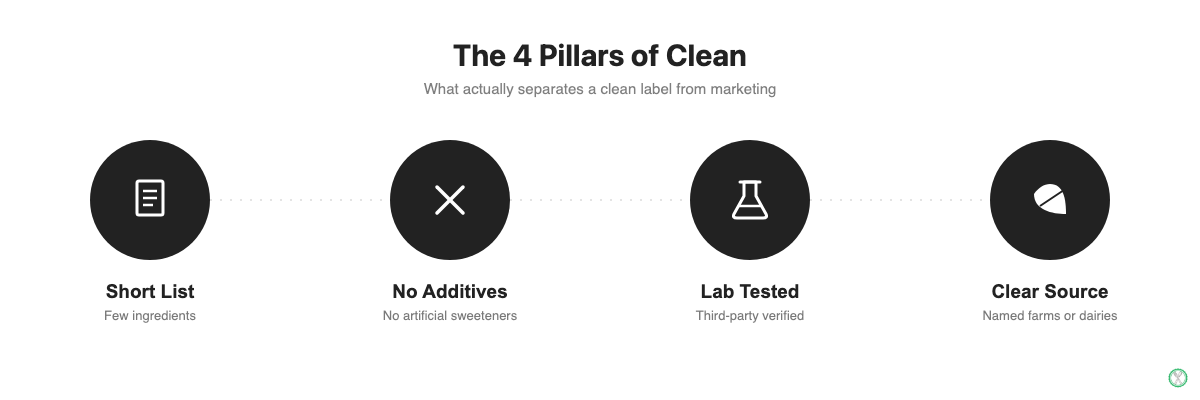
The cleanest protein powders share four traits: a short ingredient list, no artificial sweeteners or gums, verified third-party testing for heavy metals or banned substances and a label that tells you exactly what's in the tub. Transparent Labs 100% Grass-Fed Whey Protein Isolate is the strongest all-around pick, but the right choice depends on whether you need sport-specific testing, a single-ingredient formula, or a plant-based option.
We built this list around one question: which protein powders can actually prove they're clean, not just market themselves that way? Every pick below carries a named third-party certification or an independently disclosed testing standard. None of them rely on "proprietary blend" labeling, and none of them are on this list because of taste alone. That angle is covered on our best-tasting protein powder guide instead, and our best protein powder overall guide covers the wider field if clean label isn't your only priority.
What Makes a Protein Powder "Clean"?
There's no official FDA definition of a "clean" protein powder, and that gap is exactly why the term gets slapped on products that don't deserve it. In practice, a genuinely clean pick holds up on four separate criteria, not just one.
- Ingredient minimalism. The label reads like a short grocery list, not a chemistry set, so you shouldn't need a dictionary to shop. A single-ingredient whey concentrate or isolate is the clearest example, but a five-ingredient plant blend can qualify too.
- Sweetener policy. No sucralose, acesulfame potassium, or aspartame. Stevia and monk fruit extract are the common natural substitutes, and unflavored versions skip sweeteners entirely.
- Third-party testing. A named lab or certification body checks the product after it's manufactured, not just the manufacturer's own internal quality claims.
- Transparent sourcing. The brand discloses where the protein comes from, such as grass-fed dairy cows or a specific organic farm, instead of hiding behind a generic "premium protein blend."
A product that hits three of these four is still worth considering, since it's rare to find one that clears all four perfectly. A product that hits none of them, no matter what the front label says, isn't clean by any reasonable standard, full stop.
Ingredients to Avoid on a Protein Powder Label
Flip the tub over before you buy. Here's what undercuts a clean-label claim, and why each one matters.
- Maltodextrin and other fillers. Cheap bulking agents that add calories and carbs without adding protein. They aren't there for your benefit.
- Carrageenan and gums. Thickeners used to fake a creamier texture. They aren't dangerous in small amounts, but they have no nutritional purpose, and some people report digestive discomfort from them.
- Artificial sweeteners. Sucralose and acesulfame potassium are the two most common offenders in flavored protein powders, and they're clearly the first thing a clean-label brand cuts.
- Artificial colors and flavors. Dyes and lab-synthesized flavor compounds that exist purely for shelf appeal.
- Proprietary blends. A "recovery matrix" or "muscle blend" with no individual ingredient amounts listed hides exactly how little of anything useful might be in the mix. If a label won't tell you the dose, assume it's a marketing name for filler, no exceptions.
Do Protein Powders Contain Heavy Metals? Should You Worry?
Yes, some protein powders test positive for lead, cadmium, arsenic, or mercury, though the amount varies enormously by brand and sourcing. The Clean Label Project, a nonprofit that independently tests packaged food and supplements, screened 165 protein powder products and found that the five dirtiest products carried dramatically higher contaminant loads than its "Clean Sixteen" list: 45.9 times more cadmium, 38.4 times more lead, 31.5 times more arsenic, and roughly 2 times more mercury per serving.
Consumer Reports ran its own test of 23 popular protein powders and shakes in 2025, using a level-of-concern benchmark of 0.5 micrograms of lead per day, based on California's Prop 65 maximum allowable dose. Detected lead ranged from not detectable up to 70.2 parts per billion, and about 40% of the tested products exceeded 14 ppb. Notably, Consumer Reports specifically named Momentous and Transparent Labs, two of the picks on this list, as brands that publish their own third-party test results. That's not a coincidence; it's exactly why they made the cut here.
None of this means every protein powder is unsafe. It means sourcing and independent verification aren't optional details. They're the difference between a product that's actually clean and one that only claims to be.
The takeaway for shopping: don't trust the word "pure" on the front label. Trust brands that disclose third-party heavy-metal testing results instead.
NSF Certified for Sport vs Informed Sport vs Informed Choice: What's the Difference?
These three certifications get used almost interchangeably in marketing copy, but they aren't the same thing, and they don't test for the same thing either.
| Certification | What it verifies | Who it matters most for |
|---|---|---|
| NSF Certified for Sport | Product is tested batch-by-batch for banned substances on WADA and professional league lists, plus label accuracy | Athletes tested by the NCAA, NFL, MLB, NHL and Olympic programs |
| Informed Sport | Every batch is tested for banned substances before it ships, with a public batch-lookup database | Competitive and Olympic-level athletes who need batch-level proof |
| Informed Choice | Same testing standard as Informed Sport, aimed at general consumer and non-drug-tested athletic use | Serious gym-goers who want the same rigor without needing sport-specific batch lookups |
| Labdoor | Independent lab analysis of label accuracy, purity and contaminant levels, published as a public grade | Any buyer who wants a third-party purity grade, not sport-specific banned-substance screening |
If you're a tested athlete, NSF Certified for Sport or Informed Sport isn't optional. A positive test from a contaminated supplement can end a season regardless of intent, no matter how it got there. If you just want proof that the label matches what's in the tub, any of the four certifications above clears a meaningfully higher bar than an uncertified product.
Compare the Cleanest Protein Powders at a Glance
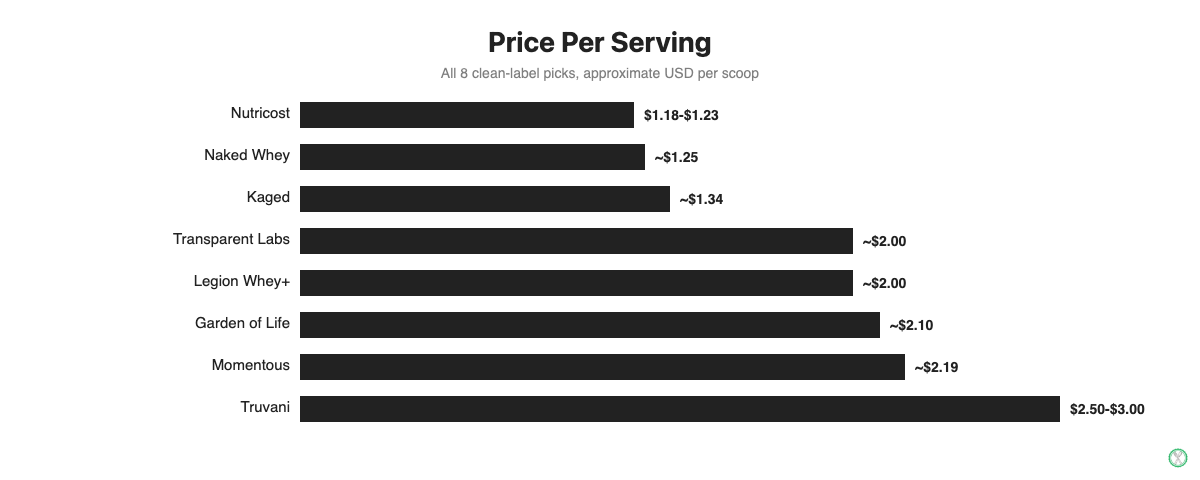
Here's how the eight picks below stack up on the facts that matter most for a clean-label decision.
| Product | Type | Protein/serving | Price/serving | Key certification |
|---|---|---|---|---|
| Transparent Labs 100% Grass-Fed Whey Protein Isolate | Whey isolate | 28g | ~$1.99-$2.00 | Informed Sport |
| Naked Nutrition Naked Whey | Whey concentrate | 25g | ~$1.25 | NSF Certified |
| Garden of Life SPORT Grass-Fed Whey | Whey isolate | 24g | ~$2.10 | NSF Certified for Sport |
| Kaged Whey Protein Isolate | Whey isolate | 25g | ~$1.34 | Informed Sport |
| Momentous Essential Grass-Fed Whey | Whey isolate | 20g | ~$2.19 | NSF Certified for Sport + Informed Sport |
| Nutricost Whey Isolate | Whey isolate | 30g | ~$1.18-$1.23 | Third-party tested (GMP facility) |
| Truvani Organic Plant-Based Protein | Plant protein | 20g | ~$2.50-$3.00 | USDA Organic |
| Legion Whey+ | Whey isolate | 21-23g | ~$2.00 | Labdoor + Truly Grass-Fed |
Cleanest Overall: Transparent Labs 100% Grass-Fed Whey Protein Isolate
Transparent Labs earns the top spot because it clears all four clean-label criteria at once: a short ingredient list, stevia instead of artificial sweeteners, Informed Sport certification with third-party testing through Ellipse Analytics, plus full disclosure of its grass-fed, hormone-free dairy sourcing.
- Type: Whey protein isolate
- Protein per serving: 28g
- Calories: 130-150 (varies by flavor)
- Sugar: Under 1g, no added sugar
- Price per serving: About $1.99-$2.00
- Flavors: 14-18, depending on the current lineup
- Format: Powder tub, about 30 servings
- Third-party testing: Informed Sport certified, tested by Ellipse Analytics; independently scored 98/100 by Labdoor
- Rating: 4.5/5 on Amazon, roughly 3,000 ratings
The label lists hormone-free whey, natural flavors and stevia, with nothing hidden behind a blend name. It isn't the cheapest option here, but it's flat-out the pick that asks the fewest questions of you as a buyer.
Cleanest Single-Ingredient Whey: Naked Nutrition Naked Whey
Naked Whey's unflavored version has exactly one ingredient: grass-fed whey protein concentrate. Nothing to decode, nothing to look up.
- Type: Whey protein concentrate
- Protein per serving: 25g
- Calories: 120
- Sugar: 2g
- Price per serving: About $1.25
- Flavors: Unflavored, chocolate, vanilla
- Format: Powder bag
- Third-party testing: NSF Certified, with published per-serving heavy-metal ceilings (under 0.30mcg arsenic, under 0.15mcg each for cadmium, lead and mercury), a level of per-serving contaminant transparency few other brands publish
- Rating: 4.2/5 on Amazon with over 140,000 ratings; 4.8/5 on the brand's own site with about 8,000 ratings
The flavored versions add only two or three extra ingredients, so the single-ingredient promise mostly holds even outside the unflavored SKU. If you want the shortest possible label in this list, this is it.
Cleanest NSF Certified for Sport Pick: Garden of Life SPORT Grass-Fed Whey
Garden of Life SPORT carries the NSF Certified for Sport mark. That means an independent lab screens every batch for substances banned by the NCAA, NFL and Olympic testing programs before it ships.
- Type: Whey protein isolate, with a small amount of milk protein
- Protein per serving: 24g
- Calories: Not verified to a safe precision at the time of research; check the current label
- Sugar: Not verified to a safe precision at the time of research; check the current label
- Price per serving: About $2.10
- Flavors: Vanilla and chocolate
- Format: Powder tub, about 20 servings
- Third-party testing: NSF Certified for Sport
- Rating: About 4.2-4.4/5 on Amazon, depending on the flavor listing
This is the pick to reach for if you're subject to school or league drug testing and need a certification that testing bodies specifically recognize, not just a general purity claim.
Cleanest Value Pick With Informed Sport Certification: Kaged Whey Protein Isolate
Kaged pairs Informed Sport certification with one of the lowest per-serving prices of any certified pick here. That's a rare combination.

- Type: Whey protein isolate
- Protein per serving: 25g
- Calories: Not verified to a safe precision at the time of research; check the current label
- Sugar: Not verified to a safe precision at the time of research; check the current label
- Price per serving: About $1.34
- Flavors: Vanilla, chocolate and several rotating options
- Format: Powder tub, about 44 servings
- Third-party testing: Informed Sport certified
- Rating: 4.5/5 on Amazon
If certified testing usually means paying a premium, Kaged is the counterexample. It undercuts several uncertified whey isolates on price per serving.
Cleanest Dual-Certified Pick for Tested Athletes: Momentous Essential Grass-Fed Whey
Momentous is the only product on this list carrying both NSF Certified for Sport and Informed Sport certification at the same time. That's the highest testing bar any pick here clears.
- Type: Whey protein isolate
- Protein per serving: 20g
- Calories: 100
- Sugar: Not verified to a safe precision at the time of research; check the current label
- Price per serving: About $2.19
- Flavors: Unflavored, chocolate, vanilla
- Format: Powder tub, about 25 servings
- Third-party testing: NSF Certified for Sport and Informed Sport, dual certified
- Rating: Not independently verified at the time of research; check current retailer listings
Momentous sources the whey from European dairy cows raised without hormones, steroids or rBST. The formula uses a digestive-enzyme blend called ProHydrolase instead of gums to help with mixability.
Cleanest Budget Pick: Nutricost Whey Isolate
Nutricost's unflavored version is whey protein isolate plus a single ingredient, sunflower lecithin, and it's priced below nearly every other pick on this list.
- Type: Whey protein isolate
- Protein per serving: 30g
- Calories: 130-140
- Sugar: None in the unflavored version; flavored SKUs vary and use sucralose, so check the specific flavor label
- Price per serving: About $1.18-$1.23
- Flavors: 10 total, including unflavored
- Format: Powder bag, 2lb
- Third-party testing: Third-party tested in a GMP-compliant facility; the specific lab is not publicly named
- Rating: 4.4/5 on Amazon, over 9,100 ratings
Nutricost is the one caveat on this list: it doesn't carry a named certification like NSF or Informed Sport, and the flavored versions use sucralose. The unflavored SKU is the version that earns its spot here.
Cleanest Organic Plant-Based Pick: Truvani Organic Plant-Based Protein
Truvani is USDA Organic certified, and that's a real, independently audited standard. This certifies farming and processing practices, not the finished product's banned-substance testing the way NSF or Informed Sport does.
- Type: Plant protein, pea protein concentrate blend
- Protein per serving: 20g
- Calories: Not verified to a safe precision at the time of research; check the current label
- Sugar: No added sugar; total sugar content not verified to a safe precision
- Price per serving: About $2.50-$3.00
- Flavors: Vanilla and chocolate
- Format: Powder bag, 18-20 servings
- Third-party testing: USDA Organic certified; the brand states it tests before and after manufacturing, though this is a brand-disclosed process rather than an independent sport or purity certification
- Rating: Individual Amazon reviews range from 4.0 to 5.0/5; the brand's own site reports 4.5/5 across roughly 15,000 ratings
The five-ingredient formula, pea protein concentrate, organic vanilla powder, organic pumpkin seed protein concentrate, organic monk fruit extract and organic chia seed protein concentrate, is short enough to read in one glance. That's rare for a plant-based protein. If you want more plant-based options ranked on protein quality and mixability rather than clean-label criteria alone, see our best vegan protein powder guide.
Cleanest Full-Transparency Grass-Fed Pick: Legion Whey+
Legion Whey+ carries both Labdoor certification and a Truly Grass-Fed certification. That's two separate independent checks on label accuracy and sourcing claims, not one.
- Type: Whey protein isolate
- Protein per serving: 21-23g, depending on flavor
- Calories: 100-130, depending on flavor
- Sugar: 0g, sugar-free per the product label
- Price per serving: About $2.00
- Flavors: 16 or more
- Format: Powder tub, 30 or 60 servings
- Third-party testing: Labdoor certified; Truly Grass-Fed certified
- Rating: Not consistently verified across flavor listings at the time of research; check the specific flavor page
Legion also shows up on best-tasting roundups, but that's not why it belongs here. It lists exact ingredient amounts instead of a blend name, and that's what earns it a spot on a clean-label list specifically.
How to Pick the Cleanest Protein Powder for Your Goals
Match the certification to what you actually need. Don't just chase the word "clean" on the front of the tub.
- Tested athlete (NCAA, pro league, Olympic program): Momentous Essential Grass-Fed Whey or Garden of Life SPORT, both NSF Certified for Sport.
- Shortest possible ingredient list: Naked Nutrition Naked Whey, unflavored.
- Lowest price with a real certification: Kaged Whey Protein Isolate.
- Tightest budget overall: Nutricost Whey Isolate, unflavored version only.
- Plant-based and organic-certified: Truvani Organic Plant-Based Protein.
- No strong preference, just want the safest all-around bet: Transparent Labs 100% Grass-Fed Whey Protein Isolate.
None of these picks are chosen for muscle-building macros or women-specific formulation. For those angles, see our best protein powder for muscle gain and best protein powder for women guides instead.
Cleanest Protein Powder FAQ
Is clean protein powder worth paying more for?
Yes, in most cases the extra cost buys independent verification you can't get from an uncertified product, since third-party testing and certification programs charge brands real fees to participate. A few extra dollars per tub for a certified pick is a small price to pay when you're weighing it against the risk of contaminated or mislabeled protein.
Does "clean" mean the same thing as organic?
No, organic certification and clean-label testing aren't the same thing, though they sometimes overlap. USDA Organic certifies farming and processing practices, while certifications like NSF Certified for Sport or Informed Sport test the finished product for banned substances and label accuracy. A protein powder can be organic without being tested for contaminants, and vice versa.
Do I need NSF Certified for Sport if I'm not a tested athlete?
Not necessarily. If you're not tested, Informed Choice, Labdoor, or a brand's own disclosed third-party heavy-metal testing can be enough purity assurance. NSF Certified for Sport specifically matters when a positive banned-substance test would have real consequences, such as a college or professional athletic career.
How do I know if a protein powder is actually third-party tested?
Check the label or product page for a named certification body, such as NSF, Informed Sport, Informed Choice or Labdoor, and stay skeptical of vague phrases like "lab tested" with no named lab attached. A real certification usually comes with a batch-lookup tool or a public database entry you can check yourself.
Are heavy metals in protein powder dangerous?
It depends heavily on the specific product and the amount detected, since trace heavy metals show up in many foods and supplements without necessarily crossing a harmful threshold. The Clean Label Project's testing found some products with dramatically higher contaminant loads than others. That's exactly why choosing a third-party-tested brand matters more than assuming all protein powders carry the same risk, without question.