
Best Creatine Monohydrate: 6 Real Picks for 2026
 Lisa BenzFounder and editor-in-chief · Text and research
Disclosure: this article may contain partner links. If you buy through them, we earn a commission at no extra cost to you. The ranking is set by our editors.
Contents
- Our Picks at a Glance
- The 6 Best Creatine Monohydrate Powders, Reviewed
- Creapure vs. Generic Creatine Monohydrate: What the Certification Actually Tests For
- Micronized vs. Standard Monohydrate: Why Particle Size Changes Mixability, Not Results
- Price Per Gram of Creatine: What You're Actually Paying For
- Third-Party Testing: NSF Certified for Sport, Informed Choice, and What "Certified" Actually Means
- How Much Creatine Monohydrate to Take: Loading Phase vs. Daily Maintenance
- How We Chose These 6 Products
- Frequently Asked Questions
Creatine monohydrate is the most studied form of creatine on the market, but not every tub on a store shelf is the same. Some brands use Creapure, a German-made creatine monohydrate with a purity standard verified by outside labs. Others use generic monohydrate sourced from bulk chemical suppliers, sometimes at a fraction of the price. Some run NSF Certified for Sport testing to screen out banned substances. Others publish nothing at all.
This guide covers six pure, single-ingredient creatine monohydrate powders. Not blends. Not capsule stacks. Not the demographic-specific picks you'll find in our best creatine for men or best creatine for women guides. If you're deciding between monohydrate and other forms like HCl or buffered creatine first, start with our general creatine buying guide. Here, we go deep on what actually separates one monohydrate tub from another: the Creapure certification, the price you're actually paying per gram of creatine, which products carry real third-party testing, and how the loading-phase math works when two credible studies land on different timelines for the same result.
Our Picks at a Glance
| Product | g Creatine/Serving | Servings | Price | $/g Creatine | Creapure | Certification |
|---|---|---|---|---|---|---|
| Legion Athletics Micronized Creatine Monohydrate | 5g | 60 | $29.99 | ~$0.10 | No | Self-published lab tests (Labdoor) |
| Muscle Feast Creapure Creatine Monohydrate | 5g | 60 | $37.90 | ~$0.13 | Yes | Third-party purity tested |
| Bare Performance Nutrition Creatine Monohydrate | 5g | 60 | $34.99 | ~$0.12 | Yes | NSF Certified for Sport |
| Promix Creatine Monohydrate | 5g | 180 | $23.99 | ~$0.03 | No | NSF Certified for Sport |
| MyProtein Creatine Monohydrate | 5g | 45/100/200 | Varies, $11.99-$29.99 | ~$0.03-$0.04 | No | None disclosed |
| Onnit Creatine Monohydrate | 5g | 90 | $37.99 | ~$0.08 | Disputed | IGEN Non-GMO Tested |
The 6 Best Creatine Monohydrate Powders, Reviewed
1. Legion Athletics Micronized Creatine Monohydrate
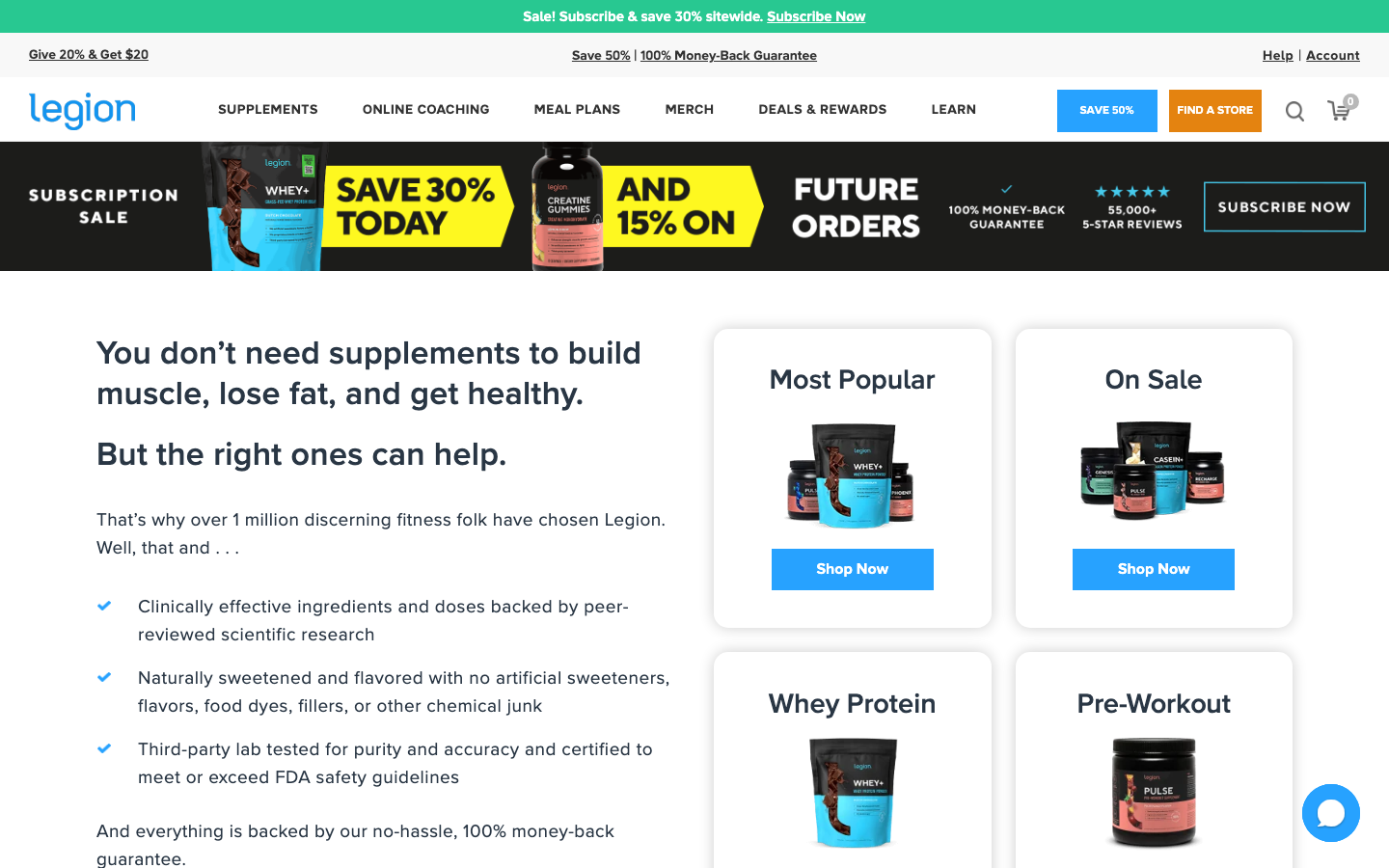
Legion's creatine sits in the middle of this list on price and doesn't carry the Creapure name, but the company publishes its own third-party lab results through Labdoor rather than asking buyers to take purity on faith. It's micronized, meaning the powder particles are broken down finer than standard creatine, which mostly shows up as better mixability in a shaker bottle. Legion also sells a separate "Recharge" post-workout blend with added HMB and tart cherry, but that's a different product from the plain monohydrate powder reviewed here.
- Type: Micronized creatine monohydrate
- Creatine per serving: 5g
- Servings per container: 60 (312g)
- Price: $29.99 (iHerb-listed price for the 312g unflavored size)
- Price per gram of creatine: ~$0.10
- Flavor: Unflavored, plus flavored options
- Third-party certification: Self-published Labdoor lab results; no NSF or Informed Choice certification found
- Rating: Not independently verified
Who it's for: buyers who want documented lab testing without paying the Creapure premium, and who don't need NSF Certified for Sport for drug-tested competition.
2. Muscle Feast Creapure Creatine Monohydrate
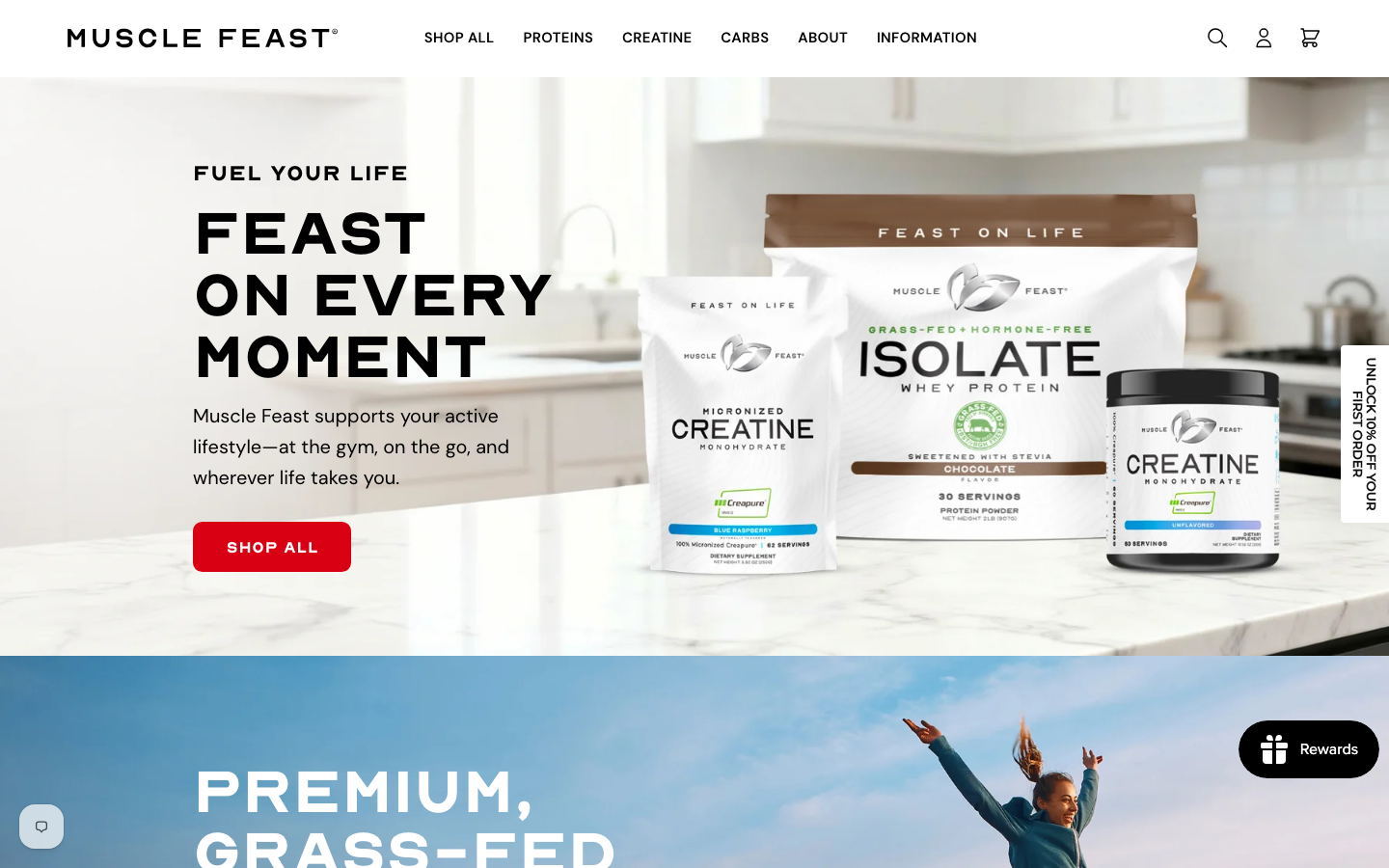
Muscle Feast sells its creatine under the Creapure name. That means the raw material comes from AlzChem's Trostberg, Germany facility, not a generic bulk supplier. The product page states a purity of at least 99.9%, and Muscle Feast publishes contaminant testing for the batch. It costs more per gram than the budget options on this list, but the sourcing is the most transparently documented of any product here.
- Type: Micronized Creapure creatine monohydrate
- Creatine per serving: 5g
- Servings per container: 60 (300g)
- Price: $37.90
- Price per gram of creatine: ~$0.13
- Flavor: Unflavored
- Third-party certification: Purity and contaminant tested; no NSF Certified for Sport disclosed on the product page
- Rating: Not independently verified
Who it's for: buyers who specifically want the Creapure name on the label and are willing to pay roughly 30% more per gram than the cheapest pick on this list for that sourcing guarantee.
3. Bare Performance Nutrition (BPN) Creatine Monohydrate
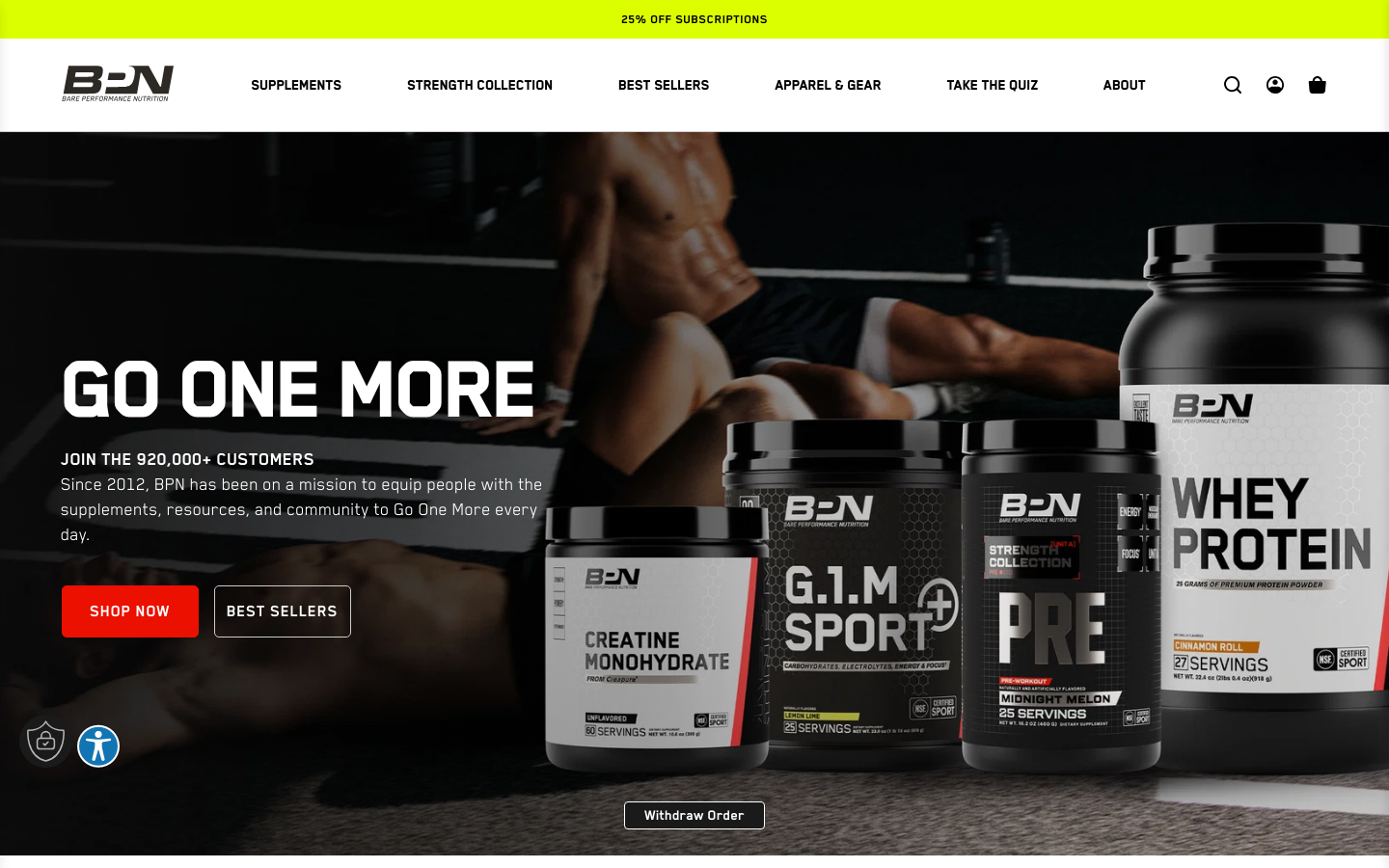
BPN combines Creapure sourcing with NSF Certified for Sport testing, which is the strongest certification pairing on this list. NSF Certified for Sport screens for more than 290 substances banned by major athletic governing bodies, and BPN's product also carries NSF Contents Certified status, which checks that the label matches what's actually in the tub. A subscription order brings the price down to roughly $0.09 per gram of creatine; a one-time purchase runs closer to $0.12.
- Type: Micronized Creapure creatine monohydrate
- Creatine per serving: 5g
- Servings per container: 60
- Price: $34.99 one-time, $26.24 with subscription
- Price per gram of creatine: ~$0.12 one-time, ~$0.09 subscription
- Flavor: Unflavored
- Third-party certification: NSF Certified for Sport, NSF Contents Certified, Kosher, Halal
- Rating: Not independently verified
Who it's for: competitive or drug-tested athletes who need documented banned-substance screening, not just a purity claim.
4. Promix Creatine Monohydrate
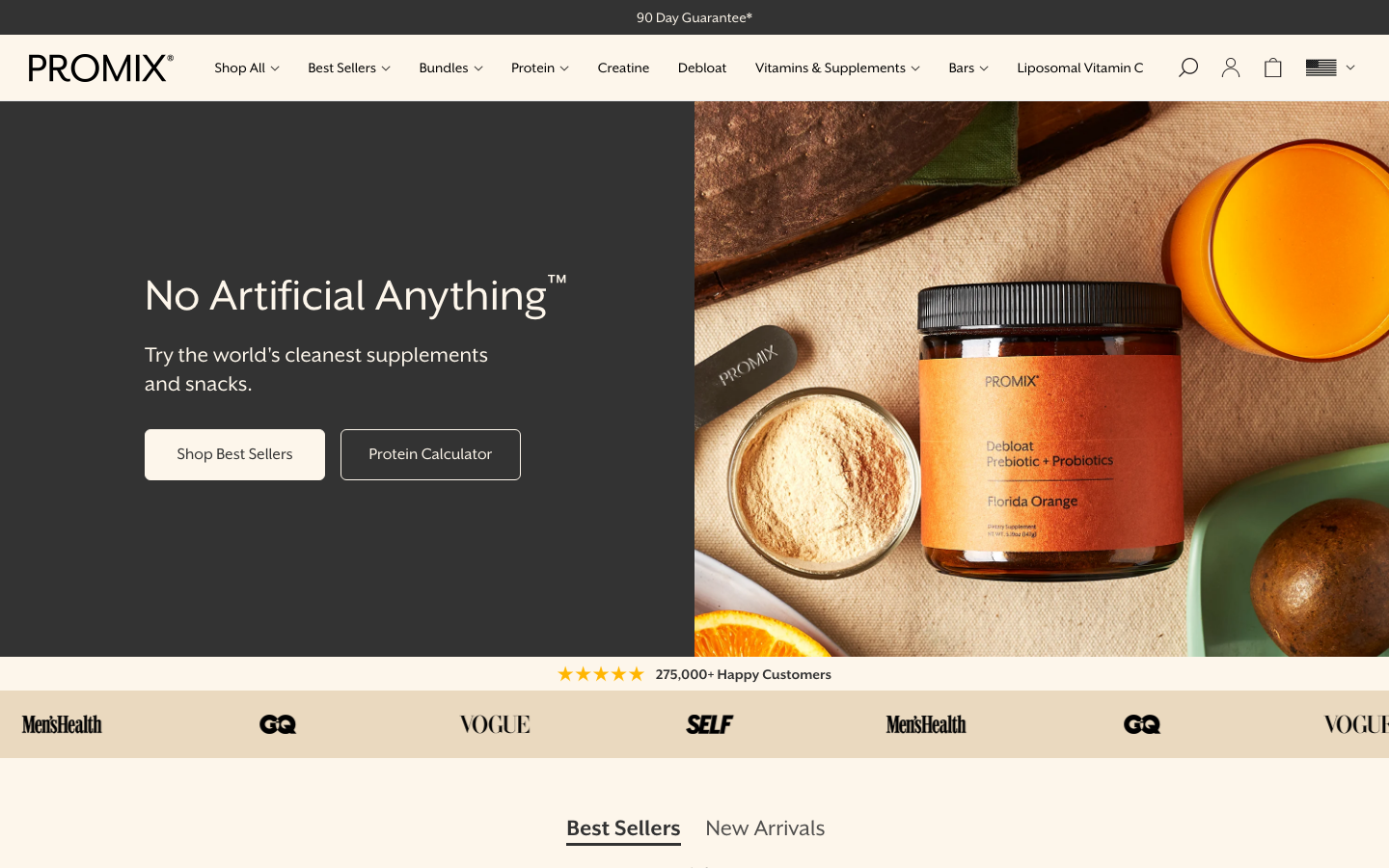
Promix is the value pick on this list by a wide margin. At roughly $0.03 per gram of creatine, it costs about a quarter of what the Creapure-branded options run. It carries NSF Certified for Sport testing, which counts for something even without the Creapure name. Promix just doesn't brand its raw material as Creapure, so the creatine's specific origin is documented less transparently than Muscle Feast's or BPN's.
- Type: Micronized creatine monohydrate
- Creatine per serving: 5g
- Servings per container: 180
- Price: $23.99 (Walmart-listed price)
- Price per gram of creatine: ~$0.03
- Flavor: Unflavored
- Third-party certification: NSF Certified for Sport
- Rating: Not independently verified
Who it's for: buyers who want NSF Certified for Sport testing on a budget and don't consider Creapure branding a requirement.
5. MyProtein Creatine Monohydrate
MyProtein is the cheapest option here on a per-serving basis, but its pricing is also the least stable: the brand runs frequent site-wide sales, and we saw the 100-serving size listed anywhere from $11.99 to $19.99 on MyProtein's own site depending on the promotion running that week, while third-party retailer Muscle & Strength lists the 200-serving size at a flat $29.99. Treat any single price quoted for this product as a snapshot, not a fixed number. MyProtein does not disclose Creapure sourcing or any third-party certification on its product page, which is the tradeoff for the low price. If you want the fuller picture on this brand across its protein and supplement lineup, see our MyProtein review.
- Type: Creatine monohydrate (micronization not specified on the product page)
- Creatine per serving: 5g (flavored versions run roughly 15% less creatine per serving)
- Servings per container: 45, 100, or 200, sold separately
- Price: Varies with promotions; seen at $11.99-$19.99 for the 100-serving size on myprotein.com and $29.99 for the 200-serving size at Muscle & Strength
- Price per gram of creatine: roughly $0.03-$0.04 depending on size and promotion
- Flavor: Unflavored (flavored versions available at reduced creatine content)
- Third-party certification: None disclosed
- Rating: Not independently verified
Who it's for: budget-focused buyers who don't need certification documentation and are comfortable with a brand that changes its pricing often.
6. Onnit Creatine Monohydrate
Onnit's official product page lists a single ingredient and no Creapure branding, but multiple third-party sourcing write-ups describe Onnit's creatine as coming from AlzChem in Germany, the same manufacturer behind Creapure. We could not confirm this on Onnit's own site. Treat the Creapure connection as third-party reported, not brand-confirmed. Pricing is another area where sources disagree: a January 2026 industry write-up listed the 90-serving size at an introductory $30.40, while the current onnit.com listing shows $37.99 for the same size. We're using the live, current onnit.com price here rather than the older promotional figure.
- Type: Creatine monohydrate
- Creatine per serving: 5g
- Servings per container: 90 (also sold in a 30-serving size)
- Price: $37.99 (current onnit.com listing; a January 2026 source reported $30.40 for the same size as an introductory price)
- Price per gram of creatine: ~$0.08 at the current listed price
- Flavor: Unflavored
- Third-party certification: IGEN Non-GMO Tested (per Amazon listing); no NSF or Informed Choice certification found on the official product page
- Rating: Not independently verified
Who it's for: buyers who want a single-ingredient product from a recognizable wellness brand and don't need certified sourcing documentation.
Creapure vs. Generic Creatine Monohydrate: What the Certification Actually Tests For
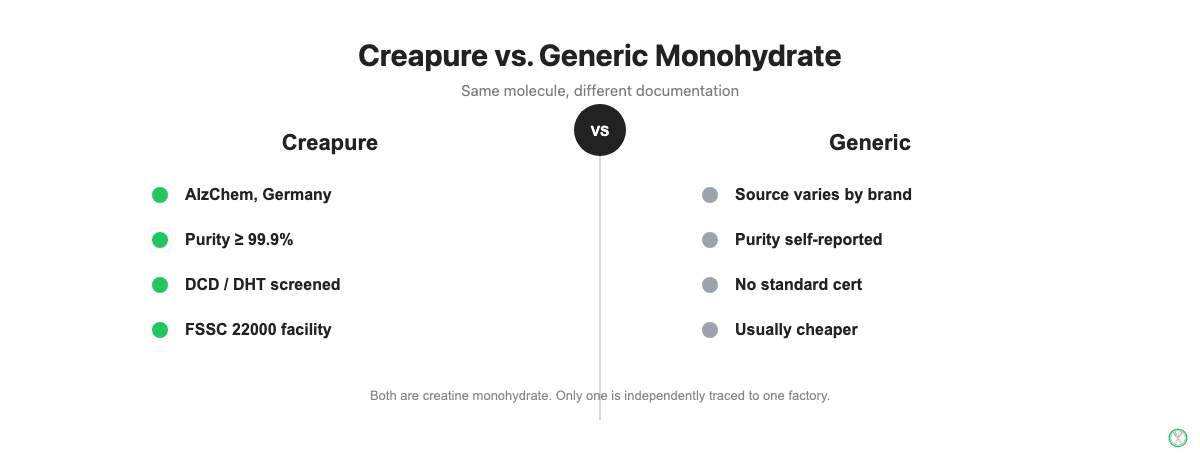
Creapure isn't a different chemical from generic creatine monohydrate. It's the brand name for creatine monohydrate manufactured by AlzChem Trostberg GmbH at a dedicated facility in Trostberg, Germany, using a controlled synthesis process. The reason it commands a price premium is what gets tested and guaranteed at the batch level, not a different molecule.
Independent lab analysis of Creapure batches has confirmed purity at or above 99.9%. Each batch is screened for two specific manufacturing byproducts: dicyandiamide (DCD), which is kept below 20 mg/kg, and dihydrotriazine (DHT), which testing shows as undetectable. Heavy metals, including lead, arsenic, cadmium and mercury, are also tested and kept below detection limits. AlzChem's facility operates under FSSC 22000 certification, a food-safety standard.
Generic creatine monohydrate, the kind used by brands that don't pay for Creapure licensing, can still be pure and safe. The difference is documentation: without the Creapure name, a buyer is trusting the individual brand's own testing claims rather than a standardized, independently verified process tied to a specific manufacturer. Of the six products above, Muscle Feast and BPN both use Creapure by name. Onnit is reported by third parties to source from AlzChem but doesn't use the Creapure brand on its own packaging or site. Legion, Promix, and MyProtein all use generic monohydrate with their own testing claims layered on top, ranging from Promix's NSF Certified for Sport screening to MyProtein's undisclosed sourcing.
Micronized vs. Standard Monohydrate: Why Particle Size Changes Mixability, Not Results
"Micronized" on a creatine label refers to particle size, not a different form of the molecule. Micronized creatine monohydrate particles are roughly 20 times smaller than standard creatine monohydrate particles. That size difference is a physical property, and it plays out in one place: how the powder behaves in a shaker bottle. Smaller particles have more surface area relative to their volume, which lets them dissolve into water faster and leave less grit at the bottom of the glass.
What micronization does not change is how much creatine your muscles absorb or how much benefit you get from it. Research comparing standard and micronized creatine monohydrate has not found a meaningful difference in muscle phosphocreatine saturation between the two forms when the daily dose is the same. The International Society of Sports Nutrition's position is that no form of creatine has demonstrated superior muscle uptake compared to standard monohydrate. Absorption is limited by how much creatine your muscle's transport mechanism can take up at a given time, not by how quickly the powder dissolves in your glass. Of the six picks above, Legion, Muscle Feast, BPN, and Promix are explicitly labeled micronized; Onnit and MyProtein don't specify particle size on their product pages, which doesn't tell you anything about effectiveness, only about how much grit you might notice when you mix it.
Price Per Gram of Creatine: What You're Actually Paying For
Sticker price on a tub of creatine tells you almost nothing on its own, because servings per container and grams per serving both swing the real cost. The number that actually matters is price per gram of creatine delivered, calculated as total price divided by (servings times grams per serving). Here's how the six picks compare:
| Product | Price | Total Grams Creatine | $/g Creatine |
|---|---|---|---|
| Promix Creatine Monohydrate | $23.99 | 900g (180 x 5g) | ~$0.03 |
| MyProtein Creatine Monohydrate (200-serving) | $29.99 | 1,000g (200 x 5g) | ~$0.03 |
| Legion Athletics Micronized Creatine Monohydrate | $29.99 | 300g (60 x 5g) | ~$0.10 |
| Onnit Creatine Monohydrate | $37.99 | 450g (90 x 5g) | ~$0.08 |
| BPN Creatine Monohydrate | $34.99 | 300g (60 x 5g) | ~$0.12 |
| Muscle Feast Creapure Creatine Monohydrate | $37.90 | 300g (60 x 5g) | ~$0.13 |
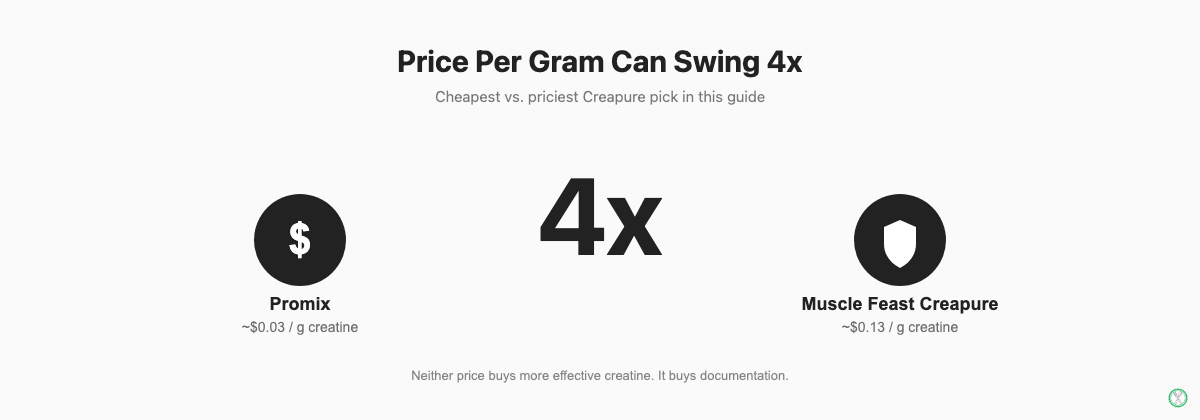
The spread here is real: Promix and the bulk MyProtein size run about four times cheaper per gram than Muscle Feast's Creapure powder. That gap is the Creapure premium plus, in BPN's case, the added cost of NSF Certified for Sport testing. Neither premium buys you more effective creatine milligram for milligram. What it buys is documentation: a verified manufacturing source, contaminant screening, or banned-substance testing, depending on the product. Whether that's worth roughly $0.09-$0.10 extra per gram is a question of how much you value third-party verification versus raw cost, not a question of which product works better.
Third-Party Testing: NSF Certified for Sport, Informed Choice, and What "Certified" Actually Means
Two of the six products on this list carry real third-party athletic certifications. BPN and Promix are both NSF Certified for Sport, a program that requires products to be made in a cGMP-compliant facility and tested for more than 290 substances banned by major sports governing bodies, including the NFL, NBA, MLB, and many Olympic federations. Informed Choice and Informed Sport, run by a different testing body, provide a similar batch-tested guarantee, though none of the six products reviewed here carry that specific certification based on their current product pages.
Legion publishes its own third-party lab results through Labdoor rather than enrolling in NSF's or Informed Choice's certification programs. That's a meaningfully different guarantee: it verifies label accuracy and general purity, but it isn't the same as banned-substance screening for competitive sport. Onnit's IGEN Non-GMO Tested certification addresses a different question entirely (genetic modification status, not banned substances or contaminants). Muscle Feast publishes purity and contaminant testing but doesn't carry NSF Certified for Sport. MyProtein discloses no third-party testing on its product page.
If you're a drug-tested athlete, NSF Certified for Sport or Informed Choice/Informed Sport is the certification to look for specifically, not just any third-party testing claim. Of these six, that narrows the field to BPN and Promix.
How Much Creatine Monohydrate to Take: Loading Phase vs. Daily Maintenance
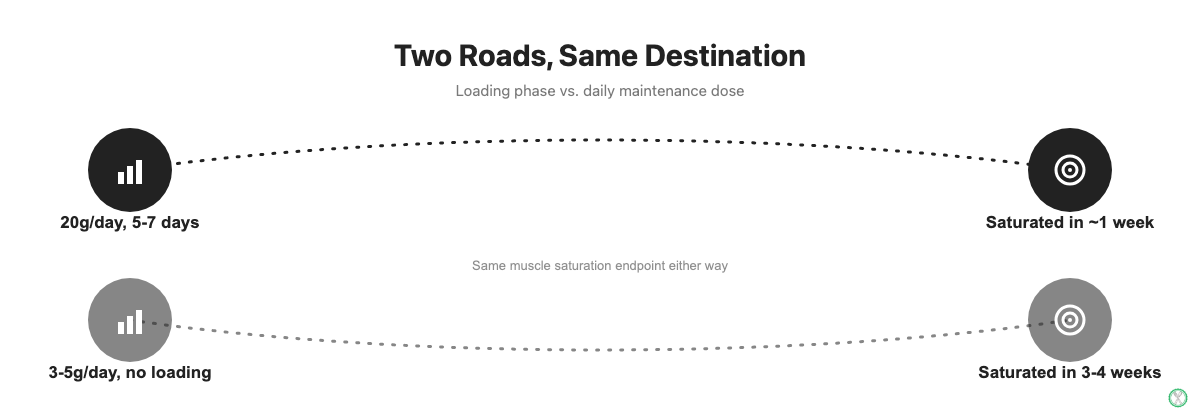
There are two common dosing approaches. The research behind both is old and consistent, though the studies frame the comparison a bit differently.
The loading approach uses roughly 20 grams per day, split into 4 doses of about 5 grams each, for 5 to 7 days, followed by a maintenance dose of 3 to 5 grams per day. A widely cited 1996 study by Hultman and colleagues compared this loading protocol against a straight 3 grams per day with no loading phase at all, and found that muscle creatine stores reached the same saturation point in both groups by day 28. The loading group just got there faster, in about a week instead of three to four weeks.
A 2021 review published in the Journal of the International Society of Sports Nutrition by Antonio and colleagues reached a similar conclusion but framed the loading dose slightly differently, describing it as up to roughly 20 grams per day for up to 7 days as sufficient to produce measurable benefits, with or without a subsequent maintenance phase of 3 to 5 grams per day. The two sources agree on the core finding (loading accelerates saturation without changing the end result) but don't use identical numbers for the loading window, so if you see "5 days" in one place and "7 days" in another, that's a real variation in the underlying research, not an error.
The practical takeaway: if you want faster results and can tolerate the higher short-term dose (some people report mild stomach discomfort at 20 grams per day, since that's typically 4 separate servings), load for 5 to 7 days, then drop to a 3-5 gram daily maintenance dose. If you'd rather skip the higher initial dose entirely, taking 3 to 5 grams per day from the start gets you to the same muscle saturation level in three to four weeks. Neither approach requires cycling off creatine once you're on a maintenance dose; there's no evidence that continuous daily use loses effectiveness over time.
How We Chose These 6 Products
Every product on this list is a single-ingredient creatine monohydrate powder. Not a blend, not a capsule-first format, and not one of the picks already covered in our broader creatine buying guide or our men's and women's guides. Prices, serving counts and certification claims were checked against each brand's current product page or a named retailer listing, not assumed from past reviews. Every price is dated to this writing, since supplement pricing shifts with promotions. We also considered and rejected Genius Creatine for this specific list: it markets itself as a creatine product, but its formula is a tri-blend with added CarnoSyn beta-alanine and AstraGin, which makes it a blend rather than the single-ingredient monohydrate this guide is scoped to.
None of the six products carry a star rating from our own testing. We marked each one "Not independently verified" in its key-facts block instead of borrowing a rating from a retailer page or inventing one. Where two credible sources disagreed on a price or a sourcing claim, as with Onnit's pricing and Creapure sourcing, we reported both figures instead of picking one.
Frequently Asked Questions
Is Creapure worth the extra cost over generic creatine monohydrate?
Creapure and generic creatine monohydrate are the same molecule; the premium buys documented sourcing and contaminant testing from a single verified manufacturer, not a more effective supplement. If third-party purity documentation matters to you, it's worth the roughly $0.09-$0.10 extra per gram seen in this list. If it doesn't, a generic NSF Certified for Sport product like Promix delivers the same creatine at a much lower price.
Do I need to do a loading phase, or can I just start with 3-5 grams a day?
You don't need to load. Research shows a daily 3-5 gram dose reaches the same muscle saturation as a loading protocol, it just takes three to four weeks instead of about a week. Loading is a speed option, not a requirement.
Does micronized creatine work better than regular creatine monohydrate?
No. Micronization affects how well the powder dissolves and mixes, not how much creatine your muscles absorb. Choose micronized if you dislike gritty texture in your shaker bottle; choose standard if the price is lower and mixability doesn't bother you.
Does mixing creatine with water versus juice change how well it works?
No meaningful difference has been shown between mixing creatine monohydrate in plain water versus juice or another beverage. Some people find it dissolves a bit more easily in warm water, but this is a mixability preference, not an effectiveness factor.
Why does third-party testing matter if I'm not a competitive athlete?
Certifications like NSF Certified for Sport also verify that a product's label matches what's actually inside and that it's free of contaminants, which is relevant even if you're never drug-tested. If you're not competing under a sport-testing body, it's a quality signal rather than a requirement.
Does flavored creatine monohydrate contain less creatine than unflavored?
Sometimes. At least one brand on this list, MyProtein, discloses that its flavored versions contain roughly 15% less creatine per serving than the unflavored version, since some of the serving volume goes to flavoring and sweetening. Check the supplement facts panel rather than assuming flavored and unflavored servings match.
This article summarises general information and does not replace advice from a doctor or dietitian. If you have a medical condition, are pregnant or breastfeeding, or for children, talk to your doctor before changing your diet or taking supplements.