
Best Creatine for Men: 6 Real Picks for 2026
 Lisa BenzFounder and editor-in-chief · Text and research
Disclosure: this article may contain partner links. If you buy through them, we earn a commission at no extra cost to you. The ranking is set by our editors.
Contents
- The Best Creatine Supplements for Men at a Glance
- How Much Creatine Should Men Take?
- Does Creatine Raise Testosterone?
- Does Creatine Cause Hair Loss?
- Is Creatine Safe for Your Kidneys?
- What Drug-Tested Athletes Need to Check Before Buying
- The Best Creatine Supplements for Men, Reviewed
- How We Chose These Picks (What to Avoid)
- Frequently Asked Questions
Most men researching creatine already know the basic pitch: it helps you lift more and recover faster. What trips people up is everything else: the dosing math, the testosterone rumors, the hair loss scare stories, and whether a "third-party tested" label means anything. This guide answers those questions with real studies. Then it walks through six creatine monohydrate products worth buying, each one verified against live pricing and certification data.
The Best Creatine Supplements for Men at a Glance
Creatine monohydrate is the form worth buying, full stop. It has more research behind it than every other form combined, and nothing on the market has been shown to outperform it for strength or muscle gains. The six picks below cover the main tradeoffs: budget, verified drug-tested certification, purity documentation and capsule convenience.
| Pick | Best for | Price per serving | Certification |
|---|---|---|---|
| Optimum Nutrition Micronized Creatine | Widest availability | $0.36-$0.66 (verify at purchase) | Informed Choice certified |
| Cellucor COR-Performance Creatine | Drug-tested athletes | $0.14-$0.36 (verify at purchase) | NSF Certified for Sport |
| NutraBio Creatine Monohydrate | Published purity data | $0.36-$0.40 (verify at purchase) | Third-party batch tested |
| Jacked Factory Creatine Monohydrate | Budget with certification | $0.18-$0.41 (verify at purchase) | Informed Choice certified |
| Allmax Creatine Monohydrate | Bulk value | $0.13-$0.27 (verify at purchase) | Brand-claimed WADA testing |
| MuscleTech Platinum 100% Creatine | Capsule format | $0.56-$0.62 (verify at purchase) | Not NSF Certified for Sport |
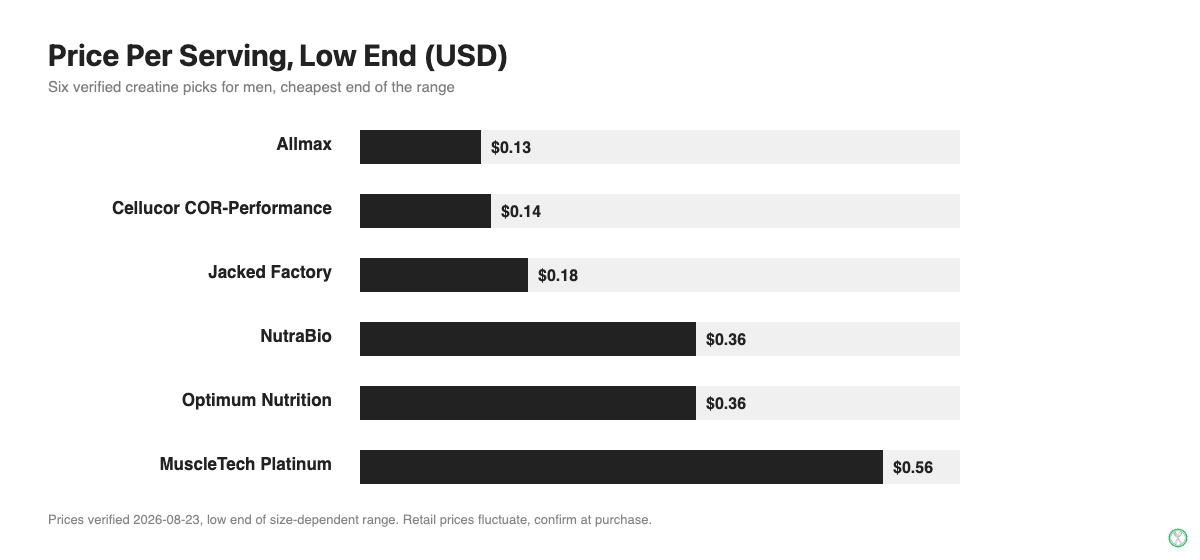
The chart above lines up price per serving across all six picks so you can see the spread before reading the full reviews. Now for the parts most buying guides skip. How much to take, and what the hormone and kidney myths say.
How Much Creatine Should Men Take?
Most men need 3 to 5 grams of creatine monohydrate per day, taken any time, with or without food. That single number covers the maintenance dose recommended by the International Society of Sports Nutrition (ISSN) 2017 position stand on creatine safety and efficacy, and it works whether you weigh 150 pounds or 230 pounds.
Body size matters more for the loading phase, which is optional. The ISSN protocol calls for about 20 grams a day, split into four 5-gram doses, for 5 to 7 days, followed by the standard 3 to 5 gram maintenance dose. Loading saturates your muscle creatine stores faster, usually within a week instead of the three to four weeks a flat maintenance dose takes on its own. Larger men with more muscle mass to saturate often lean toward the higher end of that maintenance range: 5 grams instead of 3, once loading ends. Some sports-nutrition guidance goes further for heavier or bigger-framed athletes, using a rough weight-based rule of about 0.03g per kilogram of body weight, which works out closer to 7 or 8 grams a day for a 220-pound man. That figure is not part of the core ISSN dosing table, so treat it as an upper-range option for larger athletes rather than a universal requirement.
- Loading phase: about 20g/day (4 doses of 5g) for 5-7 days, then drop to maintenance
- No loading: a flat 3-5g/day dose reaches the same saturation point in about 3-4 weeks
- Both approaches land at the same place; loading just gets there faster
Neither approach requires cycling off. The ISSN position stand states there is no evidence that short or long-term use of creatine monohydrate, including continuous daily use for years, causes harm in healthy people at these doses.
Does Creatine Raise Testosterone?
No, creatine monohydrate does not meaningfully raise testosterone. This is one of the most repeated claims in gym culture, and it does not hold up against the actual research. The 2017 ISSN position stand, which reviewed decades of creatine research, does not list testosterone elevation among creatine's effects, and controlled studies that measured resting testosterone directly have not found a consistent increase.
The most-cited study in this debate, a 2009 trial in college-aged rugby players, is evidence against the testosterone claim. Serum testosterone stayed flat in that study, even during a high-dose loading phase. A newer 12-week randomized controlled trial from 2025 confirms the same pattern with a modern, placebo-controlled design: testosterone rose slightly over the study period in both the creatine and placebo groups, which points to normal training-related change rather than anything creatine caused. What changed in the 2009 trial was a different hormone, and that shift is the source of a separate, more persistent myth covered next.
Does Creatine Cause Hair Loss?
No, a 2025 randomized controlled trial that directly measured hair health found no link between creatine and hair loss. That trial exists specifically because the original 2009 scare study never measured hair at all, only a hormone ratio, and the internet ran with an assumption the data never supported.
Here is what the study did. Researchers van der Merwe, Brooks and Myburgh recruited 20 college-aged male rugby players for a double-blind, placebo-controlled crossover trial, published in the Clinical Journal of Sport Medicine (2009, 19(5):399-404). One group loaded with 25 grams of creatine a day for 7 days, then dropped to a 5 gram maintenance dose for 14 days. The other group took a matched glucose placebo on the same schedule. The two groups then swapped after a six-week washout period.
The researchers drew blood and measured hormone levels, not hair. Serum testosterone did not change in a statistically meaningful way. Dihydrotestosterone (DHT), a testosterone byproduct linked to male-pattern baldness in men who are genetically predisposed to it, rose 56% after the loading week. The ratio of DHT to testosterone increased 36% after loading and stayed about 22% above baseline through the two-week maintenance phase.
For sixteen years, that hormone-ratio shift in 20 athletes was the entire evidence base behind the internet's "creatine causes hair loss" claim, with no hair counts, no scalp photography and no shedding measurements taken at any point. A rise in a hormone linked to hair loss is not the same thing as documented hair loss.
In 2025, researchers finally closed that gap. A double-blind, randomized controlled trial (Lak et al., Journal of the International Society of Sports Nutrition, 2025) put 38 men through 12 weeks on either 5g daily creatine monohydrate or a placebo, then measured actual hair outcomes: density, hair count, follicular units and shaft thickness, alongside DHT and testosterone. The result was no statistically significant difference between groups on any hair measurement, and no meaningful difference in DHT, testosterone, or the DHT:T ratio either. The study authors called it the first direct assessment of hair follicle health following creatine supplementation, and described their result as strong evidence against the idea that creatine contributes to hair loss.
If you already have a strong family history of male-pattern baldness, that context is still worth knowing before starting any supplement. If you do not, both the 2009 hormone study and the 2025 trial that checked hair directly point the same direction: creatine is not a reason to worry about your hairline.
Is Creatine Safe for Your Kidneys?
Yes, creatine monohydrate is safe for the kidneys in the large majority of healthy adults taking standard doses, though the evidence is not perfectly unanimous. A systematic review and meta-analysis pooling 12 studies (177 people on creatine versus 263 controls) found only a modest, transient rise in serum creatinine, and a smaller pool of 5 studies measuring actual filtration rate (69 people on creatine versus 74 controls) found no meaningful change in kidney function. That is the strongest available evidence, and it lines up with the ISSN position stand, which found no evidence of harm from long-term creatine use in healthy people at standard doses.
The exception worth knowing about is a single published case report of an 18-year-old with no prior kidney problems who developed acute kidney injury after a standard creatine protocol, 20g/day loading for 5 days followed by a low maintenance dose. It is one documented case against a much larger body of research showing no harm, so it does not overturn the overall safety picture, but it is a real, citable exception rather than internet speculation.
The more common wrinkle is creatinine itself. Creatine supplementation raises blood creatinine, a waste product doctors use to estimate kidney function on a standard metabolic panel. That rise usually reflects higher creatine turnover, not kidney damage, but it can make routine bloodwork look abnormal to a doctor who does not know you supplement. Mention it at your next physical. If you already have diagnosed kidney disease, talk to your doctor before starting creatine, since the case report above and most clinical guidance both point toward avoiding it without medical supervision if your kidneys are already compromised.
What Drug-Tested Athletes Need to Check Before Buying
If you compete in a drug-tested sport, check for NSF Certified for Sport specifically, not just a generic "third-party tested" label on the package. NSF Certified for Sport is a named, product-level certification you can verify yourself against NSF's public product list. It is the standard most collegiate and professional drug-testing programs recognize.
- Look for the NSF Certified for Sport logo on the label, then confirm the exact product on nsfsport.com's certified product search
- "Third-party tested" and "banned substance tested" on their own are marketing phrases, not certifications; they can mean anything from a real lab program to an internal quality check
- Informed Choice/Informed Sport is a separate, legitimate certification (used by Optimum Nutrition and Jacked Factory in this roundup), but confirm which specific program a brand is claiming before you trust it for a drug-tested competition
- Facility-level certifications (a factory that is NSF-certified for manufacturing practices) are not the same as a product being NSF Certified for Sport; check the product, not just the factory
Of the six picks in this guide, Cellucor COR-Performance Creatine is the one confirmed on NSF's official Certified for Sport product list at the time of writing. That status can change as certifications expire and renew, so competitive athletes should still verify current status directly on nsfsport.com before a purchase that matters for testing.
The Best Creatine Supplements for Men, Reviewed
Every pick below is creatine monohydrate, the only form with strong, consistent research behind it. None of these overlap with the picks already covered in our general best creatine guide or our best creatine for women picks, so treat this as a complementary shortlist rather than a repeat of either.
Optimum Nutrition Micronized Creatine Monohydrate Powder
Optimum Nutrition is one of the most widely stocked sports nutrition brands in the US, and its creatine line is a common first purchase for men new to strength training. Its creatine is Informed Choice certified, which means LGC Limited tests it for over 250 banned substances on an ongoing schedule. It is a single-ingredient product with no flavoring or filler, sold in both unflavored powder and capsule formats, and large container sizes bring the per-serving cost down for anyone buying for the long haul.
| Attribute | Detail |
|---|---|
| Type | Monohydrate |
| Dose per serving | 5g (powder); 2.5g per capsule serving |
| Price per serving | $0.36-$0.66, varies by container size (verify at purchase) |
| Third-party testing | Informed Choice certified |
| Format | Unflavored powder or capsules |
| Rating | Not independently verified |
Cellucor COR-Performance Creatine
Cellucor's COR-Performance line carries NSF Certified for Sport status, confirmed directly on NSF's official certified-product list, which makes it the clearest pick in this roundup for collegiate or professional athletes who face drug testing. It comes in flavored and unflavored versions, with the unflavored option running noticeably cheaper per gram.
| Attribute | Detail |
|---|---|
| Type | Monohydrate |
| Dose per serving | 5g |
| Price per serving | $0.14-$0.36, flavor and size dependent (verify at purchase) |
| Third-party testing | NSF Certified for Sport (confirmed on official list) |
| Format | Flavored or unflavored powder |
| Rating | Not independently verified |
NutraBio Creatine Monohydrate
NutraBio built its reputation on publishing batch-level purity data for every supplement it sells, and its creatine monohydrate (branded PharmaPure) is marketed at 99.98% purity with third-party testing through the brand's CheckMySupps program. The company manufactures in the US under FDA cGMP rules and sells unflavored and flavored versions at several container sizes. It is not on NSF's Certified for Sport list, so treat it as a purity-focused pick for general training rather than a drug-tested-athlete pick.
| Attribute | Detail |
|---|---|
| Type | Monohydrate (PharmaPure branded) |
| Dose per serving | 5g |
| Price per serving | $0.36-$0.40, depending on container size (verify at purchase) |
| Third-party testing | Third-party batch tested (CheckMySupps); not NSF Certified for Sport |
| Format | Unflavored or flavored powder |
| Rating | Not independently verified |

Jacked Factory Creatine Monohydrate
Jacked Factory's creatine is Informed Choice certified and vegan, and it is one of the cheapest per-serving certified options on the market for men who want proof of testing without paying a premium brand markup. It skips flavoring and mix-ins, so the ingredient list stays down to just creatine monohydrate, and it comes in scoop sizes ranging from small trial containers up to bulk 200-serving tubs.
| Attribute | Detail |
|---|---|
| Type | Monohydrate |
| Dose per serving | 5g |
| Price per serving | $0.18-$0.41, size dependent (verify at purchase) |
| Third-party testing | Informed Choice certified |
| Format | Unflavored powder, vegan |
| Rating | Not independently verified |
Allmax Creatine Monohydrate
Allmax sells its creatine in large containers that push the per-serving price down further than most of this list, and the brand states it sources German Creapure-processed creatine through what it calls its CreaMax micronization method. The brand also claims third-party testing against WADA's banned substance list. That claim is a brand statement, not a named, independently checkable certification program.
| Attribute | Detail |
|---|---|
| Type | Monohydrate (brand states German Creapure-sourced) |
| Dose per serving | 5g |
| Price per serving | Approx. $0.13-$0.27 in large containers (verify at purchase) |
| Third-party testing | Brand-claimed WADA banned-substance testing; not an independently confirmed named program |
| Format | Unflavored powder |
| Rating | Not independently verified |
MuscleTech Platinum 100% Creatine
Some men would rather swallow a capsule than mix a scoop into water. MuscleTech's Platinum line is a capsule option sold at most mainstream retailers. Retail listings describe the creatine source as Creapure, but MuscleTech's own product page does not confirm this the way some competitors do. Treat that detail as retailer-reported, not brand-confirmed.
| Attribute | Detail |
|---|---|
| Type | Monohydrate (Creapure per retail listings) |
| Dose per serving | 2.5g per serving (2 capsules) |
| Price per serving | $0.56-$0.62 (verify at purchase) |
| Third-party testing | Not confirmed on the NSF Certified for Sport list |
| Format | Capsules |
| Rating | Not independently verified |
How We Chose These Picks (What to Avoid)
Every product on this list is single-ingredient or near-single-ingredient creatine monohydrate with a label that discloses its exact dose per serving. That ruled out a lot of the market.
- Skip proprietary blends that list "creatine complex" without a gram amount, you cannot verify the dose
- Skip anything claiming a novel creatine form "outperforms" monohydrate without citing a head-to-head study; the ISSN position stand has not found evidence for this in any alternative form
- Be skeptical of gummies, since creatine can degrade in the moist, heated manufacturing process gummies require, and independent testing has flagged some gummy products as underdosed relative to the label
- If a drug test matters to you, confirm NSF Certified for Sport status directly on nsfsport.com rather than trusting a package claim
Frequently Asked Questions
Do I need to do a loading phase?
No, a loading phase is optional. Skipping it and taking a flat 3-5g daily dose reaches full muscle saturation in about three to four weeks, roughly the same place a loading phase reaches in about one week.
Can I take creatine every day, including rest days?
Yes, and you should. Creatine works by keeping your muscle stores saturated over time, not by giving you an acute boost on training days, so daily use including rest days is the standard recommendation.
Is creatine powder or capsules better for men?
Neither is better for absorption, since both deliver the same creatine monohydrate once it dissolves. Capsules cost more per gram and usually require more of them to hit a full 5g dose, so powder is the cheaper option if you do not mind mixing it into water.
Will creatine make me gain weight?
Some initial weight gain is normal in the first week or two, and it comes from water pulled into your muscle cells, not body fat. It is a sign creatine is saturating your muscle stores, not a red flag.
Should I cycle off creatine periodically?
No, cycling off is not necessary. The ISSN position stand found no evidence that continuous long-term use causes harm in healthy adults, and cycling does not appear to add any performance benefit.
Is creatine worth it if I am not trying to bulk up?
Yes, creatine's benefits extend beyond size. Research also links it to improved high-intensity exercise capacity and power output, which matters for strength athletes and anyone doing repeated short bursts of hard effort, not just men chasing muscle mass.
This article summarises general information and does not replace advice from a doctor or dietitian. If you have a medical condition, are pregnant or breastfeeding, or for children, talk to your doctor before changing your diet or taking supplements.
Sources
These sources are cited and linked in the article:
- International Society of Sports Nutrition (ISSN) 2017 position stand ncbi.nlm.nih.gov
- published in the Clinical Journal of Sport Medicine (2009, 19(5):399-404) pubmed.ncbi.nlm.nih.gov
- Lak et al., Journal of the International Society of Sports Nutrition, 2025 pmc.ncbi.nlm.nih.gov
- systematic review and meta-analysis pmc.ncbi.nlm.nih.gov
- single published case report pmc.ncbi.nlm.nih.gov