
Best Creatine for Women: 6 Real Picks for 2026
 Lisa BenzFounder and editor-in-chief · Text and research
Disclosure: this article may contain partner links. If you buy through them, we earn a commission at no extra cost to you. The ranking is set by our editors.
Contents
- How we picked these six
- The 6 best creatine supplements for women (2026)
- Side-by-side comparison
- How much creatine should women actually take?
- Do you need a loading phase?
- Creatine and water retention: monohydrate vs. HCl
- Creatine and the menstrual cycle: what the research says
- Is creatine safe during pregnancy or breastfeeding?
- Creatine and protein: do you need both?
- FAQ
Most "best creatine" lists are written for men and then relabeled for women by swapping in a pink label. That skips real physiology. Women carry 70-80% lower baseline creatine stores than men and respond differently to loading protocols. Pregnancy, breastfeeding and the menstrual cycle also raise safety questions a generic list never touches. This guide picks six creatine products with verifiable specs, none of which overlap with our general best creatine supplements roundup. Then it answers what that roundup does not: how much to take based on body weight, whether a loading phase is worth the bloating, and what the clinical research says about pregnancy and breastfeeding.
How we picked these six
We verified every price, dose and serving count against at least two live retailer or manufacturer sources as of August 2026. Where a product carries an independent testing program, Informed Sport, iTested, or an equivalent lot-tested certification, we named it. Where it doesn't, we said so instead of assuming. We also spread the picks across three formats: monohydrate powder, monohydrate gummies and creatine HCl. That way this list helps you choose a form, not just a brand. No invented star ratings. Where a reliable aggregate rating wasn't independently confirmable, the key-facts block says so.
The 6 best creatine supplements for women (2026)
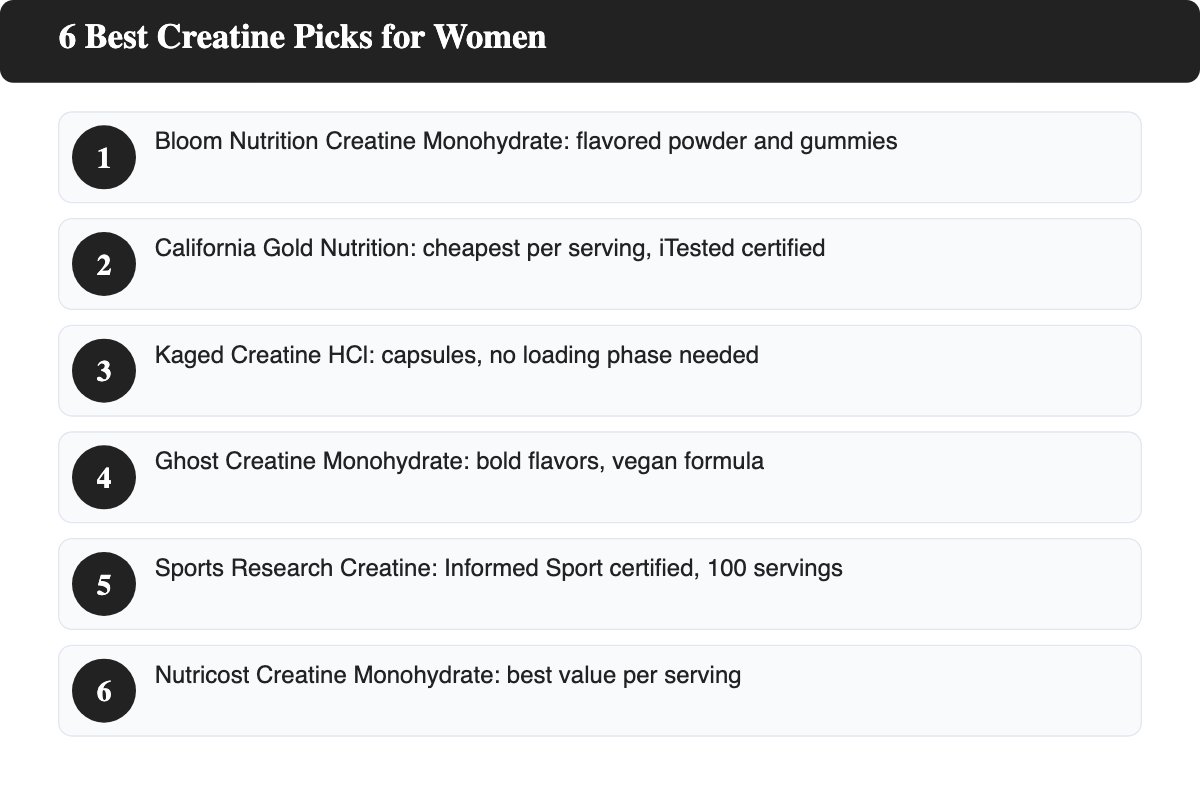
1. Bloom Nutrition Creatine Monohydrate
Bloom built its business on a female fitness-and-wellness audience, and its creatine line reflects that: a flavored powder option (Raspberry Lemon) alongside unflavored, plus a sugar-free gummy version for anyone who wants to skip mixing a scoop into water entirely. The 5 g dose matches the clinically studied range, and the ingredient list is a single active plus flavoring, nothing proprietary-blended into an under-dosed mix. The tradeoff is that Bloom doesn't publish a named third-party sport-testing program the way Informed Sport-certified brands do, which matters more if you're a tested athlete than if you're lifting for general strength.
- Type: Creatine monohydrate (micronized)
- Dose per serving: 5 g
- Servings per container: 40
- Price: ~$19.98 (powder)
- Flavor options: Unflavored, Raspberry Lemon; gummies in Berry Boost and Orange Squeeze
- Third-party tested: No named sport-certification program confirmed; label states non-GMO, gluten-free
- Rating: Not independently verified across retailers at time of writing
2. California Gold Nutrition Creatine Monohydrate
This is the clean, no-frills option: one ingredient, micronized for better mixability, made in a cGMP-audited US facility, and run through iHerb's iTested third-party verification program for purity and potency. At roughly $0.19 per 5 g serving in the 1 lb tub, it's one of the cheapest independently-tested monohydrates you can buy, which matters if you're taking it daily for months. It's unflavored only, so if taste or mix-in convenience is a priority, look at Bloom or Ghost instead.
- Type: Creatine monohydrate (micronized)
- Dose per serving: 5 g
- Servings per container: ~91 (1 lb / 454 g tub)
- Price: ~$17.41 (1 lb tub)
- Flavor options: Unflavored only
- Third-party tested: Yes, iHerb iTested program, cGMP-audited US facility
- Rating: Not independently verified across retailers at time of writing
3. Kaged Creatine HCl
Kaged's C-HCl is the pick if plain monohydrate leaves you gassy or bloated. Creatine HCl is roughly 40-60 times more soluble than monohydrate, so the effective dose is much smaller (Kaged's capsules are 750 mg each), and it skips the loading-phase water surge entirely. The catch: at label-recommended intake, most people land under the 3-5 g range that the bulk of the clinical research is built on unless they take multiple servings, so read the "how much per day" section below before assuming one capsule is equivalent to a full monohydrate dose.
- Type: Creatine HCl (patented C-HCl)
- Dose per serving: 750 mg per capsule (label allows up to 4 servings/day if no other creatine source is used)
- Servings per container: 75
- Price: ~$29.86
- Flavor options: Unflavored capsules; powder also available in Fruit Punch
- Third-party tested: Yes, Informed Sport certified
- Rating: Not independently verified across retailers at time of writing
4. Ghost Creatine Monohydrate
This brand leans hardest into flavor, with rotating collaboration flavors like Warheads Sour Watermelon and Welch's Grape alongside a plain unflavored SKU. The dose is a straightforward 5 g monohydrate scoop, vegan and free of soy and added sugar. No named third-party sport-certification program covers this specific SKU, though some other Ghost lines do carry certifications. Drug-tested athletes should verify current lot documentation before buying instead of assuming certification carries across the whole product family.
- Type: Creatine monohydrate
- Dose per serving: 5 g
- Servings per container: 50 (unflavored) / 40 (flavored)
- Price: ~$24.99
- Flavor options: Unflavored, Warheads Sour Watermelon, Welch's Grape, Cherry Limeade, Strawbango
- Third-party tested: No named sport-certification program confirmed for this SKU
- Rating: Not independently verified across retailers at time of writing
5. Sports Research Creatine Monohydrate
Sports Research is the safest default if you want a tested, unflavored monohydrate at a reasonable price and don't care about branding. It's Informed Sport certified, which means every lot is screened for banned substances, a real advantage for competitive athletes over brands that only claim general purity. The 100-serving size works out to roughly $0.25-0.28 per 5 g dose, competitive with the cheaper options on this list once you factor in the certification.
- Type: Creatine monohydrate (micronized)
- Dose per serving: 5 g
- Servings per container: 100 (17.64 oz)
- Price: ~$25-28
- Flavor options: Unflavored, Fruit Punch
- Third-party tested: Yes, Informed Sport certified
- Rating: Not independently verified across retailers at time of writing
6. Nutricost Creatine Monohydrate
Nutricost is the value pick, and it's not a compromise pick: it's micronized, third-party tested, made in a GMP-compliant facility, and the unflavored version has exactly one ingredient. At the largest container sizes it drops to around $0.19-0.22 per serving, cheap enough that cost stops being a reason to skip a daily dose. It's a plain powder with no flavor system and no gummy option, so it's best for anyone who already mixes it into a shake or pre-workout drink.
- Type: Creatine monohydrate (micronized)
- Dose per serving: 5 g
- Servings per container: 100 (500 g)
- Price: ~$19-22
- Flavor options: Unflavored only
- Third-party tested: Yes, third-party tested, GMP-compliant facility (no named sport-specific program confirmed)
- Rating: Not independently verified across retailers at time of writing
Side-by-side comparison
| Product | Type | Dose/serving | Servings | Price | 3rd-party tested |
|---|---|---|---|---|---|
| Bloom Nutrition Creatine Monohydrate | Monohydrate | 5 g | 40 | ~$19.98 | Not confirmed |
| California Gold Nutrition Creatine Monohydrate | Monohydrate | 5 g | ~91 | ~$17.41 | Yes (iTested) |
| Kaged Creatine HCl | HCl | 750 mg | 75 | ~$29.86 | Yes (Informed Sport) |
| Ghost Creatine Monohydrate | Monohydrate | 5 g | 40-50 | ~$24.99 | Not confirmed for this SKU |
| Sports Research Creatine Monohydrate | Monohydrate | 5 g | 100 | ~$25-28 | Yes (Informed Sport) |
| Nutricost Creatine Monohydrate | Monohydrate | 5 g | 100 | ~$19-22 | Third-party tested, program not named |
How much creatine should women actually take?
The flat "3 to 5 grams a day" figure you see everywhere comes from research that skews male and skews toward a single dose that works across most body sizes. It's a reasonable default, but it's not the most precise approach. A body-weight-based dosing model, roughly 0.1 g per kilogram of body weight per day, tracks closer to how the studies that actually enrolled women dosed their subjects, including a trial in female collegiate dancers that used exactly that ratio.
- Under ~140 lb (63 kg): around 3 g/day is typically sufficient
- Over ~140 lb (63 kg): around 5 g/day is the more appropriate target
- Postmenopausal women: some research protocols use a slightly higher 0.1-0.14 g/kg/day range, paired with resistance training, though this isn't a universal requirement
None of this requires a prescription-level of precision, rounding to the nearest full or half scoop is fine, but if you're a smaller-framed woman taking a flat 5 g "because that's what the label says," you're not doing anything wrong, you're just likely taking more than you need for saturation.
Do you need a loading phase?
No, not for the outcome you actually care about. A loading protocol, typically 20 g a day split into four doses for 5-7 days, saturates your muscle creatine stores faster. But skipping it and just taking 3-5 g a day gets you to the same full saturation point in about three to four weeks. The only thing loading buys you is speed, and the trade is a bigger acute water shift and more GI discomfort during that first week. For most women who aren't training for a specific event in the next seven days, skipping the loading phase and taking a steady daily dose is the more comfortable path to the identical long-term result.
Creatine and water retention: monohydrate vs. HCl
This is the question we get asked most, and the honest answer has two parts. First: the water retention that creatine causes is intracellular, it pulls water into your muscle cells, not under your skin, and it's mostly tied to the loading phase's higher doses. At a steady 3-5 g maintenance dose, the evidence for meaningful extra water retention is thin. Second: if you're experiencing bloating, cramping, or gas on creatine, that's usually a digestive sensitivity issue, not the same mechanism as water retention, and it often has more to do with a specific product's fillers or how much you're taking at once than with creatine itself.
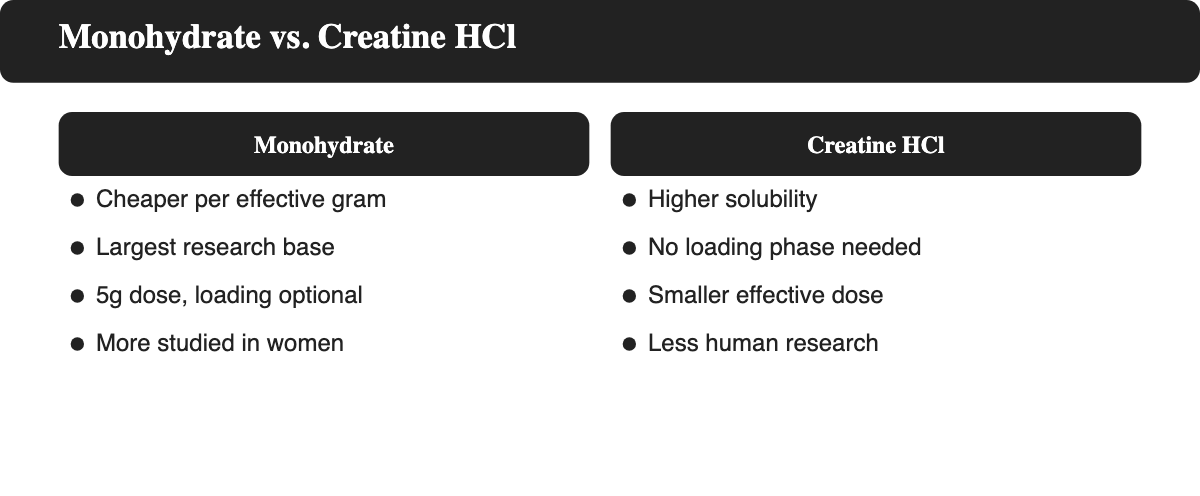
This is where creatine HCl earns its niche. Because the effective HCl dose is a fraction of the monohydrate dose (Kaged's capsules are 750 mg vs. monohydrate's 5,000 mg), some users report less GI discomfort and a smoother first week with no loading phase needed at all. The evidence base for HCl's performance benefits is much smaller than monohydrate's decades of trials, so it's a reasonable swap for comfort, not necessarily a performance upgrade.
Creatine and the menstrual cycle: what the research says
Creatine metabolism isn't static across a monthly cycle. Estrogen affects the enzyme (AGAT) involved in creatine synthesis and suppresses some of the glycolytic pathways your body would otherwise lean on, and creatine kinase activity itself fluctuates with the hormonal shifts of the cycle. A 2023 randomized controlled trial published in Nutrients found that creatine monohydrate loading supported exercise recovery and blunted fatigue during the high-hormone luteal phase in active women, suggesting the timing of supplementation relative to cycle phase may matter more for women than it does for men. A 2025 review in the Journal of the International Society of Sports Nutrition broadened this further, covering creatine's role across menstruation, pregnancy, and into menopause as an area of genuine, still-developing research interest rather than a settled topic.
None of this changes the baseline dosing advice above. It does mean that if you notice your energy or recovery from creatine feels different in different weeks of your cycle, that's plausible physiology, not something you're imagining.
Is creatine safe during pregnancy or breastfeeding?
This is not medical advice, and it's the one section on this page where we'd rather under-claim than over-claim. Creatine occurs naturally in the body and in breast milk, but supplemental creatine has not been studied in controlled human trials in pregnant or breastfeeding women. The International Society of Sports Nutrition's position stands describe creatine monohydrate as one of the most-researched and safest supplements for the general adult population, while separately noting that pregnant and lactating women are specifically excluded from that safety consensus because the research doesn't yet exist for those groups.
In practical terms: no clinical trial shows creatine supplementation is unsafe during pregnancy or breastfeeding. None shows it's been properly tested for those groups either. An infant's kidneys and metabolism are still developing, so most guidance defaults to caution over assumption. Pregnant, trying to conceive or breastfeeding and want to keep taking creatine? Talk to your OB-GYN or midwife. That call doesn't belong on a supplement label, and it doesn't belong on this page.
Creatine and protein: do you need both?
Creatine and protein do different jobs and neither substitutes for the other. Creatine supports the phosphocreatine energy system for short, high-intensity efforts (a heavy set, a sprint); protein supplies the amino acids your body uses to actually repair and build the muscle tissue you just worked. If you're deciding whether to prioritize one first, our best protein powder for women guide breaks down the same real-data approach, verified pricing and protein-per-serving figures, no rating inflation, for the other half of that stack.
FAQ
Will creatine make me bulky?
No. Creatine improves how much work you can do in a training session; it doesn't directly add muscle mass on its own, and any weight change is mostly water inside your muscle cells, not fat or bulk.
Should I take creatine gummies instead of powder?
Gummies are convenient but carry a real quality risk: creatine degrades in moist, heated manufacturing environments into inactive creatinine, and independent lab testing has found some gummy brands significantly understrength against their label claims. See our creatine gummies vs. powder breakdown for the lab data before choosing a gummy brand on convenience alone.
Does creatine cause acne or hair loss in women?
There's no strong clinical evidence directly linking creatine monohydrate supplementation to acne or hair loss in women; most of that concern traces back to a single small study on DHT in male rugby players, not a female-specific finding.
What time of day should I take creatine?
Timing matters far less than consistency. Creatine works by saturating your muscle stores over weeks, not by an acute pre-workout spike, so taking it at the same time daily, with or without food, is more important than the specific hour.
Is creatine safe for women with kidney concerns?
Creatine hasn't been shown to harm healthy kidneys at standard doses, but anyone with existing kidney disease or reduced kidney function should get medical clearance before starting, since the research base excludes that population.
Can I take creatine on rest days?
Yes, and you should. Creatine works by keeping your muscle stores saturated over time, not by an acute training-day effect, so skipping rest days breaks that saturation cycle for no benefit.
This article summarises general information and does not replace advice from a doctor or dietitian. If you have a medical condition, are pregnant or breastfeeding, or for children, talk to your doctor before changing your diet or taking supplements.