
Best Protein Powder for Muscle Gain: 5 Picks Backed by Real Nutrition Data
 By Lisa Benz, Editor-in-chief · Updated Aug 19, 2026 · 10 min read
Disclosure: this article may contain partner links. If you buy through them, we earn a commission at no extra cost to you. The ranking is set by our editors.
Contents
- How much protein you actually need to build muscle
- The leucine threshold: why more protein doesn't always mean more muscle
- The 5 best protein powders for muscle gain, at a glance
- The 5 best protein powders for muscle gain, reviewed
- Whey vs mass gainer: which one you actually need
- How to use protein powder to build muscle
- Frequently asked questions
The best protein powders for muscle gain deliver 20 to 55 grams of protein per serving, cover a real leucine dose that triggers muscle protein synthesis, and fit either a lean-bulk or a hardgainer calorie target depending on which one you pick. Five products lead this list. Dymatize ISO 100 wins on post-workout absorption speed. Transparent Labs Mass Gainer wins for hardgainers who struggle to eat enough. Momentous Whey Protein Isolate wins on third-party banned-substance testing for competitive athletes.
We compared five protein powders built for a muscle-building goal, not a general "best overall" list, across protein content, absorption profile, calorie density, third-party testing and price per serving, using each brand's own current nutrition panel and official pricing. We also checked something most muscle-gain roundups skip: how much protein and how much leucine you need per meal to trigger muscle growth, based on published sports-nutrition research instead of marketing copy.
How much protein you actually need to build muscle
The International Society of Sports Nutrition's position stand on protein and exercise sets daily intake for building and maintaining muscle mass at 1.4 to 2.0 grams per kilogram of body weight for most exercising adults. That range moves higher for resistance-trained lifters eating in a calorie deficit who need to protect lean mass while losing fat: 2.3 to 3.1 grams per kilogram. Take an 80kg (176lb) lifter in a muscle-building phase. That works out to 112 to 160 grams of protein a day from all sources combined, not just powder.
Protein powder is a convenience tool for hitting that number, not a requirement. Whole food covers the same target for plenty of lifters. Powder earns its place in the meals you would otherwise skip: a post-workout window when cooking a full meal is not realistic, or a mass-gain phase where the sheer volume of food needed makes a calorie-dense shake easier to finish.
The leucine threshold: why more protein doesn't always mean more muscle
Every gram of protein you eat is not equally useful for muscle growth. The switch on muscle protein synthesis flips when leucine, one of the nine essential amino acids, hits a minimum concentration in your blood. Below that threshold, the growth signal barely fires no matter how much total protein you ate. Above it, extra protein in that same meal mostly gets used for energy or stored, not extra muscle.
Published research does not agree on one exact number for that threshold. We're reporting both figures rather than picking one to sound more precise than the science is. A randomized controlled trial comparing native whey to standard whey concentrate found that 1.8 to 2.0 grams of leucine was enough to maximally stimulate muscle protein synthesis in young, trained adults. Earlier foundational studies, including Moore et al. (2009) and Witard et al. (2014), point to a higher 2.5 to 3 grams as the practical target most training guides now cite. Either way: a standard 20 to 30 gram scoop of whey protein runs about 10 to 12% leucine by weight, clearing even the higher estimate in a single serving. A smaller 10 to 15 gram protein source, or a low-leucine plant protein taken alone, often will not.
The practical takeaway: check the total protein per serving before you check the price. A 20-gram serving and a 30-gram serving of the same whey both clear the leucine threshold, but the 30-gram serving leaves less protein "wasted" below the effective dose if you are only having one shake a day.
The 5 best protein powders for muscle gain, at a glance
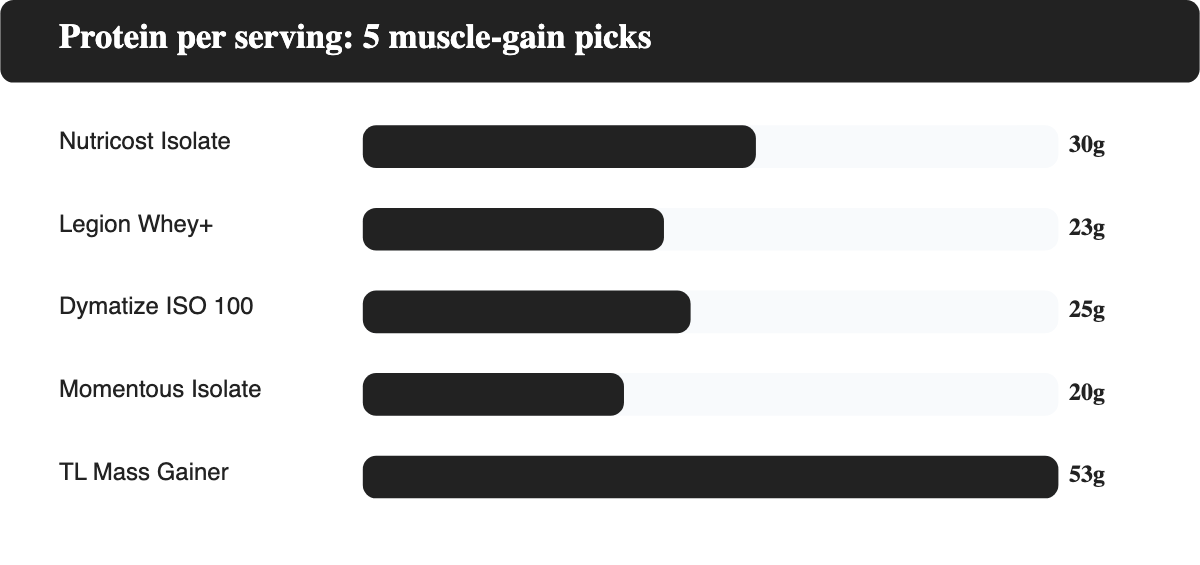
This table lines up protein, calories and price per serving so you can compare all five picks before reading the full reviews below.
| Product | Best for | Protein/serving | Calories | Price/serving | Certification |
|---|---|---|---|---|---|
| Dymatize ISO 100 | Post-workout absorption | 25g | ~110 | ~$1.67 | Informed Choice |
| Transparent Labs Mass Gainer | Hardgainers / bulking | 52-55g | 760-770 | ~$5.33 | Informed Choice |
| Momentous Whey Protein Isolate | Third-party tested | 20g | 90 | ~$2.40 | NSF Certified for Sport |
| Legion Whey+ | Natural / clean label | 22-24g | 100-130 | ~$1.99 | Labdoor tested |
| Nutricost Whey Protein Isolate | Budget | 30g | 140 | ~$1.12-1.68 | GMP / FDA registered facility |
The 5 best protein powders for muscle gain, reviewed
Dymatize ISO 100 Hydrolyzed: best for post-workout absorption
Dymatize ISO 100 uses hydrolyzed whey isolate. The protein chains are pre-broken into smaller pieces before you drink it, so amino acids reach your bloodstream faster than a standard isolate or concentrate does. That speed matters most in the hour after training, when your muscles are primed to use them, which is why this is the pick for a tight post-workout window. Each scoop delivers 25 grams of protein and 5.5 grams of BCAAs, clearing the leucine threshold discussed above, for around 110 calories and $1.67 per serving.
| Protein per serving | 25g |
| Calories per serving | ~110 |
| BCAAs | 5.5g |
| Format | Hydrolyzed whey isolate (fast-absorbing) |
| Price per serving | ~$1.67 |
| Certification | Informed Choice tested |
The tradeoff is taste and cost. Hydrolyzed whey has a more bitter profile than concentrate, and some tasters notice it even through flavoring. It also costs more per gram of protein than a budget pick like Nutricost. Skip a tight post-workout window and a standard isolate covers the same total protein target for less.
Transparent Labs Mass Gainer: best for hardgainers and bulking
This pick is for lifters who struggle to eat enough to gain weight, not just to hit a protein number. One serving delivers 52 to 55 grams of protein from grass-fed whey concentrate alongside 100-plus grams of complex carbs from organic tapioca maltodextrin, oat flour and sweet potato powder. Total calories land at 760 to 770. That is closer to a meal than a shake. A true hardgainer often cannot eat their way to a calorie surplus with whole food alone, and a calorie-dense shake closes that gap without the volume of a full plate.
| Protein per serving | 52-55g |
| Calories per serving | 760-770 |
| Carbs per serving | 100g+ |
| Protein source | Grass-fed whey protein concentrate |
| Price per serving | ~$5.33 |
| Certification | Informed Choice tested |
The calorie count sets the limit. Skip this pick if your goal is a lean bulk, or if you already eat enough food to hit a surplus. Adding 760-plus calories a day on top of a sufficient diet adds fat faster than muscle. Save it for a genuine hardgainer situation, not as a default protein shake.
Momentous Whey Protein Isolate: best third-party tested
Every batch of Momentous Whey Protein Isolate carries NSF Certified for Sport status. That screening checks for hundreds of banned substances and confirms the label matches what is in the tub, a real concern if a failed drug test could end a season for a competitive athlete. The current official formula delivers 20 grams of grass-fed whey protein isolate for 90 calories per serving, at $2.40 per serving ($59.99 for a 25-serving jar).
| Protein per serving | 20g |
| Calories per serving | 90 |
| Protein source | Grass-fed whey protein isolate |
| Price per serving | ~$2.40 |
| Certification | NSF Certified for Sport |
One discrepancy worth flagging: some existing reviews of this product cite 23 grams of protein per serving, but the current official product page lists 20 grams as of this writing. That looks like a formula or serving-size update, not an error on either side. Check the nutrition panel on your own tub before trusting an older review's numbers. At 20 grams, it still clears the leucine threshold from a single scoop, with less margin than the higher-protein picks on this list. Compared with Legion Whey+ or Nutricost, you are paying a premium for certification, not for extra protein per dollar.
Legion Whey+: best natural and clean-label
Legion Whey+ skips artificial sweeteners entirely. It uses stevia leaf extract instead and sources its whey from grass-fed, Animal Welfare Approved Irish dairy farms. Each serving delivers 22 to 24 grams of protein and 5.6 grams of BCAAs for $1.99. Labdoor independently tested it for heavy metals, microbes, allergens and banned substances. A separate Ellipse Analytics screen ranked it in the top 10% of protein powders tested for phthalates, pesticides and bisphenols, a level of outside verification most whey brands in this price range do not publish.
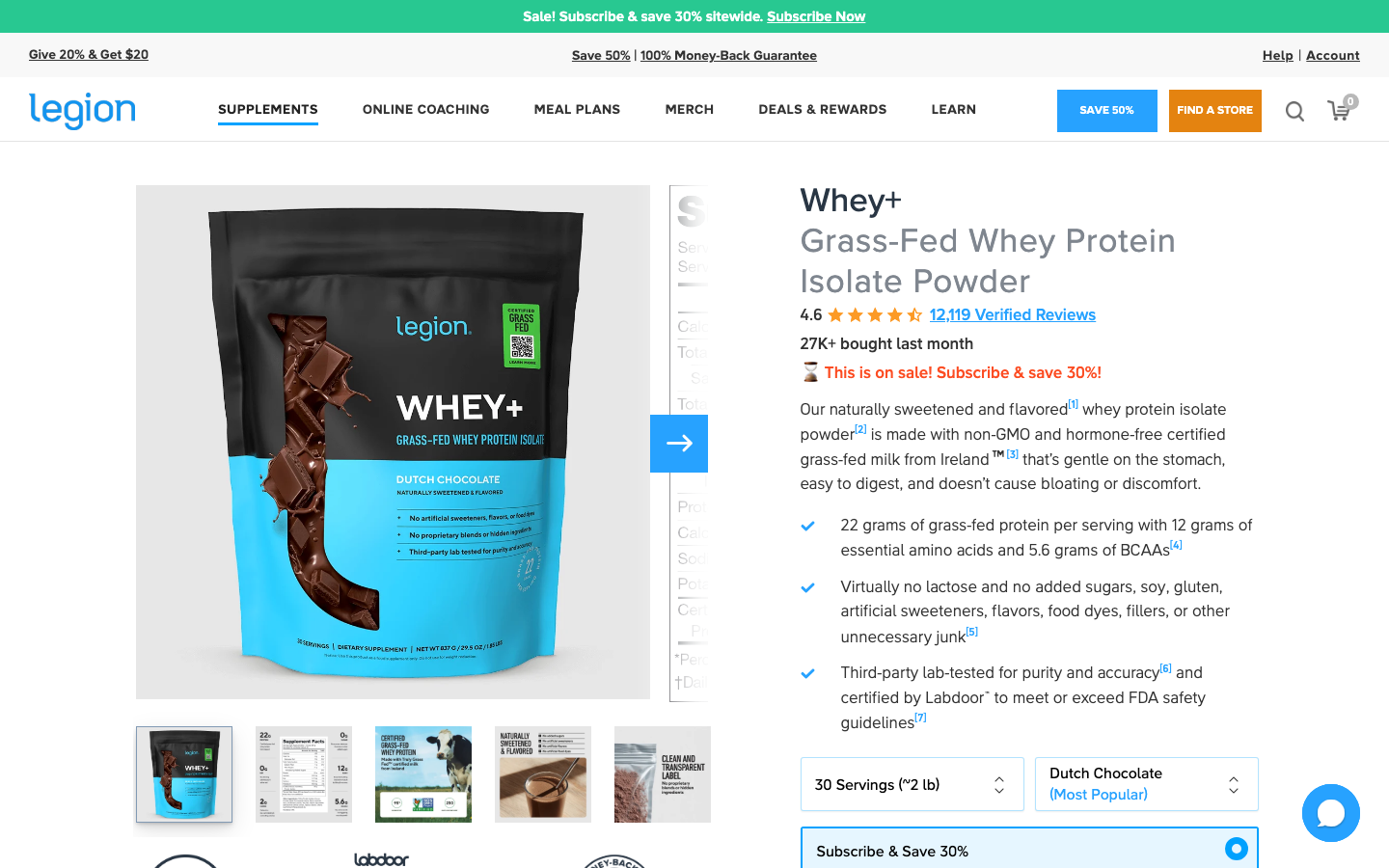
| Protein per serving | 22-24g |
| Calories per serving | 100-130 |
| BCAAs | 5.6g |
| Sweetener | Stevia leaf extract (no artificial sweeteners) |
| Price per serving | ~$1.99 |
| Certification | Labdoor tested |
The tradeoff is sweetness. Stevia has a different aftertaste than sucralose-sweetened whey, and some tasters find certain Legion Whey+ flavors either too sweet or lacking intensity compared to a conventional whey. It also costs more per gram of protein than Nutricost, though less than Dymatize ISO 100 or Momentous.
Nutricost Whey Protein Isolate: best budget
Nutricost Whey Protein Isolate delivers 30 grams of protein per serving, the highest of any whey isolate on this list. Price runs as low as $1.12 to $1.68 per serving depending on flavor and container size, and it is manufactured in a GMP-compliant, FDA-registered facility. A high per-scoop protein number at a low price makes this the cheapest way on this list to clear the leucine threshold with real margin to spare.
| Protein per serving | 30g |
| Calories per serving | 140 |
| Protein source | Whey protein isolate |
| Price per serving | ~$1.12-1.68 |
| Certification | GMP compliant, FDA registered facility |
The tradeoff is flavor and formulation variety. Nutricost runs a leaner product line than brands like Dymatize or Legion, with fewer flavor options and none of the added enzyme or BCAA-boosting extras those brands include. It also has no published third-party banned-substance certification like NSF or Informed Choice, so competitive athletes subject to drug testing should look at Momentous or Dymatize instead.
Whey vs mass gainer: which one you actually need
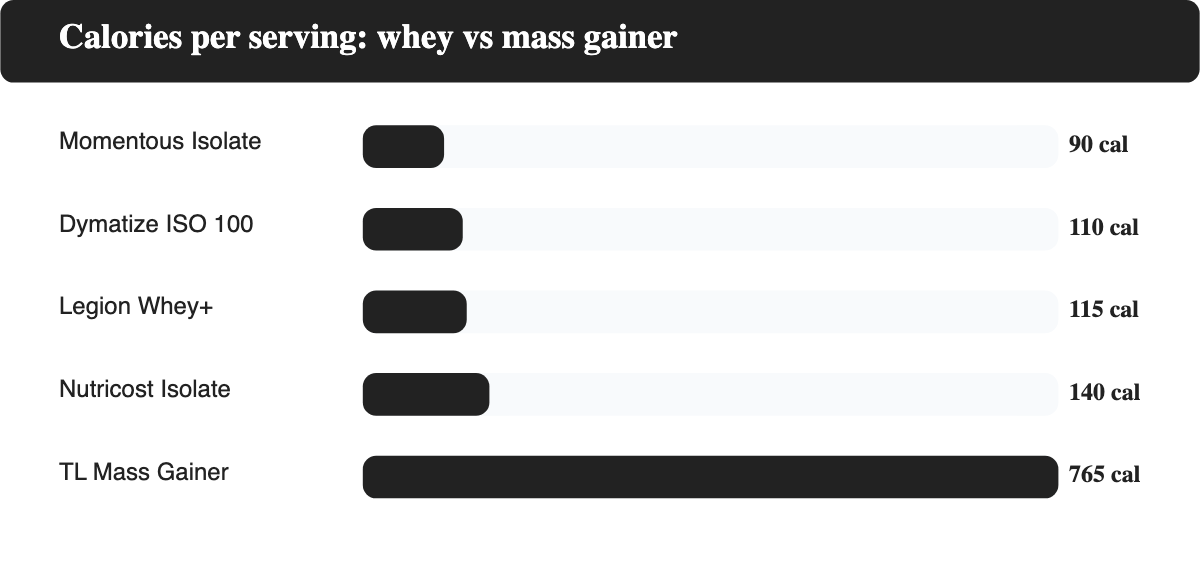
These are not interchangeable products, even though they sit on the same store shelf. A whey isolate or concentrate like Dymatize ISO 100, Legion Whey+ or Nutricost is built to add protein without adding many calories, typically 90 to 140 calories per serving. A true mass gainer like Transparent Labs Mass Gainer is built to add both protein and a large calorie surplus at once, often 700-plus calories per serving from added carbs and fats.
The right choice comes down to your current eating, not just your training goal. If you already eat enough food to gain weight and just want an easy protein top-up, a mass gainer adds calories you do not need and will accelerate fat gain along with muscle. If you are a genuine hardgainer who cannot eat enough through whole food alone, even with real effort, the extra calories in a mass gainer solve a problem a plain whey shake cannot.
How to use protein powder to build muscle
Total daily protein intake matters more than the exact timing of any single shake. Still, a few habits make a protein powder easier to use well. Spread protein across three to four meals or shakes a day rather than loading it all into one sitting, since each dose only needs to clear the leucine threshold once to trigger a fresh round of muscle protein synthesis. Eating it all at once wastes the surplus. A protein source, whole food or a shake, within a couple of hours of training covers the post-workout window. You do not need to obsess over an exact 30-minute cutoff; that rule is stricter than the current research supports. Track your total daily grams against the 1.4 to 2.0 g/kg range above before assuming you need more powder. Most lifters who eat a reasonable amount of meat, dairy or legumes sit closer to that target through food alone than they expect.
For a broader look at whey protein options outside the muscle-gain angle, see our best protein powder pillar guide. If you are shopping specifically as a woman, our best protein powder for women guide covers picks matched to that audience's own research and dosing questions. And if dairy is off the table entirely, our best vegan protein powder guide reviews plant-based picks built to hit the same protein and leucine targets.
Frequently asked questions
How much protein do I need per day to build muscle?
Most exercising adults need 1.4 to 2.0 grams of protein per kilogram of body weight per day to build and maintain muscle, per the International Society of Sports Nutrition's position stand. That range rises to 2.3 to 3.1 grams per kilogram for resistance-trained lifters eating in a calorie deficit who need to protect lean mass while losing fat.
Does protein powder alone build muscle?
No. Protein powder only supplies one input, total protein intake, and only helps if you are also strength training with progressive overload and eating enough total calories to support growth. It is a convenience tool for hitting your daily protein target, not a substitute for training or whole food.
What is the leucine threshold and why does it matter?
The leucine threshold is the minimum dose of the amino acid leucine, roughly 1.8 to 3 grams depending on which study you reference, needed in a single meal to maximally trigger muscle protein synthesis. A standard 20 to 30 gram scoop of whey protein clears this threshold in one serving, while a smaller protein source or a low-leucine plant protein taken alone often does not.
Is a mass gainer better than whey protein for muscle gain?
Only if you are a genuine hardgainer who struggles to eat enough calories through whole food. A mass gainer adds 700-plus calories per serving on top of its protein content, which speeds up fat gain as well as muscle gain if you already eat enough. A standard whey isolate or concentrate, at 90 to 140 calories per serving, is the better choice for most lifters who already hit their calorie target through meals.
What is the best protein powder for muscle gain on a budget?
Nutricost Whey Protein Isolate is the best budget pick on this list, delivering 30 grams of protein per serving for as little as roughly $1.12 to $1.68 per serving depending on flavor and size, made in a GMP-compliant, FDA-registered facility.