
Best Creatine Gummies: 6 Real Picks for 2026
 Lisa BenzFounder and editor-in-chief · Text and research
Disclosure: this article may contain partner links. If you buy through them, we earn a commission at no extra cost to you. The ranking is set by our editors.
Contents
- Our Top Creatine Gummy Picks at a Glance
- Why Creatine Gummies Are Different From Powder
- How We Picked These Gummies
- The Best Creatine Gummies, Reviewed
- Price per Gram of Creatine, Compared
- Dosing and Serving Size, Compared
- The Creatine Gummy Underdosing Problem
- Creatine Gummies vs. Powder: Pros and Cons
- How to Choose a Creatine Gummy
- Frequently Asked Questions
Creatine gummies solve the two biggest complaints people have about powder: the gritty texture and the hassle of mixing a shaker every day. But gummies come with a problem powder does not have. Heat, moisture, and acidity during manufacturing can break creatine down into creatinine, an inactive compound. Independent lab testing has found that some brands ship gummies with little to none of the creatine listed on the label. We compared dose accuracy, price per gram, and third-party testing across six brands that sell creatine gummies. Legion Creatine Gummies and Wild Gainz Creatine Gummies came out on top for verified dosing, and Wild Gainz currently has the lowest price per gram of creatine. Two other brands on this list, Beast Bites and Create, were specifically named in an independent 2024 industry test as showing high creatinine levels, meaning some of their labeled creatine had broken down into an inactive form. We cover that finding in detail in each brand's review below rather than leaving it out.
Our Top Creatine Gummy Picks at a Glance
- Best overall: Legion Creatine Gummies, 5g creatine per serving, third-party lab tested and Labdoor-certified, 4.4/5 from 505+ verified reviews on Legion's own product page
- Best independently verified dose and lowest current price per gram: Wild Gainz Creatine Gummies, Eurofins-tested at 5.54-5.84g per serving against a 5g label claim, about $0.25 per gram of creatine at current sale pricing
- Best for fewer gummies per dose: Bucked Up Creatine Gummies (Gummy Bucks), 5g across 4 gummies
- Best budget single-flavor pick: Swoly Creatine Mono Gummies, 4g creatine, $32.98 for 30 servings
- NSF Certified for Sport, with a caveat: Create Creatine Gummies was independently named in a 2024 industry test as showing high creatinine levels (see below)
- Also reviewed, with the same caveat: Beast Bites Creatine-Infused Gummies carries NSF Certified for Sport and Clean Label Project certification, but was also named in that same 2024 test
Why Creatine Gummies Are Different From Powder
Creatine monohydrate is chemically stable as a dry powder, which is why a tub of plain powder can sit in a cupboard for two years without losing potency. Gummies are a different story. Manufacturing a gummy requires heat, moisture, and often an acidic environment to set the pectin or gelatin base, and all three of those conditions accelerate the conversion of creatine into creatinine, an inactive breakdown product. We cover the mechanism, absorption differences, and when a powder still makes more sense in our full creatine gummies vs. powder comparison. The short version for this article: gummies win on convenience and taste, but the format only works if the brand actually controls for degradation and proves it with testing, which is the main filter we used to build this list.
How We Picked These Gummies
We started from the brands that actually appear in independent gummy-specific roundups (not general creatine lists, since most creatine listicles, including our own best creatine supplements guide, review powder and capsules almost exclusively) and cross-checked every product against its own official page. We prioritized four things: whether the label dose is 5g of creatine monohydrate, the clinically studied amount, or close to it; whether the brand publishes or references third-party lab testing; price per gram of creatine rather than price per bag, since gummy serving sizes vary widely; and flavor and format options, since taste compliance is the entire reason someone chooses a gummy over powder in the first place. We excluded any brand we could not confirm sells an actual creatine gummy product through a real, checkable official storefront.
The Best Creatine Gummies, Reviewed
Legion Creatine Gummies
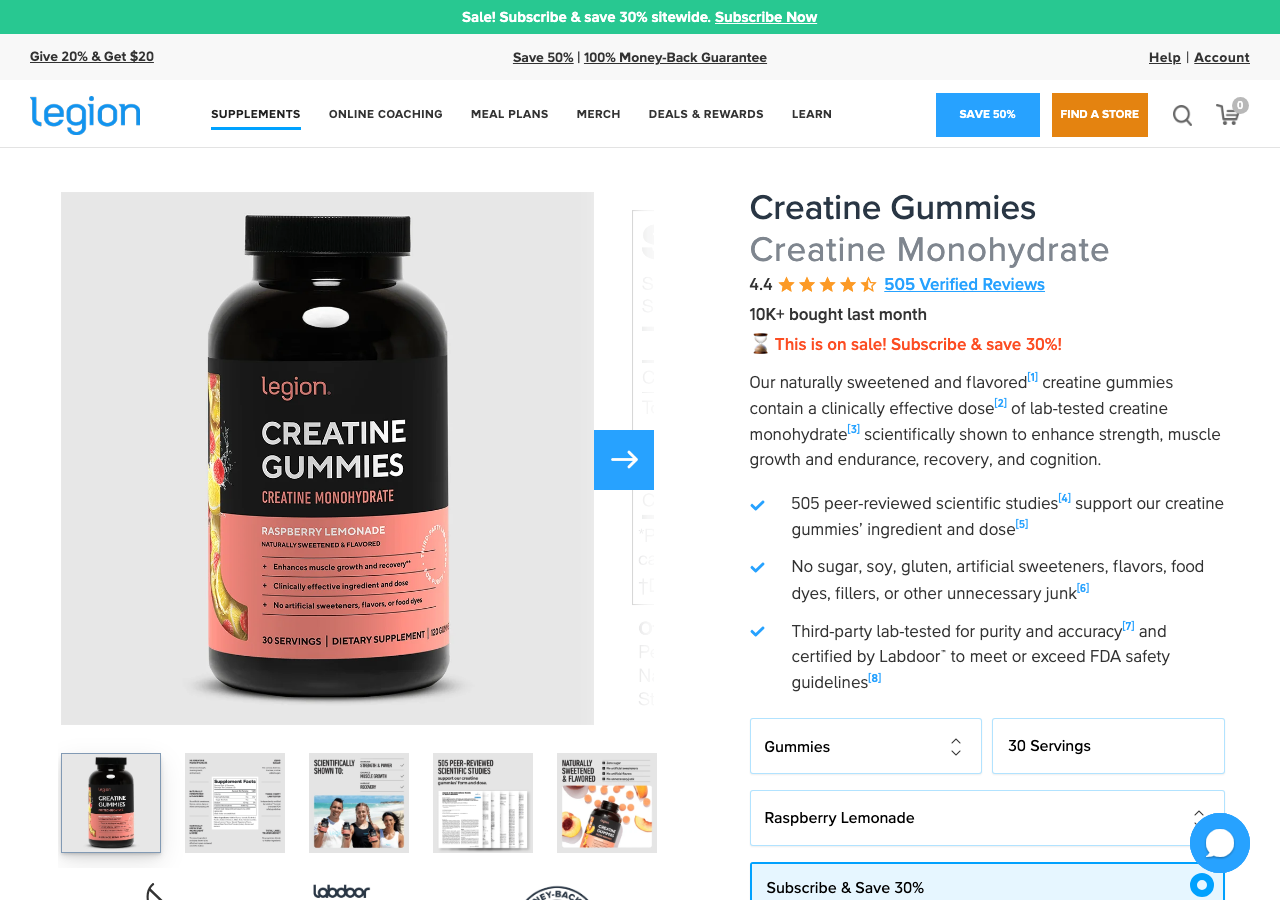
Best overall. Legion built its reputation on powder, and its gummy line carries over the same third-party testing habit. Every batch is tested for purity and creatine content, and Legion says the gummies are independently certified by Labdoor to meet or exceed FDA safety guidelines, on top of manufacturing in an NSF-certified, GMP facility. The gummies use sugar alcohols and stevia rather than added sugar in most flavors, and reviewers consistently rate the taste and texture above average for the category.
- Type: Creatine monohydrate gummy
- Creatine per serving: 5g
- Gummies per serving: Sources disagree: 4 (Muscle & Strength) vs. 5 (Garage Gym Reviews)
- Price: $39.99 for 30 servings ($1.33/serving)
- Flavors: Lemon Drop, Sour Blue Raspberry, Sour Watermelon, Sour Green Apple, Pink Lemonade, Raspberry Lemonade (flavor lineup varies slightly by retailer)
- Third-party testing: Yes, third-party lab tested and Labdoor-certified; NSF-certified manufacturing facility
- Rating: 4.4/5 from 505+ verified reviews shown live on Legion's own product page; Garage Gym Reviews separately scored it 4.25/5 in its own testing rubric
The one inconsistency worth flagging: retailer pages disagree on whether a serving is 4 or 5 gummies, which we could not resolve from Legion's own product page during this review. Check the label on the bag you receive before assuming either number.
Wild Gainz Creatine Gummies
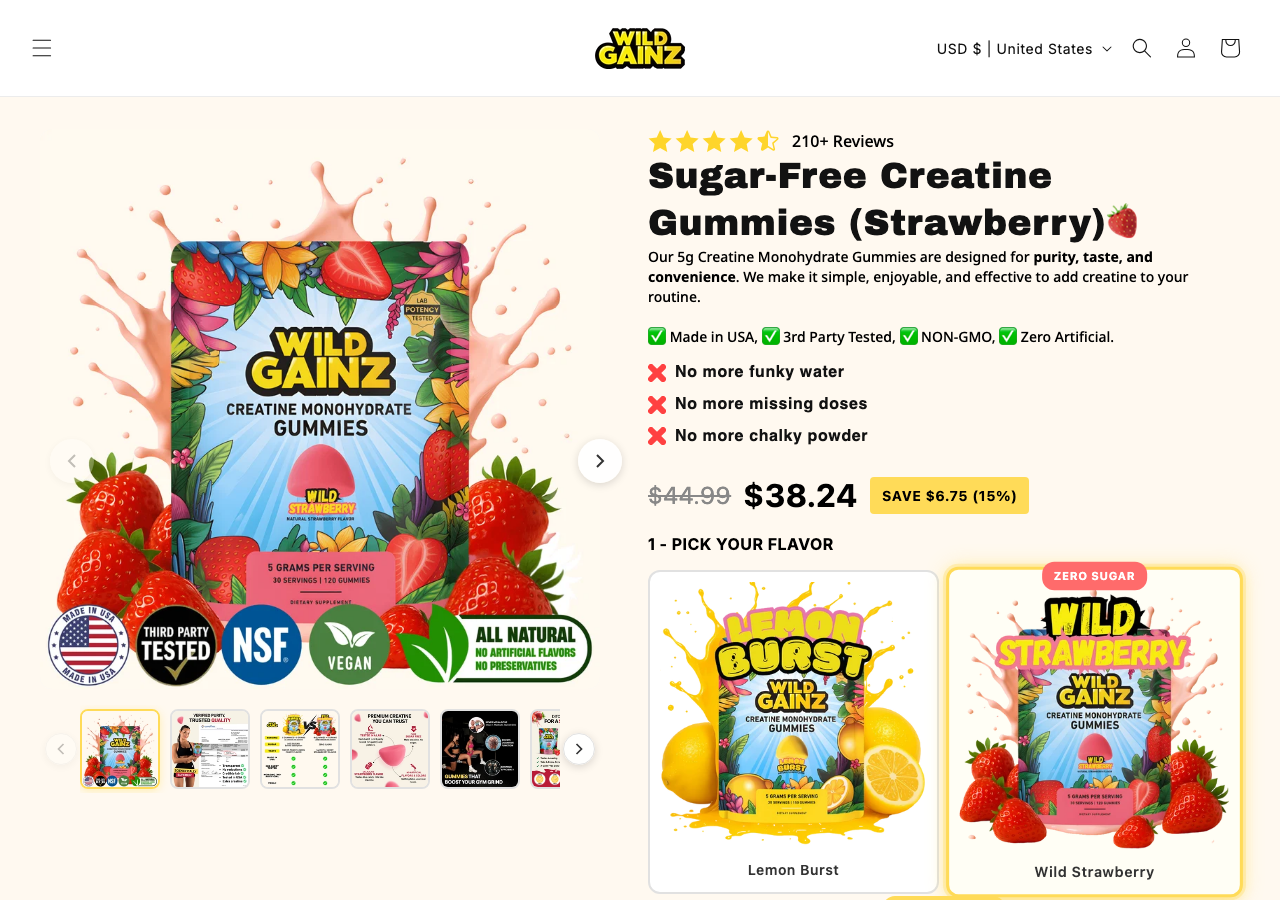
Best independently verified dose. Wild Gainz is the only brand on this list that publishes actual batch-by-batch lab results rather than just a testing claim. Its Eurofins HPLC results, dated across multiple 2025 and 2026 batches, showed 5.54g to 5.84g of creatine per serving against a 5g label claim. The product has consistently met or exceeded its stated dose, the opposite of the failure pattern seen industry-wide. Note that sources disagree on gummy count per serving: some retailer copy describes dosing by body weight (3 gummies under 150 lbs, 5 gummies over), but the product label shown on Wild Gainz's own packaging states 120 gummies for 30 servings, a flat 4 gummies per serving. We're using the label figure below since we could verify it directly from a product photo.
- Type: Creatine monohydrate gummy
- Creatine per serving: 5g label claim; lab-verified 5.54-5.84g across tested batches
- Gummies per serving: 4 (per product label: 120 gummies / 30 servings); some retailer copy instead describes 3-5 by body weight
- Price: $38.24 for 30 servings at 15% off ($1.27/serving); $44.99 regular price
- Flavors: Wild Strawberry, Lemon Burst (zero sugar)
- Third-party testing: Yes, Eurofins HPLC testing with published batch results
- Rating: Not independently verified by two agreeing sources; we did not fabricate a number
The Wild Strawberry flavor uses maltitol syrup, isomalt, and erythritol and contains roughly 1g of sugar per gummy by some retailer listings; the Lemon Burst flavor is formulated as zero sugar with glucose syrup, sucrose, allulose, and stevioside as sweeteners. If you're sugar-sensitive, Lemon Burst is the safer pick.
Create Creatine Gummies
NSF Certified for Sport, with a real caveat. Create markets itself as the first gummy-first creatine brand, and it backs that up with NSF Certified for Sport, a certification that screens for banned substances and verifies label accuracy through an accredited third party. Create says it is the only creatine gummy on the market carrying that specific certification. Each gummy uses Creapure, a German-manufactured creatine monohydrate with its own purity testing pedigree, at 1.5g per gummy. That certification makes the next fact more notable: in a March 2024 independent HPLC screening of 12 creatine gummy products, supplement manufacturer NOW Foods named Create as one of six brands that failed to meet its label claim, specifically citing a large amount of creatinine (the inactive compound creatine breaks down into) in the tested batch. We traced this brand-specific attribution to NOW Foods' own press release on the test (via a supplement-industry citation of that release; independent trade press covering the same test reported the aggregate 5-of-12 failure rate but did not name brands). NSF Certified for Sport screens primarily for banned substances and confirms accuracy at the time of that specific audit, which is not the same guarantee as every retail batch matching label claim indefinitely, and a single 2024 lot result may not reflect the product's current formulation.
- Type: Creatine monohydrate (Creapure) gummy
- Creatine per serving: 4.5g (1.5g per gummy x 3 gummies)
- Gummies per serving: 3
- Price: $65 for a 30-serving variety pack direct from trycreate.co (confirmed via two independent sources); Target sells a smaller 15-serving variety box for $24.99, which works out cheaper per gram of creatine than the direct-site pack
- Flavors: Sour Cherry, Watermelon, Orange, Blue Raspberry, Sour Green Apple, Sour Peach, Sour Grape, Variety Pack
- Third-party testing: NSF Certified for Sport
- Rating: Not independently verified by two agreeing sources; we did not fabricate a number
Create's 4.5g dose sits slightly under the 5g most clinical studies use, and each serving carries 3g of total sugar (2g added). NSF Certified for Sport still makes Create the pick with the strongest banned-substance screening for drug-tested athletes, but the 2024 creatinine finding above means it is not automatically the safest pick for potency. If content accuracy matters more to you than banned-substance testing, ask Create for a current certificate of analysis before buying, the same advice we'd give for Beast Bites below.
Bucked Up Creatine Gummies (Gummy Bucks)
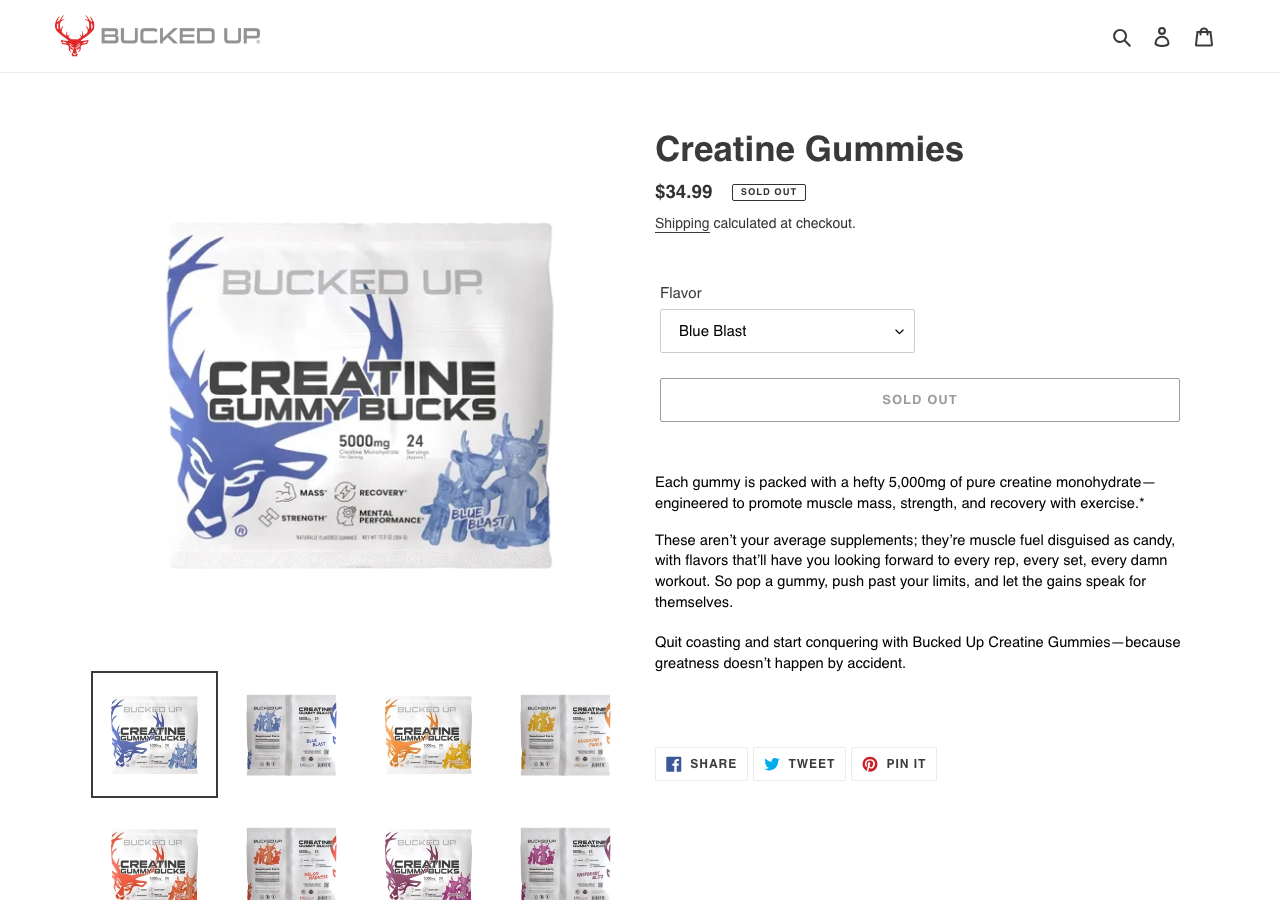
Best for fewer gummies per dose. Bucked Up reformulated its creatine gummies into what it calls "Gummy Bucks," concentrating the full 5g clinical dose into 4 gummies instead of the 5 gummies its earlier formula required. An older 5-gummies-per-serving, 20-serving version is still floating around some retailers, so check the label to know which formulation you're buying.
- Type: Creatine monohydrate gummy
- Creatine per serving: 5g (5,000mg)
- Gummies per serving: 4 in the current "Gummy Bucks" formula; 5 in the older formula still sold by some retailers
- Price: $34.99 for 24 servings ($1.46/serving, current formula)
- Flavors: Tropic Thunder, Raspberry Blitz, Melon Madness, Knockout Punch, Blue Blast
- Third-party testing: No third-party testing or certification claim found on Bucked Up's own product page at time of review
- Rating: Not independently verified by two agreeing sources; we did not fabricate a number
Bucked Up is a known energy and pre-workout brand, and its creatine gummies lean on flavor variety rather than a testing badge. That's the one real gap versus the rest of this list: we could not find a published third-party lab result or certification for this specific product, which matters more for gummies than for powder given the industry's degradation problem.
Beast Bites Creatine-Infused Gummies
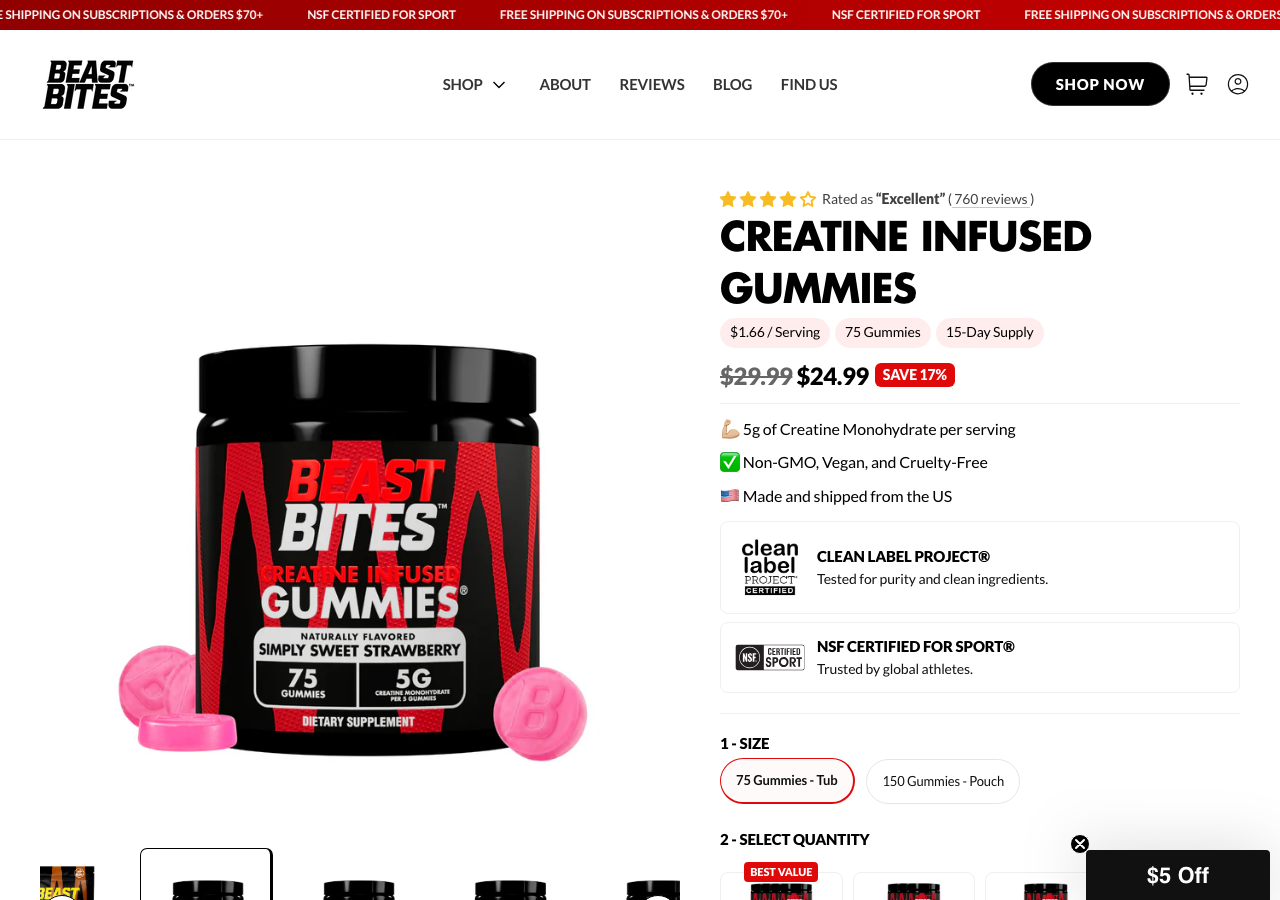
NSF and Clean Label certified, with the same caveat as Create. Beast Bites' 150-gummy pouch splits into 30 servings of 5 gummies each, delivering the full 5g clinical creatine dose, and it carries both NSF Certified for Sport and Clean Label Project certification. It was also one of the six brands NOW Foods named in that same March 2024 test as showing a large amount of creatinine, the same finding covered in Create's review above and sourced the same way (via a supplement-industry citation of NOW Foods' own press release; independent trade press reported the aggregate failure rate without naming brands).
- Type: Creatine monohydrate (Creapure) gummy
- Creatine per serving: 5g
- Gummies per serving: 5
- Price: $39.99 currently listed on Beast Bites' own site for 150 gummies / 30 servings ($1.33/serving, about $0.27/g of creatine); Walmart and some other retailers show $34.95 as the regular price and discount as low as $21.95 to $25, so sources disagree on the true list price and it's worth comparing before buying
- Flavors: Simply Sweet Strawberry, Sour Watermelon Splash, Sweet Blue Raspberry, Sour Peach Rings, Pink Lemonade Squeeze (limited), Hawaiian Fruit Punch (limited)
- Third-party testing: NSF Certified for Sport, Clean Label Project certified
- Rating: Not independently verified by two agreeing sources; we did not fabricate a number
To be direct about the caveat above: NOW Foods' own March 2024 press release on its HPLC testing program named Beast Bites as one of three brands (along with Create and Con-Cret) that showed a large amount of creatinine rather than a small trace, meaning a meaningful share of the labeled creatine had likely already broken down by the time it was tested. Mainstream trade press covering the same test (SupplySide Supplement Journal, NutraIngredients) reported the aggregate 5-of-12 failure rate without naming brands, so we're relying on a supplement-industry outlet's direct citation of NOW's press release for the brand-specific attribution rather than a primary document we could load ourselves. If you're weighing Beast Bites against Legion or Wild Gainz for a testing-sensitive use case, ask Beast Bites directly for a current certificate of analysis rather than relying on the certification badges alone.
Swoly Creatine Mono Gummies
Best budget single-flavor pick. Swoly keeps things simple: one flavor, a straightforward 4g creatine dose, and a lower price than most of the 5g options on this list. It's a reasonable entry point if you just want to try gummies without committing to a premium brand, though the 4g dose is 1g under what Legion, Wild Gainz, Bucked Up, and Beast Bites all deliver.
- Type: Creatine monohydrate gummy
- Creatine per serving: 4g
- Gummies per serving: 5
- Price: $32.98 for 30 servings ($1.10/serving); subscription price around $27.95
- Flavors: Strawberry (single flavor)
- Third-party testing: Swoly states its gummies are "tested by independent labs" and made in a GMP-certified facility, but does not name the testing lab or certification body on its product page
- Rating: Not independently verified by two agreeing sources; we did not fabricate a number
Price per Gram of Creatine, Compared
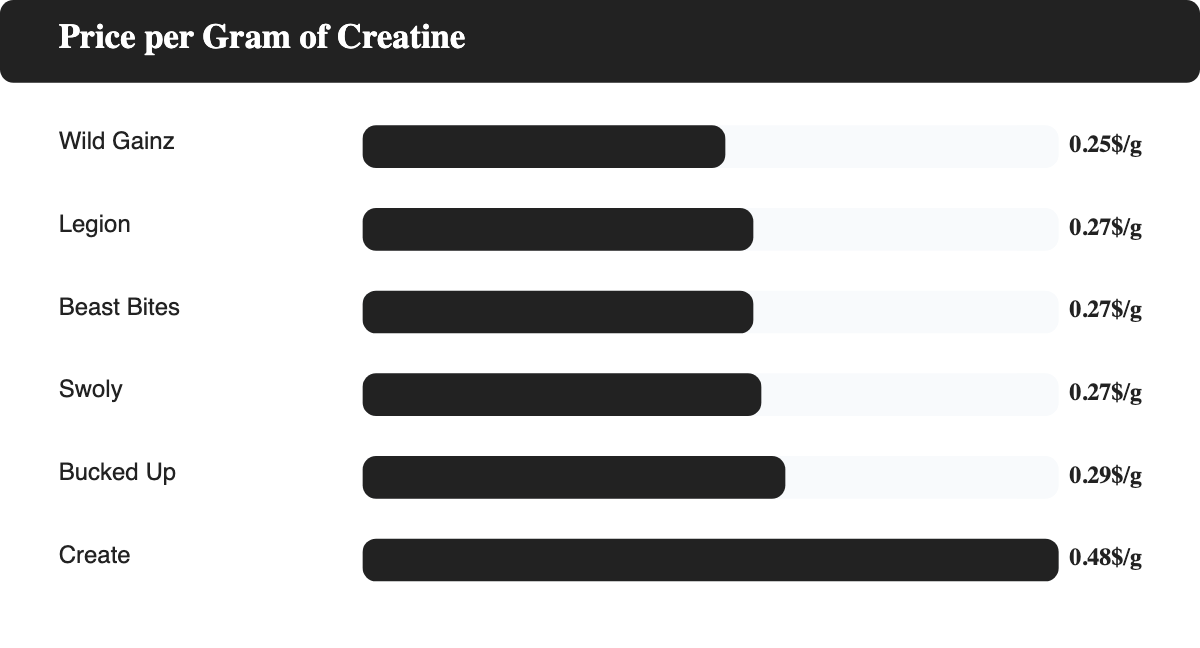
Sticker price is misleading with gummies because serving sizes range from 4g to 5g of creatine and container sizes range from 24 to 30 servings. Normalizing to price per gram of actual creatine shows a clearer picture: at current official pricing, Wild Gainz is the cheapest thanks to its ongoing 15% sale, Legion, Beast Bites, and Swoly cluster within two cents of each other, Bucked Up runs a bit higher because of its smaller 24-serving container, and Create is more than double the price of every other option.
Dosing and Serving Size, Compared
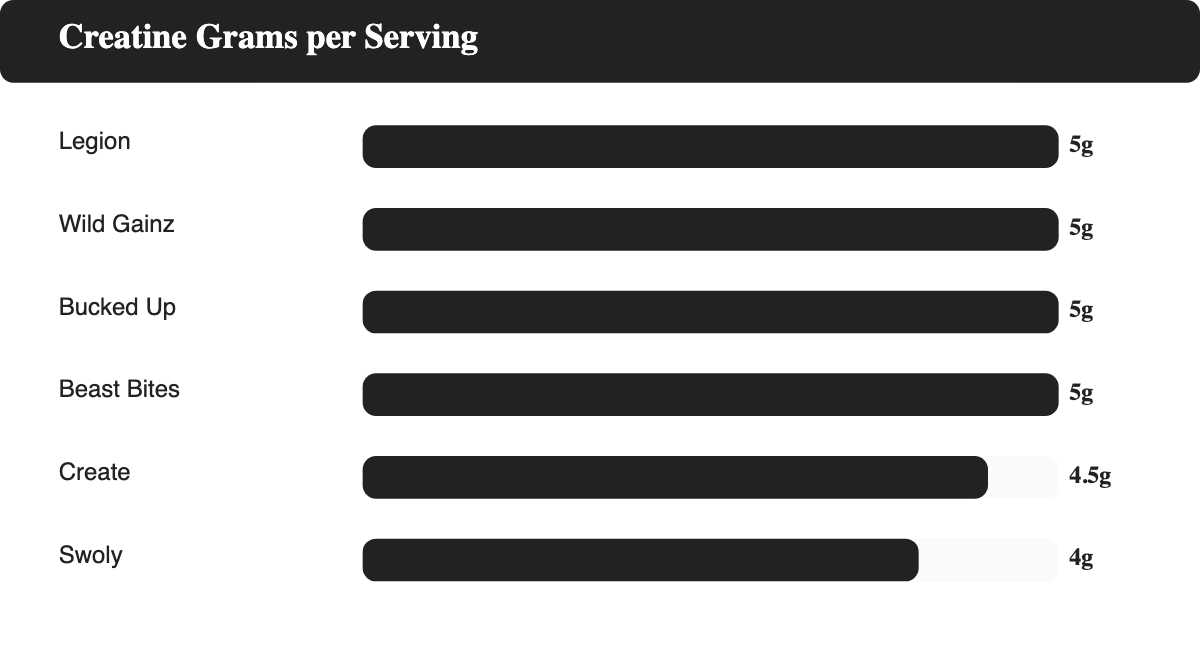
Most clinical creatine research uses a 5g daily maintenance dose (after an optional loading phase at higher amounts). Four of the six brands here hit that number on the label; Create and Swoly land under it at 4.5g and 4g respectively. Gummy count per serving also varies more than you'd expect, from 3 gummies (Create) up to 5 (Legion per one source, Beast Bites, Swoly, and the older Bucked Up formula).
The Creatine Gummy Underdosing Problem
This is the section most creatine listicles skip, and it's the reason third-party testing matters more for gummies than for almost any other supplement format. In March 2024, NOW Foods, a supplement manufacturer that also runs its own testing lab, used high-performance liquid chromatography (HPLC) to check the actual creatine content of 12 creatine gummy products against their label claims. Five of the 12 failed, containing little to no detectable creatine. Every failing product also showed measurable creatinine, the breakdown product creatine turns into when it degrades from heat, moisture, or acidity. NOW's own quality director called the problem structural. Gummy manufacturing is harder on creatine's stability than a dry powder blend, and few labs are equipped to test gummies at all. That gap is part of why so few brands publish batch-level results.
Separately, consumer-testing outlets have reported even more extreme failures on some Amazon-only gummy brands, including at least one product that claimed 5g of creatine per serving but tested at roughly 0.005g, essentially none. Of the six brands reviewed in this article, NOW Foods' own press release on that March 2024 test named two, Create and Beast Bites, among the six failing brands, specifically flagging both for a large amount of creatinine rather than a small trace. A supplement-industry outlet's citation of NOW's press release is our source for that brand-specific detail, not a primary document we loaded ourselves. Mainstream trade press covering the same test reported the aggregate failure rate without naming brands. We cover the full finding in each brand's own review above. The practical takeaway: don't take a "creatine monohydrate" label at face value on a gummy, even one carrying a real certification. Look for a brand that names its testing lab, publishes a certificate of analysis, or carries a real third-party certification like NSF Certified for Sport, ask for a current certificate of analysis if a brand has been named in a prior failed test, and be more skeptical of brands that only claim testing in marketing copy without naming who did it.
Creatine Gummies vs. Powder: Pros and Cons
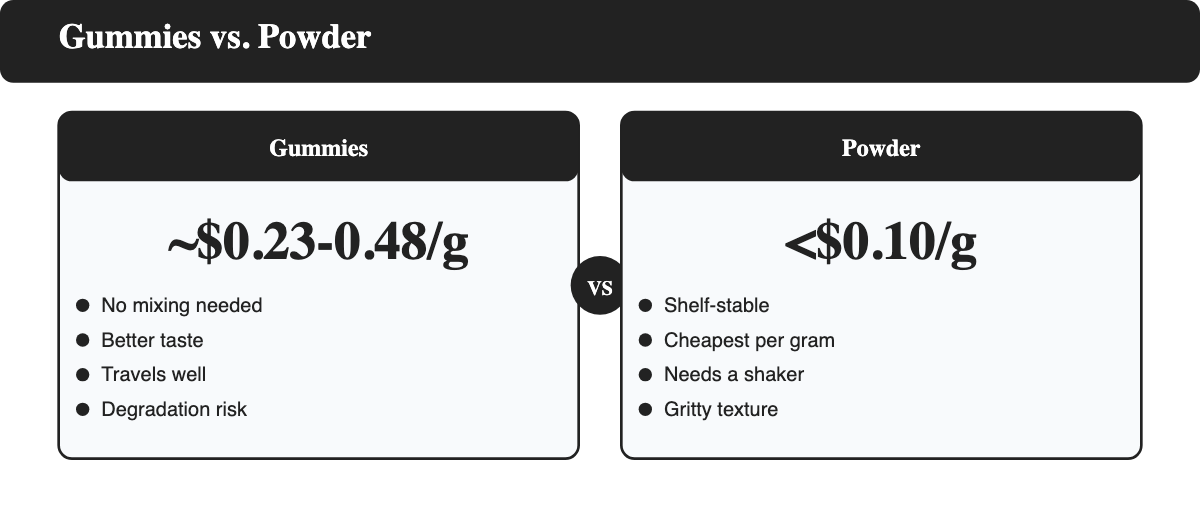
Gummies aren't a strictly better or worse format than powder, they're a different trade-off. If you've never taken creatine consistently because you hate the taste or the shaker bottle, a well-tested gummy solves your actual problem. If you want the cheapest reliable dose and don't mind mixing a scoop into water, our best creatine supplements guide covers seven powder and capsule brands that are, gram for gram, almost always less expensive than any gummy on this page. For the full mechanism-level breakdown of absorption, stability, and cost, see our dedicated creatine gummies vs. powder comparison.
How to Choose a Creatine Gummy
- Start with testing, not price, but don't treat a certification badge as the final word. A cheap gummy with no verifiable creatine in it is infinitely more expensive than an honestly dosed one, because you're paying for zero benefit. Prioritize brands that name a testing lab or carry NSF Certified for Sport, and if a brand has previously been named in a failed independent test, like Create and Beast Bites were in 2024, ask for a current certificate of analysis rather than assuming the badge alone means every batch is accurate.
- Compare price per gram, not price per bag. A $30 bag of 4g-per-serving gummies can cost more per gram of actual creatine than a $40 bag of 5g-per-serving gummies. Use the chart above rather than the sticker price.
- Match the gummy count to your routine. If swallowing five gummies a day feels like a chore, a 3-4-gummies-per-serving product like Create or the newer Bucked Up formula will be easier to stick with long-term, which matters more than shaving pennies off the price.
- Check sugar content if it matters to you. Most brands use sugar alcohols or stevia, but a few flavors (like Create's) carry a few grams of added sugar per serving. Not a large amount, but worth knowing if you're tracking it.
- Buy from the brand's own site or a major retailer, not an unverified third-party marketplace listing. Several of the worst lab-test failures reported by consumer-testing outlets involved Amazon-only brands with no real company site behind them.
Frequently Asked Questions
Do creatine gummies actually work as well as powder?
When a gummy delivers its full labeled dose of creatine monohydrate, it works the same way powder does, since the compound itself doesn't change based on delivery format. The catch is that gummies are more prone to losing potency during manufacturing than powder is, so "the same as powder" only holds true if the brand you're buying actually contains what the label claims. That's why third-party testing matters more here than for almost any other supplement format.
How many creatine gummies should I take per day?
Follow the label for the specific product you bought rather than a fixed gummy count, since gummies per serving range from 3 to 5 across the brands in this article depending on how much creatine is packed into each gummy. Most clinical research uses a 5g daily maintenance dose. Create and Swoly dose under that, at 4-4.5g.
Why did some creatine gummies fail lab testing?
Creatine converts into creatinine, an inactive compound, when it's exposed to heat, moisture, and acidity, all three of which are part of standard gummy manufacturing. NOW Foods ran HPLC testing on 12 gummy products in March 2024. Five failed to contain their labeled creatine amount, and every failing product also showed detectable creatinine. That pattern points to degradation during production, not deliberate underfilling.
Are creatine gummies more expensive than powder?
Yes, almost always. The gummies in this article range from about $0.25 to $0.48 per gram of creatine. Plain creatine monohydrate powder from brands like the ones in our best creatine guide typically runs well under $0.10 per gram. You're paying a real premium for convenience and taste, which is a reasonable trade if it's the difference between taking creatine consistently and not taking it at all.
Can I take creatine gummies every day long-term?
Creatine monohydrate itself has a long track record of safety at standard daily doses in healthy adults. The main long-term consideration specific to gummies is sugar or sugar-alcohol intake if you're eating several gummies daily, and some people notice mild digestive effects from sugar alcohols like maltitol or isomalt at higher amounts. Check the sweetener list on whichever brand you choose if you have a sensitive stomach.
What's the difference between Create's gummies and other brands?
Create and Beast Bites both carry NSF Certified for Sport on this list, a certification that specifically screens for banned substances in addition to verifying label accuracy at the time of that audit, which matters if you're a tested athlete. Create's trade-off is a lower per-gummy creatine dose (1.5g per gummy versus roughly 1-1.7g in most competitors) and the highest price per gram of creatine of any brand we compared. Both brands were also named in NOW Foods' 2024 independent test as showing high creatinine levels, so the certification is a real signal but not a guarantee that every batch matches its label.
This article summarises general information and does not replace advice from a doctor or dietitian. If you have a medical condition, are pregnant or breastfeeding, or for children, talk to your doctor before changing your diet or taking supplements.