
Best BCAA Supplements: 6 Real Picks for 2026
 By Lisa Benz, Editor-in-chief · Updated Aug 31, 2026 · 15 min read
Disclosure: this article may contain partner links. If you buy through them, we earn a commission at no extra cost to you. The ranking is set by our editors.
Contents
- BCAA supplement comparison: ratio, dose, price and testing side by side
- Do BCAAs actually work if you already eat enough protein?
- The BCAA ratio numbers explained: 2:1:1 vs 4:1:1 vs 8:1:1
- How we picked these 6 BCAA supplements
- Kaged BCAA 2:1:1: best overall
- Transparent Labs BCAA Glutamine: most BCAA per scoop
- Nutricost BCAA: best budget
- Naked Nutrition Naked BCAAs: cleanest label
- XTEND Original BCAA Powder: best with electrolytes
- Momentous Vital Aminos: best for tested athletes
- Third-party testing: what Informed Sport and NSF Certified for Sport actually catch
- How to dose and time BCAAs, if you use them
- Frequently asked questions
The best BCAA supplement for most people is Kaged BCAA 2:1:1. No proprietary blend, no artificial sweeteners. It uses fermented, plant-based amino acids in the research-backed 2:1:1 ratio and carries Informed Sport certification, the kind of trust signal most BCAA labels skip entirely. Want more BCAAs per scoop and a wider flavor lineup instead? Transparent Labs BCAA Glutamine is the stronger pick. On a budget? Nutricost BCAA gets you the same 2:1:1 ratio for about a quarter per serving.
We compared six BCAA powders on the things that change whether a product is worth buying: the leucine-to-isoleucine-to-valine ratio, grams of BCAAs per serving, price per serving, flavor options, and whether the product is independently tested for banned substances and label accuracy. We also dug into a question most BCAA roundups skip: whether BCAAs do anything useful if you already eat enough protein. The answer is not simple. Marketing copy makes it sound settled. Published research does not, and we cover that disagreement below instead of just telling you to buy the biggest tub.
BCAA supplement comparison: ratio, dose, price and testing side by side
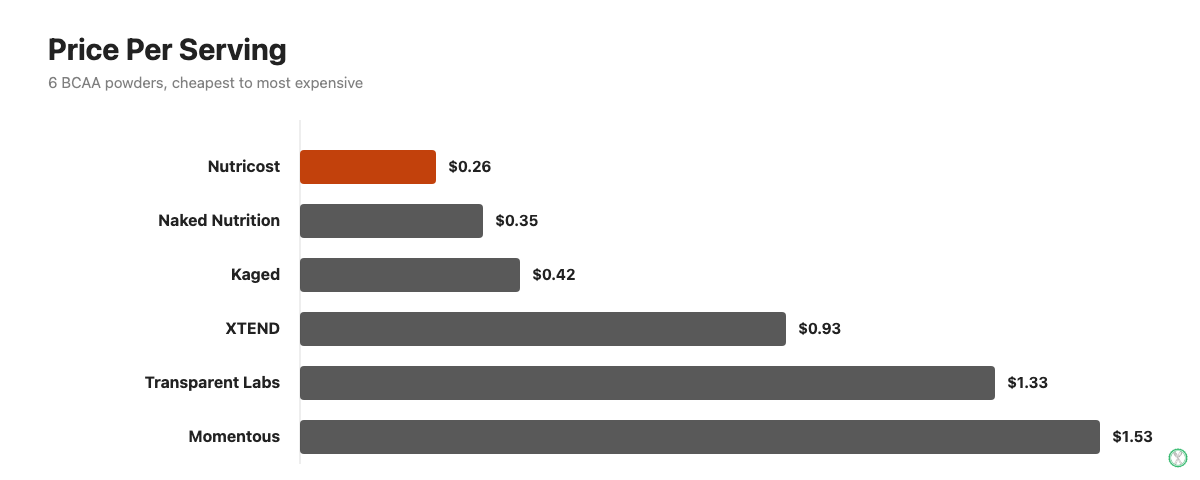
Every product below uses the research-favored 2:1:1 leucine-to-isoleucine-to-valine ratio unless noted. Prices are per-serving estimates based on standard container sizes at the time of research; check the retailer page before buying since supplement pricing changes often.
| Product | Best for | Ratio | BCAAs/serving | Price/serving | Third-party testing |
|---|---|---|---|---|---|
| Kaged BCAA 2:1:1 | Best overall | 2:1:1 | 5g | ~$0.42 | Informed Sport certified |
| Transparent Labs BCAA Glutamine | Most BCAA per scoop | 2:1:1 | 8g | ~$1.33 | Informed Choice tested |
| Nutricost BCAA | Best budget | 2:1:1 | 6g | ~$0.25-0.26 | Sources disagree, see below |
| Naked Nutrition Naked BCAAs | Cleanest label | 2:1:1 | 5g | ~$0.35 | Third-party tested, no named sport certification |
| XTEND Original BCAA Powder | Electrolytes for training | 2:1:1 | 7g | ~$0.93 | Not independently certified |
| Momentous Vital Aminos | Tested athletes | 2:1:1 (within 13 aminos) | 3.75-5g, sources disagree | ~$1.53 | NSF Certified for Sport + Informed Sport |
Do BCAAs actually work if you already eat enough protein?
This is the question most BCAA buying guides skip, and it matters more than any ratio comparison. BCAAs, leucine, isoleucine and valine, are three of the nine essential amino acids. Every gram of BCAA powder you drink is also sitting inside a normal serving of chicken, whey protein, eggs or beans. The pitch for a standalone BCAA product only makes sense if isolating those three amino acids does something a complete protein source does not.
The research on that point is not flattering to the BCAA category. Studies comparing BCAA-only supplementation against complete essential amino acid (EAA) mixtures consistently find that EAAs stimulate muscle protein synthesis more effectively. One frequently cited comparison found the muscle protein synthesis response to a full EAA dose was more than double the response to a BCAA-only dose of similar size, because muscle protein synthesis needs all nine essential amino acids present at once, not just three of them. Leucine can flip the metabolic switch that starts protein synthesis, but the process still needs a supply of the other essential aminos to actually build tissue. Several controlled trials have also found no clear evidence that BCAA-only supplementation reduces muscle protein breakdown after exercise, which was one of the original selling points for the category in the 1990s and 2000s.
None of this means BCAAs are useless. If you train fasted, restrict calories, or genuinely fall short on daily protein, a BCAA or EAA product adds real amino acids to your day. But if your total protein intake is already in a normal range for your bodyweight and training volume, most of the research suggests you'd get a bigger effect from an EAA supplement or just another scoop of whey than from an isolated BCAA product. If you're not sure your daily protein is dialed in yet, our best protein powder guide is the better starting point before adding a separate BCAA product on top. We're not saying skip BCAAs. We're saying the honest reason to buy a BCAA-specific product is taste, convenience, or an EAA formula being unavailable, not a unique physiological edge over complete protein.
The BCAA ratio numbers explained: 2:1:1 vs 4:1:1 vs 8:1:1
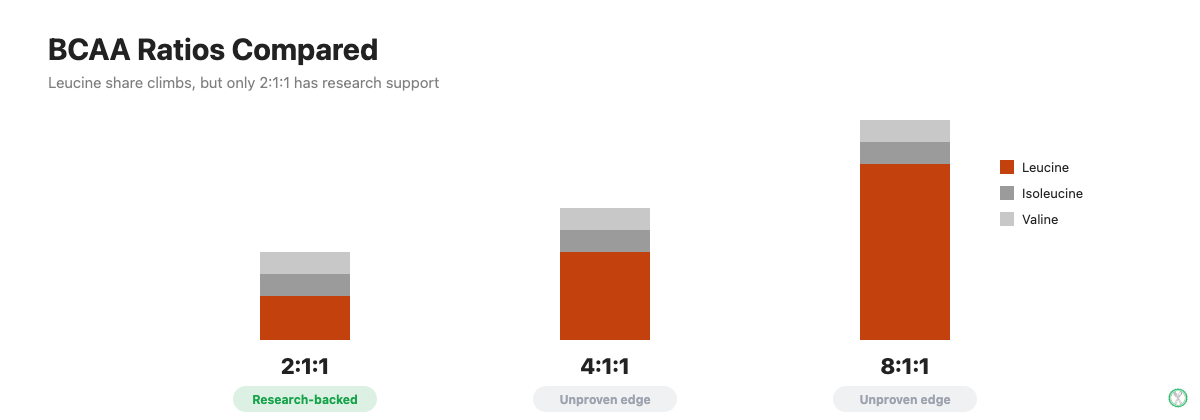
Every product on this list uses a 2:1:1 ratio, meaning two parts leucine to one part isoleucine to one part valine. That is not a marketing number. It roughly mirrors the BCAA ratio found in human muscle tissue, and it is the ratio used in most of the exercise-science research behind the category. Leucine gets singled out because it is the amino acid most directly tied to triggering muscle protein synthesis, and most research points to somewhere around 2 to 3 grams of leucine per dose as the threshold for maximizing that trigger.
Some brands sell 4:1:1 or 8:1:1 formulas that load up on extra leucine and cut back isoleucine and valine. The logic sounds reasonable on paper: leucine does the triggering, so more leucine should mean a bigger effect. In practice, there is no strong evidence that pushing the ratio past 2:1:1 improves outcomes, and there is a plausible mechanism for why it might backfire. Leucine, isoleucine and valine compete for the same transporters to cross into muscle cells, so flooding the system with disproportionate leucine can crowd out isoleucine and valine absorption instead of helping. If you see a 4:1:1 or 8:1:1 product marketed as "more effective," treat that as an unproven claim rather than an upgrade.
How we picked these 6 BCAA supplements
We started from the products that show up consistently across independent review outlets like BarBend and Garage Gym Reviews, then filtered for six specific things: a 2:1:1 ratio backed by research rather than a proprietary blend, at least 5 grams of BCAAs per serving, a transparent ingredient panel (no "amino blend" hiding actual doses), verifiable pricing from the brand's own product pages, honest reporting on third-party testing status, and enough real-world usage data to say something concrete about taste and mixability. We excluded pure capsule-only formats from the main six picks because most lifters mixing a BCAA drink want a powder, and we excluded products where the label used a proprietary blend that hides the actual leucine, isoleucine and valine split.
Kaged BCAA 2:1:1: best overall
Kaged keeps the formula simple: fermented, plant-based BCAAs in a 2:1:1 ratio, nothing else competing for attention on the label. The fermentation process (Kaged calls it Micropure) avoids the animal-derived processing some cheaper BCAA powders use, which also makes it vegan-friendly. It is Informed Sport certified, meaning every batch is tested for banned substances, which matters if you are a competitive or drug-tested athlete and matters less if you are training for yourself, but is still a meaningful trust signal either way.
| Ratio | 2:1:1 |
| BCAAs per serving | 5g (5,000mg) |
| Price per serving | ~$0.42 |
| Flavors | Unflavored only |
| Added ingredients | None; single-ingredient BCAA blend |
| Third-party testing | Informed Sport certified |
| Rating | Not independently verified |

The tradeoff is flavor. Kaged only sells this formula unflavored, so if you need something that tastes like fruit punch to get through a scoop, this is not that product. The unflavored profile is also not perfectly neutral; expect a faint bitterness typical of unflavored amino powders. Check current price at Kaged.
Transparent Labs BCAA Glutamine: most BCAA per scoop
Transparent Labs packs 8 grams of BCAAs into a single scoop, the highest dose of the six products here, in the same 2:1:1 ratio. The formula also adds glutamine and electrolytes, and the label lists every ingredient and dose explicitly rather than hiding anything behind a proprietary blend, which matches the brand's general reputation for transparent labeling. It is Informed Choice tested, a third-party program that screens for banned substances and verifies label claims.
| Ratio | 2:1:1 |
| BCAAs per serving | 8g |
| Price per serving | ~$1.33 |
| Flavors | Sour Green Apple, Tropical Punch, Strawberry Lemonade, Blue Raspberry |
| Added ingredients | Glutamine, electrolytes |
| Third-party testing | Informed Choice tested |
| Rating | Not independently verified |
It is also the most expensive powder on this list at roughly $1.33 per serving, more than three times the price of the budget picks below. The formula is sweetened with stevia rather than artificial sweeteners, which some people prefer and others find gives a slightly sour or bitter aftertaste depending on the flavor. Check current price at Transparent Labs.
Nutricost BCAA: best budget
Nutricost is the cheapest way to get a research-backed 2:1:1 BCAA ratio. Larger container sizes run $0.25 to $0.26 per serving, about a fifth of what the premium picks on this list cost. Nine flavor options ship, including unflavored, and the 6 grams of BCAAs per serving clears the minimum useful dose with room to spare.
| Ratio | 2:1:1 |
| BCAAs per serving | 6g |
| Price per serving | ~$0.25-0.26 |
| Flavors | 9 options, including unflavored |
| Added ingredients | None beyond the BCAA blend |
| Third-party testing | Sources disagree, see note below |
| Rating | Not independently verified |
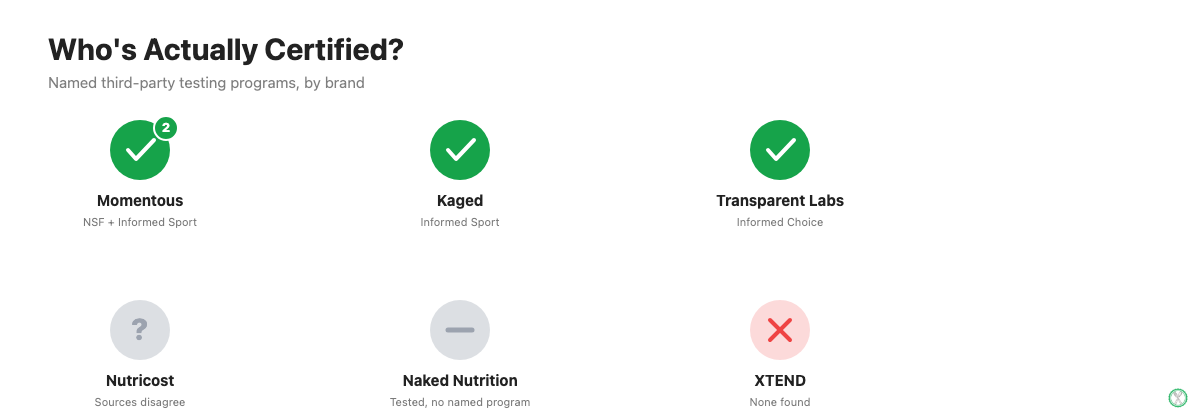
Our sources disagree on the testing question. BarBend's review lists third-party testing as "not mentioned" for this product, while Garage Gym Reviews describes it as third-party tested without naming a specific certification program. We could not find a named certification logo (Informed Sport, NSF Certified for Sport, or similar) on Nutricost's own product page for this item, so we're reporting the disagreement rather than picking a side. If certified testing matters to you, verify directly on Nutricost's current label before buying. Some flavors also test as noticeably more bitter than the flagship brands above, and the unflavored version has an earthy taste typical of the category. Check current price at Nutricost.
Naked Nutrition Naked BCAAs: cleanest label
Naked Nutrition's pitch is minimalism. The unflavored version lists one ingredient: the BCAA blend itself, with no fillers, artificial sweeteners, colors or flow agents. It delivers the 2:1:1 ratio precisely, 2.5g leucine, 1.25g isoleucine and 1.25g valine per serving, for 5g total. It is Certified Vegan and the brand states the product is third-party tested, though it does not carry a named sport-specific certification like Informed Sport or NSF Certified for Sport.
| Ratio | 2:1:1 (2.5g leucine / 1.25g isoleucine / 1.25g valine) |
| BCAAs per serving | 5g |
| Price per serving | ~$0.35 (unflavored, 100-serving size) |
| Flavors | Unflavored, Cherry Lime, Strawberry Lemonade |
| Added ingredients | None (unflavored); minimal flavor system on flavored versions |
| Third-party testing | Third-party tested, no named sport certification; Certified Vegan |
| Rating | Not independently verified |
The unflavored version has a noticeably strong smell and a bitter taste that some buyers find hard to get past, which is the direct tradeoff for having almost nothing else in the tub to mask it. The flavored versions (Cherry Lime, Strawberry Lemonade) only come in smaller 34-serving containers, which pushes the per-serving price up compared to the unflavored 100-serving size. There are also no added electrolytes or recovery ingredients here; this is BCAAs and nothing more. Check current price at Naked Nutrition.
XTEND Original BCAA Powder: best with electrolytes
XTEND pairs 7 grams of 2:1:1 BCAAs with 2.5 grams of L-glutamine and an electrolyte blend (sodium citrate, potassium chloride, sodium chloride), which makes it the strongest pick here if you specifically want a sipping drink for long or hot training sessions rather than just a post-workout dose. It is zero sugar and comes in one of the widest flavor lineups in the category, including several limited-run candy collaborations.
| Ratio | 2:1:1 |
| BCAAs per serving | 7g |
| Price per serving | ~$0.93 (based on a 30-serving container) |
| Flavors | Wide rotating lineup: Watermelon Explosion, Blue Raspberry Ice, Strawberry Kiwi, Airheads varieties, and more |
| Added ingredients | 2.5g L-glutamine, electrolyte blend |
| Third-party testing | No independent sport certification found for this product |
| Rating | Not independently verified |
We could not find a third-party sport certification (Informed Sport, NSF Certified for Sport) attached to this product; if you are a tested athlete, that is worth confirming directly with the brand before use rather than assuming it is covered. At roughly $0.93 per serving it also sits in the middle of the price range here, cheaper than the two premium picks but noticeably more than the budget options. Check current price at Cellucor.
Momentous Vital Aminos: best for tested athletes
Momentous takes a different approach than the other five products: instead of a BCAA-only formula, Vital Aminos is a complete 13-amino-acid blend built around a 2:1:1 leucine-to-isoleucine-to-valine core. That design lines up with the research on BCAA vs EAA supplementation discussed above; if the science favors complete amino acid profiles over BCAA-only products, Momentous is built closer to what that research actually recommends. It carries both NSF Certified for Sport and Informed Sport certification, the strongest combined testing credential of any product on this list, which is why it is the default recommendation for competitive or drug-tested athletes.
| Ratio | 2:1:1 core, within a 13-amino-acid complete profile |
| BCAAs per serving | Sources disagree: 3.75g to 5g depending on the source, see note below |
| Price per serving | ~$1.53 |
| Flavors | Tropical Punch only |
| Added ingredients | Full essential amino acid profile beyond the BCAA core |
| Third-party testing | NSF Certified for Sport and Informed Sport |
| Rating | Not independently verified |
Our sources disagree on the exact BCAA content: one review lists 5g of BCAAs within an 8g total EAA dose, while another lists 3.75g of BCAAs within the 13-amino-acid profile. We're reporting both figures rather than picking one, since we could not independently verify the exact number from the current label at the time of research; if the precise BCAA dose matters for your use case, check the supplement facts panel directly before buying. Multiple reviewers describe the BCAA portion specifically as underdosed relative to BCAA-only products, which is the direct tradeoff for getting a complete amino profile instead. It also only comes in one flavor and is the second most expensive product on this list. Check current price at Momentous.
Third-party testing: what Informed Sport and NSF Certified for Sport actually catch
Supplement contamination is a bigger problem than most buyers realize. Independent testing programs have found that a meaningful share of sports supplements, estimates in published research range from roughly one in ten to as high as a third or more depending on the category and study, contain trace amounts of steroids, stimulants or other substances not listed on the label, usually introduced during manufacturing rather than added intentionally. That is the actual problem third-party certification exists to solve, not just a marketing badge.
Informed Sport tests every single batch against a panel of more than 280 banned substances before it ships. NSF Certified for Sport uses a less frequent testing schedule but layers on additional checks: confirming the label's claimed doses match what is actually in the product, and screening for roughly 290 substances banned by most major sports governing bodies. NSF Certified for Sport is also the only certification specifically recognized by USADA, and it's used by organizations like Major League Baseball and the NHL for supplement screening. Of the six products in this comparison, only Momentous Vital Aminos carries both certifications. Kaged and Transparent Labs each carry one program (Informed Sport and Informed Choice respectively). Nutricost, Naked Nutrition and XTEND either lack a named sport-specific certification or have inconsistent reporting across sources, as noted in each product section above.
None of this means the uncertified products are unsafe. Most supplement contamination research focuses on categories with a documented history of spiking (pre-workouts and weight-loss products especially), and plain BCAA powder is a comparatively low-risk category. But if you are subject to drug testing at any level, from a college athletics program up to professional or Olympic competition, buying a product without a named certification is a real and avoidable risk, not a minor detail.
How to dose and time BCAAs, if you use them
If you decide a BCAA product fits your routine, the timing evidence is fairly forgiving. Most of the research behind BCAA and EAA supplementation focuses on total daily amino acid intake more than the exact minute you drink it. That said, a few practical patterns show up consistently across the products and reviews we looked at:
- Around training is the most common use case: sipping a BCAA drink during a fasted or long session, or immediately post-workout, is where most of the products above are actually marketed and used.
- 2 to 3 grams of leucine per dose is the range most research points to as the threshold for maximizing the muscle protein synthesis trigger; every 2:1:1 product on this list clears that bar in a single serving.
- Total daily protein still matters more than timing. A BCAA scoop is not a substitute for hitting your daily protein target from complete protein sources; it is, at best, a supplement to a diet that is already close to adequate.
- Unflavored and capsule formats mix into anything, which is useful if you already have a pre-workout or intra-workout drink and don't want to add another separate scoop to your routine. If you're stacking a BCAA powder with a pre-workout, see our best pre-workout picks for options that pair well without doubling up on stimulants.
Frequently asked questions
Are BCAAs better than a whey protein shake?
Not for most goals. Whey protein delivers all nine essential amino acids, including the three BCAAs, in a complete profile that the research consistently shows outperforms BCAA-only supplementation for muscle protein synthesis. BCAAs make more sense as an addition around training, not a replacement for your protein source.
Do I need BCAAs if I already eat enough protein?
Probably not for building muscle specifically. If your total daily protein intake already covers your bodyweight and training volume, the research suggests you'd get more benefit from an EAA supplement or additional complete protein than from isolated BCAAs. BCAAs still have a case for fasted training, calorie-restricted diets, or simple preference.
What's the difference between BCAAs and EAAs?
BCAAs (leucine, isoleucine, valine) are three of the nine essential amino acids. EAA products contain all nine, including the three BCAAs, in one formula. Because muscle protein synthesis requires all nine essential amino acids to be present, most current research favors complete EAA formulas over BCAA-only products for that specific goal.
Is a 2:1:1 ratio actually the best BCAA ratio?
It's the ratio with the strongest research support and the one that roughly matches the natural BCAA composition of human muscle tissue. Higher-leucine ratios like 4:1:1 or 8:1:1 are marketed as more potent, but there isn't strong evidence they outperform 2:1:1, and there's a plausible mechanism (competing amino acid transporters) for why an imbalanced ratio could actually reduce isoleucine and valine uptake.
Should I buy BCAAs if I'm a drug-tested athlete?
Choose a product with a named third-party certification, specifically NSF Certified for Sport or Informed Sport, rather than a product that only says "third-party tested" without naming the program. Of the six products in this guide, Momentous Vital Aminos is the only one carrying both certifications.
Do unflavored BCAAs taste bad?
Most unflavored BCAA powders, including two products in this guide, have a noticeable bitterness and a distinct smell that flavored versions are specifically formulated to mask. If taste is a priority, a flavored 2:1:1 product like Transparent Labs or XTEND will be easier to get through daily than an unflavored one.
Can I take BCAAs every day, even on rest days?
Yes. BCAAs are amino acids, not stimulants, so there's no cycling requirement in the way there is for something like caffeine-based pre-workout. The bigger question is whether daily BCAA use adds meaningful value on top of your regular protein intake, which the research suggests depends heavily on whether your diet is already protein-adequate.
Why do BCAA products cost so differently per serving?
Mostly certification, dose size and added ingredients. The cheapest products on this list (Nutricost, Naked Nutrition) skip named sport certifications and added ingredients beyond the core BCAA blend. The most expensive (Momentous, Transparent Labs) either carry certification programs that cost money to maintain or pack in a larger dose and additional ingredients like glutamine and electrolytes.