 Nutrition editor
Creatine gummies promise the same muscle and strength benefits as creatine powder without the chalky texture or the shaker bottle. The problem: two rounds of independent lab testing have found a meaningful share of gummy brands don’t deliver the creatine printed on the label, sometimes by a wide margin. Powder doesn’t have that problem, but it isn’t free of trade-offs either. Here’s what the testing data shows, what each format costs per gram of real creatine, and which one makes sense for you.
Key Takeaways: Creatine Gummies vs. Powder
- The format itself doesn’t change how creatine works in your body. The real question is whether the product delivers the creatine it claims to.
- Two independent lab tests found roughly a third to nearly half of tested creatine gummy brands failed to meet their label claims, some containing almost no detectable creatine at all.
- Creatine monohydrate powder costs roughly $0.03-$0.12 per gram. Verified, lab-tested creatine gummies cost roughly $0.26-$0.56 per gram, several times more.
- If you want the convenience of gummies, stick to brands with published third-party lab results rather than star ratings alone.
Does the Format Change How Well Creatine Works?
No. Creatine monohydrate works the same way once it reaches your muscles, whether it arrives dissolved in water or chewed as a gummy. The standard dose is 3 to 5 grams a day for maintenance, or an optional loading phase of 20 to 25 grams a day, split into 5-gram servings, for 5 to 7 days to saturate muscle creatine stores faster. Neither format changes that math, and there’s no meaningful evidence that gummies absorb faster or slower than a dissolved powder.
What does change between formats is whether the labeled dose is the dose you’re getting. That’s a manufacturing and quality-control question, not a biology question. It’s the real reason gummies and powder perform differently in practice, and the next section shows how big that gap can be.
Do Creatine Gummies Actually Contain What the Label Says?
Not always, and the gap can be severe. NOW Foods, a supplement manufacturer, commissioned independent lab testing on 12 popular creatine gummy brands and found that 5 of them, about 42%, were severely understrength against their label claims. Every failing product also showed detectable creatinine, a creatine breakdown byproduct, in the sample.
A separate test run by the supplement-testing outlet SuppCo checked 6 creatine gummy brands and found 4 of them failed identity and potency testing. Two of those, EcoWise and Vidabotan, contained zero detectable creatine. Happyummmm, a top-rated product on Amazon at the time, delivered just 0.09% of its 5-gram claim, meaning you’d need to eat roughly 2,000 gummies to reach a standard dose. DivinusLabs delivered about 0.50% of its claim, around 800 gummies to reach 5 grams. Two brands in that same test, Force Factor and Create, passed with real overages: 6.3 grams delivered against a 5-gram label, and 4.59 grams against a 4.5-gram label.
| Test | Brands tested | Failed label claim | Worst finding |
|---|---|---|---|
| NOW Foods (2026) | 12 | 5 (about 42%) | Severely understrength; creatinine detected in every failing sample |
| SuppCo (2026) | 6 | 4 (about 67%) | Two brands (EcoWise, Vidabotan) had zero detectable creatine |
These are two separate, independently run tests on different brand sets, not one study repeated twice, which makes the pattern harder to write off as a fluke. Lab results are also a point-in-time snapshot tied to a specific batch and test date rather than a permanent verdict on a brand, so treat any single failing result as a reason to check for current third-party testing before buying, not as a fixed blacklist.
Why Do Gummies Under-Dose? (The Creatinine Problem)
Gummies are made in a water-based gel matrix, and creatine is chemically unstable in water over time, especially with the heat used during manufacturing. Under those conditions, creatine can convert into creatinine, a byproduct with little to no performance benefit. Powder stored dry doesn’t face this problem, since the degradation reaction needs moisture to happen. That’s also why the failing gummy batches in both tests showed creatinine alongside their missing creatine: it’s not just under-filled, it’s actively broken down during production.
How Much More Do Gummies Cost Per Gram of Creatine?
Meaningfully more, even among gummy brands that pass lab testing. Verified pricing across six tested and reviewed gummy products works out to roughly $0.26 to $0.56 per gram of creatine. Verified creatine monohydrate powder pricing lands at roughly $0.03 to $0.12 per gram, depending on the brand and pack size. That’s a real gap of somewhere between 3 and 15 times more per gram for gummies, even before accounting for any product that fails to deliver its labeled dose at all.
| Product | Format | Price | Creatine per serving | Price per gram |
|---|---|---|---|---|
| Create | Gummies | $34.99 / 30 servings | 4.5g | ~$0.26 |
| Legion Athletics | Gummies | $39.99 / 30 servings | 5g | ~$0.27 |
| Bloom Nutrition | Gummies | $29.99 / 30 servings | 3g | ~$0.33 |
| Coach Soak | Gummies | $64.95 / 30 servings | 5g | ~$0.43 |
| Lemme | Gummies | $30.00 / 15 servings | 5g | ~$0.40 |
| Bear Balanced | Gummies | $49.99 / 30 servings | 3g | ~$0.56 |
| Kaged Creatine Monohydrate | Powder | ~$0.30 / 5g serving | 5g | ~$0.06 |
| Double Wood Supplements | Powder | ~$0.28 / 5g serving | 5g | ~$0.056 |
| Swolverine | Powder | from ~$0.15 / 5g serving | 5g | ~$0.03 |
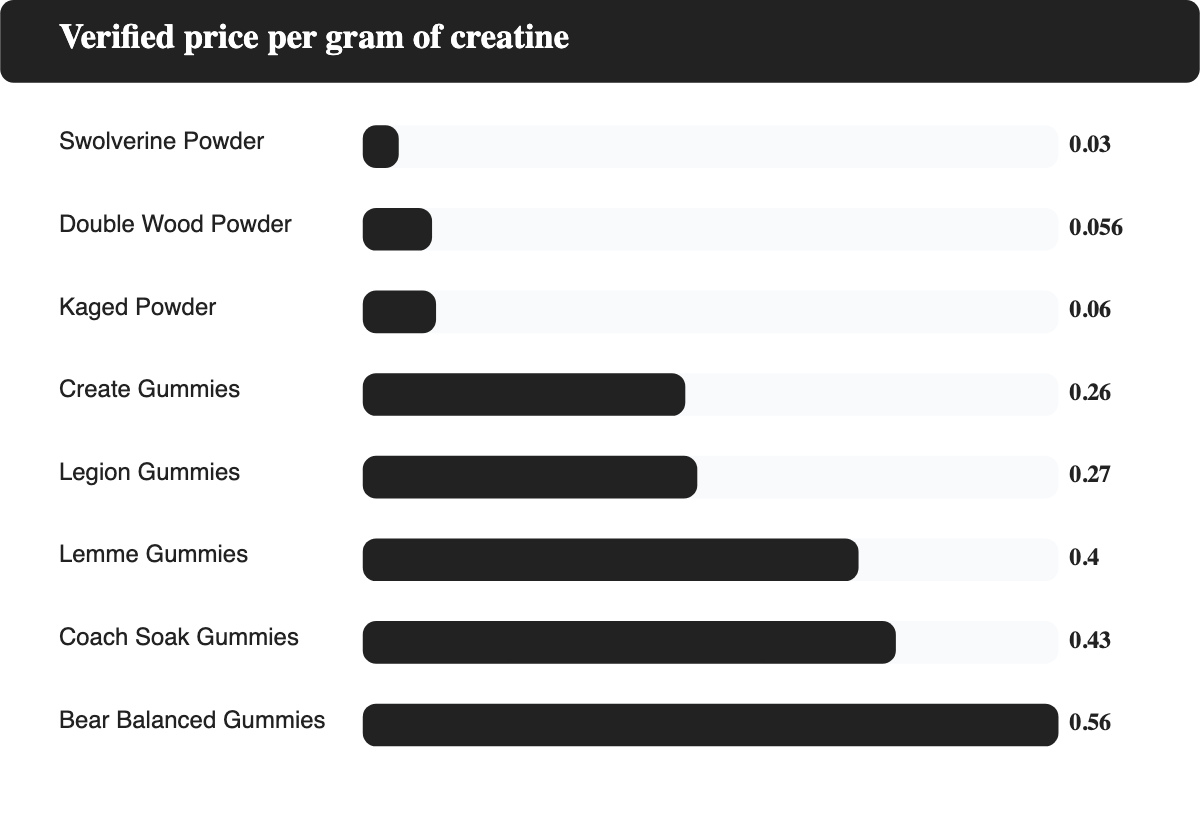
Prices shift with promotions and pack size on both sides, so treat these as typical ranges rather than fixed quotes and check the live price before you order. The direction of the gap, gummies costing several times more per gram, has held consistently across every product checked here.
Creatine Gummies vs. Powder at a Glance
Putting every verified figure from above side by side makes the trade-off easier to see in one view.
| Attribute | Creatine Powder | Creatine Gummies |
|---|---|---|
| Typical creatine per serving | 5g per scoop, standard across nearly all brands | Labels typically claim 1-5g per gummy; see lab pass rate |
| Independent lab pass rate | Not the subject of these tests; monohydrate identity issues are rare | NOW Foods: 7 of 12 passed (58%). SuppCo: 2 of 6 passed (33%) |
| Verified price per gram | $0.03-$0.12 | $0.26-$0.56 |
| Prep required | Yes, mix with liquid | No, eat directly |
| Shelf stability | Stable as a dry powder | Can degrade into creatinine during manufacturing (heat + moisture) |
| Reported taste | Unflavored is chalky/gritty; flavored options widely available | Candy-like, generally more palatable |
Convenience, Taste, and Digestive Tolerance
Powder needs a scoop and something to mix it into, which is a minor hurdle at home but a real one if you’re training somewhere without easy access to a shaker and water. Gummies skip that step entirely: open the container, chew, done, which is the entire reason the format exists. Unflavored powder is the most common complaint on the powder side, described as chalky or gritty even in flavored blends. Gummies read as pleasant by comparison, closer to candy than a supplement.
On digestion, some users report mild bloating or stomach discomfort from creatine regardless of format, and anecdotal reports from creatine users suggest this varies by individual rather than by format. If you’re sensitive to it, starting at a lower dose and skipping the loading phase tends to help more than switching formats does.
Pros and Cons of Each Format
Creatine Powder: Pros and Cons
| Powder pros | Powder cons |
|---|---|
| Cheapest way to get creatine, $0.03-$0.12 per gram | Requires mixing with liquid, less convenient on the go |
| Dosing is easy to measure and adjust precisely | Unflavored versions taste chalky or gritty to most users |
| Identity/purity issues are rare compared to gummies | Needs a shaker or glass and somewhere to clean it |
Creatine Gummies: Pros and Cons
| Gummies pros | Gummies cons |
|---|---|
| No mixing, no shaker, eat and go | Costs roughly 3-15x more per gram than powder |
| Candy-like taste with no chalky texture | Independent testing has found a large share of brands under-deliver on label claims |
| Easy to travel with, no spill risk | Manufacturing process can degrade creatine into inactive creatinine |
Which One Should You Choose?
If cost and dosing reliability matter most to you, plain creatine monohydrate powder is the safer, cheaper default, and it’s what nearly every clinical study on creatine has actually used. If convenience or taste is the deciding factor and you’re set on gummies, don’t buy on star ratings alone.
- Pick powder if: you want the lowest cost per gram, the most predictable dosing, and you don’t mind a shaker bottle.
- Pick gummies if: you won’t stick with powder otherwise, and you choose a brand that publishes current third-party lab results, like the tested products that passed above, instead of one you’ve only seen on a retail listing.
For more on building out the rest of your supplement stack, our best protein powder guide and best protein bars guide cover the brands, like MyProtein, Optimum Nutrition and Transparent Labs, that also sell their own creatine lines.
Frequently Asked Questions
Are creatine gummies as effective as creatine powder?
Only if the gummy actually contains the creatine on its label. The biology is identical between formats, but independent lab testing has repeatedly found gummy brands that deliver a fraction of their claimed dose, sometimes close to none. Powder doesn’t share that specific risk, since dry storage doesn’t trigger the same degradation.
How many creatine gummies equal a 5-gram powder dose?
It depends entirely on the brand’s creatine-per-gummy figure, which ranges from about 1 to 5 grams per piece across the market, so check the label math rather than assuming. Even then, the lab-testing data above means the printed math doesn’t always match what’s actually inside, which is a bigger source of error than counting gummies correctly.
Do creatine gummies need a loading phase?
The loading phase, 20 to 25 grams a day split into 5-gram servings for 5 to 7 days, is optional for either format and mainly speeds up how fast your muscles reach full creatine saturation. Most people can skip it and reach the same saturation with a steady 3 to 5 grams a day over a few weeks instead, whether that comes from powder or gummies.
Why do some creatine gummies test positive for creatinine?
Creatinine is what creatine breaks down into when exposed to moisture and heat over time, both of which are part of how gummies are made in a water-based gel base. Finding creatinine in a gummy sample is a manufacturing red flag: it means some of the creatine that should be in the product degraded into a form with little performance benefit before it ever reached the consumer.